Home > Economy > What Is Multi-Lane Free Flow (MLFF) Tolling? How India's Barrier-Free Toll Plazas Will Work
What Is Multi-Lane Free Flow (MLFF) Tolling? How India's Barrier-Free Toll Plazas Will Work
By Vijay Pawar · 2026-11-08 · 8 min read · Economy
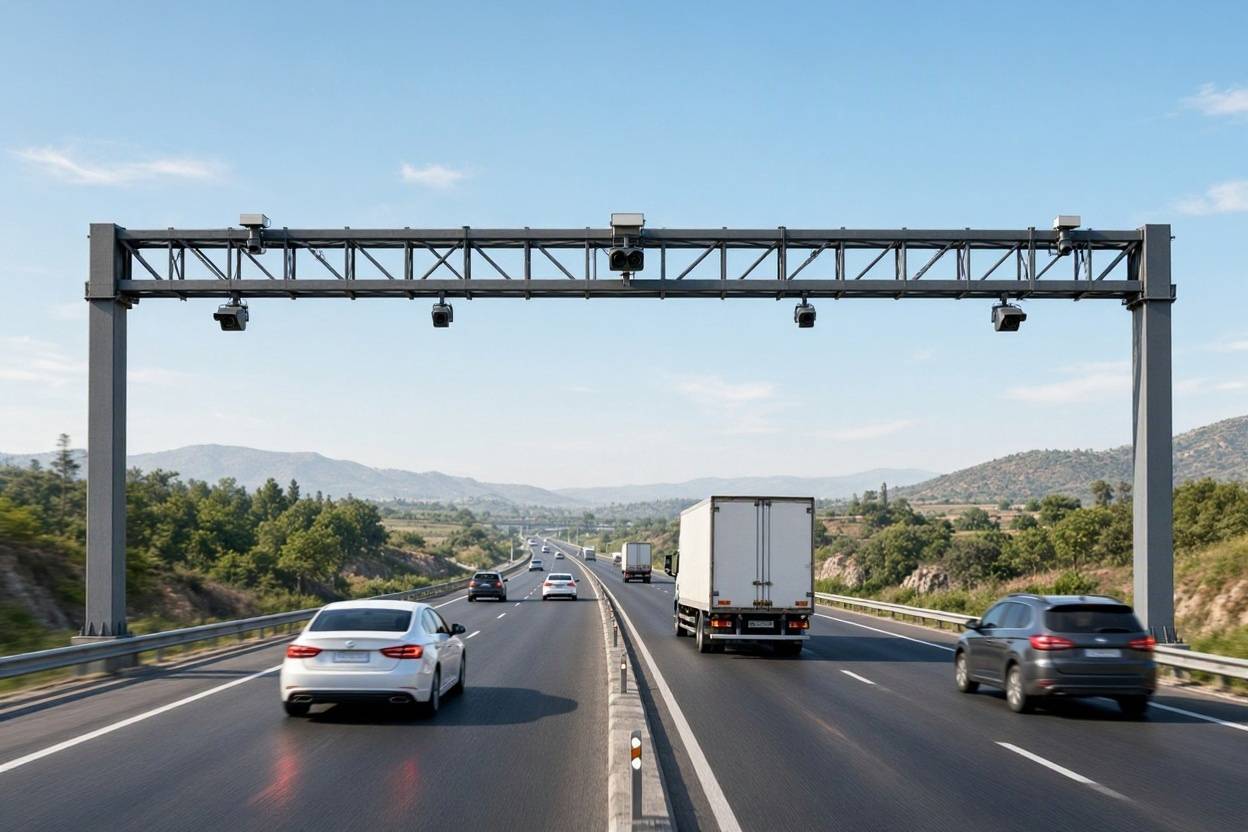
Editorial illustration: a modern Indian highway with an overhead gantry reading FASTags and number plates as vehicles drive through without stopping, symbolising barrier-free tolling.
Key Takeaways
Multi-lane free flow (MLFF) tolling lets vehicles pass a toll point without stopping: gantry-mounted RFID readers detect the FASTag and ANPR cameras read the number plate while the vehicle keeps moving.
NHAI's guidelines, announced on 6 November 2026, make barrier-free MLFF the standard design for four-lane and wider national highways, for future projects and those under construction.
Vehicles without a valid FASTag get an e-Notice under Rule 14 of the National Highways Fee Rules, 2008, and reports say owners have 72 hours to pay the normal toll on NHAI's e-notice portal.
MLFF is already running at Choryasi on NH-48 in Gujarat since 1 May 2026, and at Mundka-Bakkarwala, Daulatpura, Manoharpura, Shahjahanpur and Gharaunda; the government targets barrier-free tolling across national highways by March 2027.
Each lane under the new design is expected to handle around 600 vehicles an hour, and the change removes the need to acquire extra land for wide toll plazas with dozens of booths.
What Is Multi-Lane Free Flow (MLFF) Tolling in India?
What is multi-lane free flow tolling in India? It is the system that will let vehicles drive through a toll plaza without stopping, slowing down for a booth, or waiting for a barrier to lift. Overhead gantries fitted with FASTag readers and cameras that read number plates will identify each vehicle in motion and deduct the toll automatically. The National Highways Authority of India (NHAI) has now made this barrier-free system the standard design for new national highway projects, announcing the guidelines through the Ministry of Road Transport and Highways on 6 November 2026. For the lakhs of drivers who lose time at toll plazas every day, it is the biggest change in how India collects road tolls since FASTag itself.
The change matters because the old model has reached its limit. Even with FASTag, toll plazas still force traffic into lanes, past booths and barriers. Around big cities, some plazas have grown to more than 20 lanes, and a few to 32. The new design replaces all of that with a gantry across the road and no physical stop at all.
What NHAI's New Guidelines Say
The NHAI guidelines standardise the design and infrastructure of toll plazas on four-lane and wider national highways for barrier-free multi-lane free flow (MLFF) tolling. Until now, the layout of each plaza was decided project by project. The new circular fixes a single template: the plaza layout, the number of tolling lanes, the overhead gantries carrying the readers and cameras, and the lighting, signs and electronic message boards around them.
The rules apply to all future national highway projects and to projects already under construction. Projects still at the detailed project report stage must build the new design into their bidding documents. Projects already awarded or under construction will adopt it through changes to their contracts, where work on the toll plaza has not yet started. Two-lane highways with paved shoulders will continue under the existing tolling system.
The guidelines also fix how many tolling lanes a plaza needs. The Indian Express, reporting the circular on 30 October, said a four-lane highway will have eight fee plaza lanes, a six-lane highway ten and an eight-lane highway twelve, including spare lanes to deal with emergencies. The Times of India, reporting the same circular, said no plaza on a future project would have more than eight lanes, with a spare lane added for emergencies. Because NHAI has not published the circular itself, the exact lane numbers cannot be settled from public sources yet, and the two accounts should be read together. What both agree on is the direction: far fewer lanes than the sprawling plazas of today, because each lane under the new design is expected to handle around 600 vehicles an hour.
How the System Works
The system has two ways of identifying a vehicle, and both work while it is moving at highway speed. High-performance RFID readers mounted on overhead gantries detect the FASTag on the windscreen, and Automatic Number Plate Recognition (ANPR) cameras read the vehicle's registration number. The toll is then deducted from the FASTag wallet, and the vehicle simply keeps driving.
The design includes a second gantry placed after the main pay-axis gantry as a backup, so that a vehicle missed by the first set of readers can still be captured. The toll lane at the gantry is 3.5 metres wide, giving vehicles lateral clearance as they pass through at free-flow speed. The guidelines also require a minimum six-metre clearance for the overhead equipment, advance warning signs and variable message displays about a kilometre before the tolling point, and high-mast lighting across the plaza zone.
This is not a brand-new experiment. India has been testing the model on the ground since May 2026, and the new circular turns that pilot experience into a national design standard.
What Happens If You Do Not Have a Working FASTag
A barrier-free plaza has no booth where a driver can stop and pay cash, so the system needs another way to collect the toll from vehicles without a valid FASTag. Under the guidelines, the system generates an electronic notice, called an e-Notice, in accordance with Rule 14 of the National Highways Fee (Determination of Rates and Collection) Rules, 2008.
The notice is issued against the vehicle's registration number, which the ANPR cameras have already captured. Reports say the vehicle owner then has 72 hours to pay the normal toll through NHAI's e-notice portal. The legal framework for recovering unpaid fees under MLFF tolling was put in place through amendments made in March 2026, so the e-notice is backed by the toll rules rather than being an informal demand. Drivers should therefore keep their FASTag active and topped up, because a missed deduction will still find them through their number plate.
Where MLFF Is Already Running
India's first barrier-less tolling system began operating at the Choryasi fee plaza on National Highway 48 in Gujarat on 1 May 2026. Since then it has been extended to the Mundka–Bakkarwala stretch on Delhi's Urban Extension Road-II, and to Daulatpura, Manoharpura and Shahjahanpur on the Delhi–Jaipur section of NH-48, and Gharaunda on NH-44. Rajasthan's first MLFF system started at Daulatpura in June 2026. NHAI aims to expand the system to around 25 national highway fee plazas during the 2025–26 financial year.
The longer-term ambition is bigger. Road Transport and Highways Minister Nitin Gadkari has said India plans to make all national highway toll plazas barrier-free by March 2027, with around 60 to 70 per cent of the rollout expected by December 2026. There are about 1,200 toll plazas operated by NHAI and private concessionaires across the country, so the full changeover is a large programme, and the new guidelines are the design template it will follow.
The scale of the system it builds on is already enormous. The Indian Highways Management Company, NHAI's tolling arm, recorded 47,817 lakh FASTag transactions in 2025–26, collecting Rs 82,342 crore. MLFF does not replace FASTag; it keeps FASTag as the payment mechanism and adds number-plate recognition as a second way of identifying the vehicle.
What It Means for Drivers and for NHAI
For drivers, the most obvious gain is time. No queues at the plaza, no idling in a lane waiting for a barrier, and no sudden braking and lane-changing as traffic funnels into booths. Less stopping and starting also means less fuel burnt at toll plazas and fewer rear-end collisions in the queue. For regular highway users, the tolling point should become almost invisible, closer to driving past a signboard than entering a plaza.
For NHAI, the gain is land and money. The government will no longer need to acquire extra land to build wide plazas with dozens of booths, because the equipment sits on gantries over the carriageway instead. That matters most around cities, where land is expensive and plazas have grown the widest. The Economic Times reported that the change is expected to save public money for exactly this reason. The standardised design should also make it simpler to build and maintain tolling infrastructure, since every new project follows the same template instead of designing its own plaza. Drivers planning a switch to electric two-wheelers should also read our explainer on [how to claim the electric scooter subsidy in India, including the PM E-DRIVE amount and the documents needed](https://indiaask.tech/how-to-claim-electric-scooter-subsidy-india-explained), and for the vehicle rules now in force in the capital, see [what GRAP Stage 3 means for vehicles in Delhi-NCR](https://indiaask.tech/grap-stage-3-delhi-ncr-rules-vehicle-ban-explained).
What Is Still Unclear
A few things are not yet settled. The exact lane numbers in the new design are one of them, because the two main newspaper accounts of the circular differ and the circular itself has not been published. The ministry's release gives no date for removing barriers from today's existing plazas, and no cost for the changeover, so drivers should not expect the toll booth near them to vanish overnight. The rollout target of March 2027 for all plazas is ambitious, and the pace at which existing plazas are converted will only become clear as NHAI awards the work. Questions also remain about how quickly e-notices will be issued and how disputes will be handled if a camera misreads a number plate, though the 72-hour payment window gives owners time to respond.
Conclusion
Multi-lane free flow tolling is the next step after FASTag: the same electronic payment, but with the booth and the barrier removed entirely. NHAI's new guidelines make it the standard design for future national highways, with gantries reading FASTags and number plates while vehicles keep moving, and e-notices for vehicles without a valid tag. The first plazas are already running, and the government aims to take the system across the national highway network by March 2027. If the rollout keeps to schedule, the toll plaza as a place where traffic stops could disappear from Indian highways within a couple of years. The Indian Express first reported the new lane design and the contents of the circular in detail: [Barrier-less system to reduce toll lanes in new highways](https://indianexpress.com/article/business/barrier-less-tolling-system-new-highways-10943979/). The Times of India reported the ministry's announcement and the land-saving argument for the change: [No extra land needed for toll plazas as NHAI makes free-flow tolling must for NH projects](https://timesofindia.indiatimes.com/business/india-business/no-extra-land-needed-for-toll-plazas-as-nhai-makes-free-flow-tolling-must-for-nh-projects/articleshow/135441849.cms).
Multi-lane free flow (MLFF) tolling lets vehicles pass a toll point without stopping. Overhead gantries fitted with RFID readers and ANPR cameras identify the vehicle in motion and deduct the toll from its FASTag. NHAI has made it the standard design for new national highway projects, announcing the guidelines on 6 November 2026.
Do I still need a FASTag under barrier-free tolling?
Yes. FASTag remains the payment mechanism under MLFF. The RFID readers on the gantries detect the FASTag while the vehicle keeps moving, and the ANPR cameras act as a second check by reading the number plate. Drivers should keep their FASTag active and topped up.
What happens if my FASTag is invalid or my balance is too low?
The system generates an electronic notice (e-Notice) under Rule 14 of the National Highways Fee Rules, 2008, using the registration number captured by the ANPR cameras. Reports say the owner then has 72 hours to pay the normal toll through NHAI's e-notice portal.
Where is MLFF already running, and when will it cover all highways?
It is already running at Choryasi on NH-48 in Gujarat since 1 May 2026, and at Mundka-Bakkarwala on Delhi's Urban Extension Road-II, Daulatpura, Manoharpura and Shahjahanpur on the Delhi-Jaipur stretch of NH-48, and Gharaunda on NH-44. NHAI aims to cover around 25 plazas in 2025-26, and the government targets barrier-free tolling across national highways by March 2027.