Home > Elections & Governance > What Is India's Haj Quota for 2027? The 1,75,025-Pilgrim Agreement Explained
What Is India's Haj Quota for 2027? The 1,75,025-Pilgrim Agreement Explained
By Vijay Pawar · 2026-11-10 · 8 min read · Elections & Governance
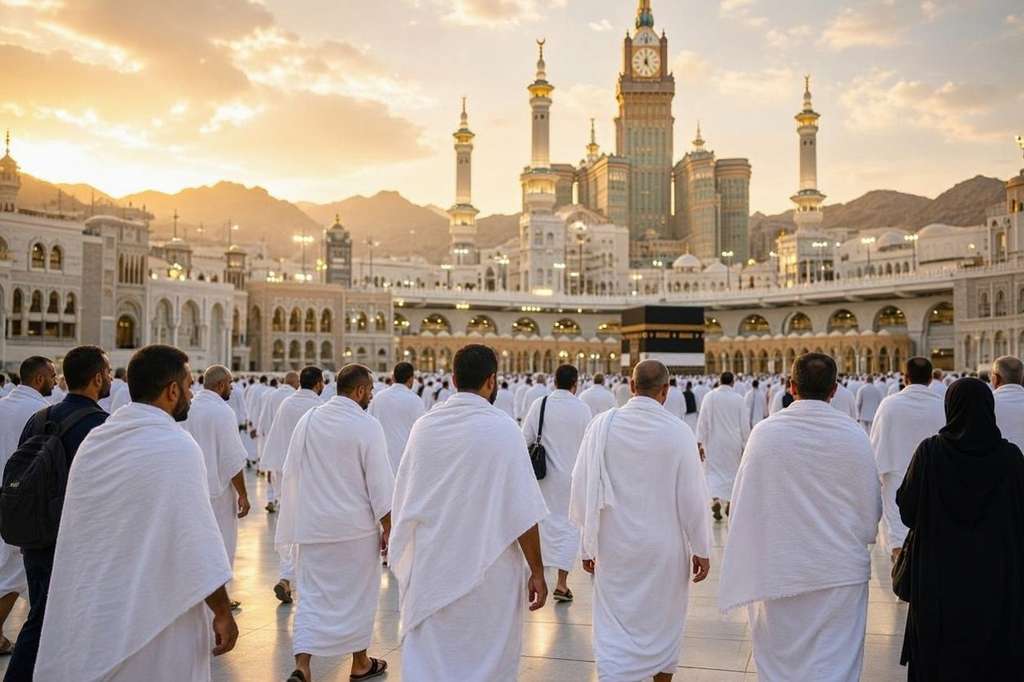
Editorial illustration: pilgrims in simple white ihram garments walking peacefully toward the Grand Mosque in Mecca at golden dawn, soft warm light — for the story on India's Haj 2027 quota of 1,75,025 pilgrims.
Key Takeaways
India's Haj quota for 2027 is 1,75,025 pilgrims, confirmed by the bilateral agreement signed in Jeddah on 9 November 2026 — unchanged from 2026 and 2025.
The quota is split 70:30: 1,22,518 seats through the Haj Committee of India and 52,507 through registered private Haj Group Organisers.
Applications through the Haj Committee opened on 22 June 2026 via hajcommittee.gov.in and the Haj Suvidha app; the third waiting list is out and provisionally selected pilgrims must pay a second instalment of Rs 1,25,000.
The 20-day Short Haj Package continues for 2027, with Kolkata added as a new departure point, and 19 embarkation points are listed across India.
Exact Haj 2027 dates depend on the moon sighting for Dhul Hijjah 1448 AH and will be confirmed closer to the time.
India and Saudi Arabia have signed the bilateral Haj agreement for 2027, and the question everyone is asking — what is India's Haj quota for 2027? — now has a firm answer: 1,75,025 pilgrims. The agreement was signed in Jeddah on 9 November 2026 by Union Minister for Minority Affairs Kiren Rijiju and Saudi Arabia's Minister of Hajj and Umrah, Dr Tawfiq bin Fawzan Al-Rabiah. The number is unchanged from 2026, which means the long wait for an increase continues for lakhs of hopeful pilgrims across India.
For families planning the pilgrimage, the confirmed quota matters more than the ceremony around it. The quota decides how many Indians can travel, who gets a seat through the government route and who must go through a private operator, and how the Haj Committee of India manages its waiting lists. This article explains what was agreed, how the 1,75,025 seats are divided, what it means for applicants, and what happens next.
What Is India's Haj Quota for 2027?
India's Haj quota for 2027 is 1,75,025 pilgrims, confirmed under the bilateral Haj agreement signed in Jeddah on 9 November 2026. The figure is exactly the same as India's quota for 2026, and the same as for 2025. The Ministry of Minority Affairs had said in June 2026, when it announced the Haj Policy 2027, that the government would try to increase the quota — but the final agreement keeps the number unchanged.
To understand why the number matters, it helps to look at how it has grown. In 2014, India's Haj quota stood at 1,36,020. Over the following decade it rose steadily to 1,75,025 by 2025, and it has now stayed at that level for three consecutive years. Saudi Arabia fixes an annual quota for every country because space and facilities at the holy sites in Mecca and Madinah are limited, and the quota is the hard ceiling on how many pilgrims each country can send.
The agreement was signed after a bilateral meeting between the two ministers at the Jeddah Superdome. Rijiju was on an official visit to Saudi Arabia from 6 to 9 November, during which he also attended the inaugural ceremony of the 6th Haj Conference and Exhibition in Jeddah on 8 November. The Indian Consulate General in Jeddah confirmed the signing, describing it as a step in strengthening India-Saudi Arabia cooperation for Haj 2027. The two ministers also reviewed preparations for the pilgrimage, covering logistics, pilgrim welfare and administrative coordination between the two governments.
How the 1,75,025 Seats Are Divided
The quota is split between two routes in a 70:30 ratio that has been in place for years. About 70 per cent of the places — 1,22,518 seats — go through the Haj Committee of India, the government body that runs the official pilgrimage. The remaining 30 per cent — 52,507 seats — are handled by registered private tour operators, known as Haj Group Organisers.
The split matters because the two routes work very differently. The Haj Committee route is the government-organised option: applications are made online, selection is done through a draw, and the package, accommodation and travel arrangements follow the committee's schedule. The private route is run by approved operators who organise their own packages, usually at different price points and with different facilities. Pilgrims who do not get a seat through the committee often turn to private operators, so the 52,507 private seats absorb a large share of the demand.
Applications through the Haj Committee opened on 22 June 2026, the day the Haj Policy 2027 was announced, through the committee's portal at hajcommittee.gov.in and the Haj Suvidha mobile app. The process has been moving steadily since then. By 5 November, the committee had released its third waiting list, and it issued a separate circular asking provisionally selected pilgrims to pay a second instalment of Rs 1,25,000. Pilgrims who have applied should keep checking the committee's website for selection, payment and document notices, because the lists and deadlines move in stages and missing a payment date can cost a seat.
What Is New for Haj 2027 Pilgrims?
The Haj Policy 2027 carries forward several facilities that were introduced for Haj 2026. These include sofa-cum-beds in Mina, high-speed train travel between Makkah and Madinah, and hotel-style accommodation in Makkah. The popular 20-day Short Haj Package has also been retained, and Kolkata has been added as a new departure point for it, giving pilgrims from eastern India a shorter and more convenient option.
The policy lists 19 embarkation points across India, including Delhi, Mumbai, Hyderabad, Bengaluru, Chennai, Lucknow, Ahmedabad, Srinagar, Patna, Guwahati and Kolkata. Pilgrims choose their departure city when they apply, and the committee allots flights from the nearest available point. One practical condition in the guidelines is that a pilgrim's passport must remain valid at least up to 31 December 2027, so anyone planning to apply should check the passport's expiry date well before the travel season.
The exact dates of Haj 2027 cannot be fixed yet, because the pilgrimage follows the Islamic lunar calendar and the dates depend on the sighting of the moon for Dhul Hijjah 1448 AH. The dates will be confirmed closer to the time, and the Haj Committee will publish the flight schedule once the Saudi authorities finalise it.
Why the Quota Stayed Unchanged
The unchanged quota is the one disappointing part of the agreement for many applicants. Demand for Haj from India far exceeds 1,75,025 places every year, and the waiting lists run long. When the Haj Policy 2027 was announced in June, the government said it would make efforts to increase the quota, and many pilgrims hoped the November agreement would deliver a higher number. That did not happen, and the quota remains where it has been since 2025.
There is a wider context worth noting. The quota is set by Saudi Arabia, not by India alone, and it depends on the capacity of the holy sites, accommodation, transport and crowd management in Mecca and Madinah. India is already one of the largest senders of pilgrims in the world, and any increase has to be negotiated against the allocations of every other country. The bilateral agreement is the formal mechanism for that negotiation, and this year it produced continuity rather than growth.
For pilgrims, the practical effect is simple: competition for seats stays intense, the waiting lists matter more than ever, and the private operator route will continue to absorb the overflow. Anyone who missed the committee's application window should check the official portal rather than turning to unauthorised agents, because only the Haj Committee and registered Haj Group Organisers can legally arrange the pilgrimage.
What Happens Next
With the agreement signed, the focus now shifts to operations. Indian authorities will finalise logistics, accommodation arrangements and health preparedness for the 1,75,025 pilgrims travelling in 2027. The Haj Committee will continue working through its waiting lists and payment schedule, and the Saudi authorities will publish the detailed timetable for the pilgrimage season.
The agreement also fits into a wider diplomatic picture. India and Saudi Arabia cooperate closely on energy, trade and the welfare of the large Indian community in the Kingdom, and the annual Haj agreement is one of the most visible parts of that relationship. For a sense of how India manages other major bilateral negotiations, see our explainer on the [proposed Trump–Xi–Putin trilateral meeting at APEC 2026](https://indiaask.tech/question.php?slug=trump-xi-putin-trilateral-meeting-apec-shenzhen-explained). And for pilgrims who want to check what other government services and schemes they may be eligible for, the [MyScheme portal guide](https://indiaask.tech/question.php?slug=myscheme-portal-find-government-schemes-eligible-explained) explains how to find them in one place.
The news was first confirmed by the Indian Consulate General in Jeddah and reported by [The Federal](https://thefederal.com/category/news/india-saudi-arabia-ink-haj-deal-for-2027-175-lakh-pilgrims-to-travel-to-mecca-262367) and the [Economic Times](https://economictimes.indiatimes.com/nri/latest-updates/india-signs-haj-2027-agreement-with-saudi-arabia-secures-quota-of-175025-pilgrims/articleshow/135703564.cms), which both reported the 1,75,025 figure on 9–10 November 2026.
Conclusion
India's Haj quota for 2027 is 1,75,025 pilgrims, confirmed by the bilateral agreement signed in Jeddah on 9 November 2026. The number is unchanged from 2026 and 2025, split 70:30 between the Haj Committee of India (1,22,518 seats) and private Haj Group Organisers (52,507 seats). Applications through the committee opened in June 2026 and the selection process is already at its third waiting list, with provisionally selected pilgrims asked to pay a second instalment of Rs 1,25,000. The 20-day Short Haj Package continues, Kolkata joins as a new departure point, and the exact pilgrimage dates will be confirmed after the moon sighting for Dhul Hijjah 1448 AH. For the lakhs of Indians hoping to perform Haj next year, the message is clear: the quota is fixed, the lists are moving, and the official portal is the only place to track your application.
India's Haj quota for 2027 is 1,75,025 pilgrims, confirmed under the bilateral Haj agreement signed by India and Saudi Arabia in Jeddah on 9 November 2026. The figure is the same as India's quota for 2026 and 2025.
How can I apply for Haj 2027 from India?
Applications through the Haj Committee of India opened on 22 June 2026 via the committee's portal at hajcommittee.gov.in and the Haj Suvidha mobile app. The selection process is already at its third waiting list, so applicants should check the official portal for selection, payment and document notices.
How is the Haj 2027 quota divided between the government and private operators?
The quota is split 70:30. About 70 per cent — 1,22,518 seats — go through the Haj Committee of India, and the remaining 30 per cent — 52,507 seats — are handled by registered private tour operators known as Haj Group Organisers.
What is the Short Haj Package for Haj 2027?
The 20-day Short Haj Package is a shorter pilgrimage option retained from Haj 2026. For 2027, Kolkata has been added as a new departure point for the package, giving pilgrims from eastern India a more convenient option.
When will Haj 2027 take place?
The exact dates cannot be fixed yet because Haj follows the Islamic lunar calendar and depends on the sighting of the moon for Dhul Hijjah 1448 AH. The dates and flight schedule will be confirmed closer to the time by the Haj Committee of India and the Saudi authorities.