Home > Economy > 8th Pay Commission Latest News: How Much Salary Hike Can Employees Expect and When Will It Be Implemented?
8th Pay Commission Latest News: How Much Salary Hike Can Employees Expect and When Will It Be Implemented?
By Vijay Pawar · 2026-11-09 · 8 min read · Economy
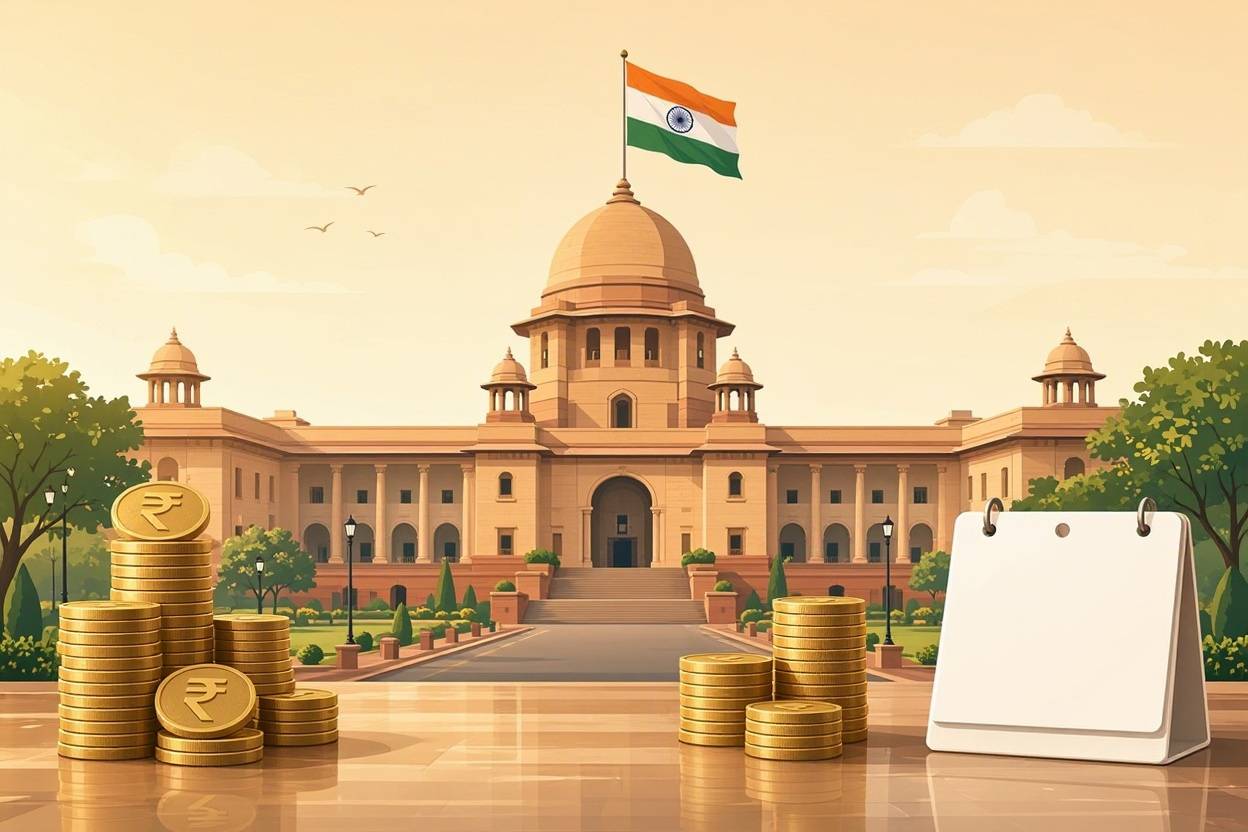
Editorial illustration: a government office building in New Delhi with the Indian flag, symbolic stacks of rupee coins and a calendar, representing the 8th Pay Commission's salary review.
Key Takeaways
The 8th Pay Commission, chaired by Justice Ranjana Prakash Desai, was constituted on 3 November 2025 and completed one year on 3 November 2026; its report is due around May 2027.
No fitment factor and no implementation date have been announced; a Lok Sabha reply on 10 August 2026 confirmed the Commission had not submitted its recommendations.
Employee unions have demanded a minimum basic pay of Rs 69,000 and a fitment factor of 3.833; figures like 2.57 or 3.15 circulating online are speculation, not decisions.
The Union Cabinet raised Dearness Allowance from 60% to 63% on 28 October 2026, effective 1 July 2026, with July-October arrears paid with the November salary.
If recommendations take retrospective effect from January 2026, employees could receive lump-sum arrears — illustrative calculations at a 2.57 factor put 12-month arrears at about Rs 5.15 lakh for a Level 7 employee on Rs 44,900 basic pay.
The 8th Pay Commission latest news is that the panel has completed one year of work without fixing a fitment factor or announcing when revised salaries will actually reach bank accounts. The Commission was set up on 3 November 2025, and 3 November 2026 marked one year since its constitution — which is why searches for the 8th Pay Commission have spiked again this week. For lakhs of central government employees and pensioners, the question is simple: how much will salaries rise, and when? The honest answer is that nothing has been decided yet. What exists today is a timetable, a set of demands from employee unions, and a long list of speculative figures circulating online. This article separates what is officially confirmed from what is only a demand or a guess.
What Is the 8th Pay Commission?
A pay commission is a panel the Government of India sets up roughly once every ten years to review the salaries, allowances and pensions of central government employees. The 7th Pay Commission, whose recommendations took effect from 1 January 2016, completed its ten-year term on 31 December 2025. The 8th Central Pay Commission (8th CPC) is its successor.
The Commission is chaired by retired Supreme Court Justice Ranjana Prakash Desai. It was formally constituted on 3 November 2025, after the government announced its formation in January 2025 and finalised its terms of reference on 28 October 2025. The panel has been given 18 months to submit its report, which puts the deadline around May 2027. Until that report is submitted and the Union Cabinet accepts it, no revised pay scale exists — only the old 7th Pay Commission structure, plus dearness allowance revisions.
8th Pay Commission Latest News: One Year On, Where Things Stand
The Commission has spent its first year in consultation. It has travelled to different states, met employee federations, pensioner associations and other stakeholders, and collected written demands. It held stakeholder consultations in Bengaluru on 7 and 8 October 2026, and in Mumbai on 22 and 23 October 2026, where it met employee and pensioner organisations, including railway staff unions, to discuss pay, pensions, allowances and service matters. These were consultation meetings only — no pay or fitment recommendations came out of them.
Replying to a question in the Lok Sabha on 10 August 2026, Minister of State for Finance Pankaj Chaudhary said the Commission had not submitted its recommendations. That reply announced neither an implementation date nor a fitment factor, and nothing has changed on either point since. Government decisions on pay and pensions come after the report, not before it. The Cabinet's terms-of-reference announcement said the recommendations would normally be expected to take effect from 1 January 2026, following the ten-year pattern — but an expected effective date and an actual payment date are two different things, and the effective date itself is yet to be confirmed.
How Much Salary Hike Are Employees Asking For?
This is where the most confusion exists, because three different kinds of numbers are circulating — demands, expert projections and viral claims — and they are often reported as if they were decisions.
The fitment factor is the multiplier applied to an employee's existing basic pay to arrive at the revised basic pay. Employee federations have formally demanded a fitment factor of 3.833 and a minimum basic pay of Rs 69,000. The National Federation of Indian Railwaymen (NFIR), in its submission on 30 October 2026 in New Delhi, also sought the annual increment doubled from 3% to 6%, a minimum benefit of Rs 10,000, at least five promotions during service, merger of dearness allowance with basic pay whenever DA reaches 25%, pension at 67% of the last pay drawn, family pension at 50%, and a cut in the commutation deduction period from 15 years to 11 years. These are negotiating positions placed before the Commission. They show what staff want; they do not show what the panel will recommend.
Separately, figures such as 2.57, 2.86, 3.00 and 3.15 are widely shared in media reports and online calculators. None of them is officially approved. A recent viral claim says a Rs 25,000 basic pension could become Rs 87,500 — that sum simply assumes a factor of 3.5, and it has no official basis. Until the Commission submits its report around May 2027 and the government accepts it, every such figure should be treated as speculation, not as a decided salary. For context on how the current pay structure works, see our explainer on the 7th Pay Matrix: Pay Levels, Allowances and Salary Explained (https://indiaask.tech/question.php?slug=government-job-pay-matrix-levels-promotions-explained).
The DA Hike: What Employees Have Actually Received
While the 8th Pay Commission's recommendations are still awaited, employees have received one concrete benefit under the existing framework. On 28 October 2026, the Union Cabinet approved an additional instalment of Dearness Allowance (DA) for central government employees and Dearness Relief (DR) for pensioners, with effect from 1 July 2026. DA and DR rose by 3 percentage points, from 60% to 63% of basic pay and pension.
The Department of Expenditure issued the formal order on 29 October 2026, and the arrears for July to October 2026 were expected alongside the November salary. This increase remains under the 7th Pay Commission framework — it does not confirm an 8th Pay Commission salary. Our detailed breakdown of this hike is here: DA Hike 3% to 63%: Salary Impact, Arrears, Pensioners (https://indiaask.tech/question.php?slug=da-hike-3-percent-63-percent-explained).
What Happens Next — and When Will Salaries Actually Rise?
The road ahead has three stages, and each one takes time. First, the Commission must finish its consultations and submit its report, which is due around May 2027. Second, the government must consider, review and decide on the recommendations — a process that itself takes months. Third, only after Cabinet approval will revised salaries be notified and paid. Many media reports suggest actual implementation could come in late 2027 or early 2028.
If the government gives retrospective effect to the new recommendations from January 2026, employees could become eligible for arrears covering the intervening period. Illustrative calculations show how large those arrears could be: at a fitment factor of 2.57, an employee at Level 7 with a basic pay of Rs 44,900 could attract arrears of roughly Rs 5.06 lakh to Rs 5.15 lakh for the 12 months of 2026, while a Level 1 employee on a basic pay of Rs 18,000 would see basic pay rise to Rs 46,260 with arrears of about Rs 2.06 lakh for the same period. These are examples and illustrations worked out by financial publications — they are not an official announcement, and the government is yet to take any decision on the fitment factor, salary hike, allowances or other benefits. Business Today has also reported that the Commission has not fixed a fitment factor or a pay date a year after it was set up, and that the employees' side has sought a minimum basic pay of Rs 69,000 with a fitment factor of 3.833 (https://www.businesstoday.in/amp/latest/trends/photo/rs25000-pension-to-rs87500-what-the-8th-pay-commission-has-really-decided-565489-2026-11-03). Goodreturns has published the illustrative arrears calculations at a 2.57 fitment factor (https://www.goodreturns.in/personal-finance/8th-pay-commission-at-fitment-factor-2-57-12-months-arrears-to-be-rs-5-15-lakh-rs-44-900-basic-pay-1545993.html).
What This Means for Employees and Pensioners
For serving employees, the practical position is unchanged for now: salaries continue under the 7th Pay Commission structure, with DA at 63% from July 2026. The real gain, whenever it comes, will arrive as a lump sum of arrears if the recommendations are given retrospective effect from January 2026 — but the size of that lump sum depends entirely on a fitment factor that has not been chosen.
For pensioners, the same logic applies. Pension revision follows the same fitment factor, and dearness relief has already risen to 63%. Pensioner associations have been part of the consultations in Bengaluru and Mumbai, and their demands — including a pension at 67% of last pay drawn and family pension at 50% — are before the Commission.
For household budgets, the honest advice is to plan on the current salary and treat any 8th Pay Commission figure as uncertain until the report is out. Social media posts that promise a specific new salary or a fixed date are not based on any government decision.
What to Watch Out For
The biggest risk for employees right now is misinformation. Viral messages routinely present union demands as government decisions, quote fitment factors as if they were notified, and attach dates to payments that have not been announced. Three checks help: first, whether the figure comes from the Commission, the government or a union demand; second, whether a date is described as expected or announced; and third, whether the source is an official notification or a calculator's illustration. If a claim fails any of these checks, it is not a decision.
The next real milestones are the Commission's report around May 2027 and the Cabinet's decision after that. Until then, the DA hike to 63% is the only confirmed improvement in hand.
Conclusion
One year after the 8th Pay Commission was constituted, the position is clear but incomplete: the panel is consulting, its report is due around May 2027, employee unions have demanded a minimum basic pay of Rs 69,000 with a 3.833 fitment factor, and the government has announced no fitment factor and no implementation date. The DA rise to 63% from July 2026 is the one confirmed gain so far. Employees and pensioners should follow the Commission's report and the Cabinet's decision — not viral salary charts — for the numbers that will actually matter.
No implementation date has been announced. The Commission, constituted on 3 November 2025, has 18 months to submit its report, which is due around May 2027. The government will decide on the recommendations only after the report is submitted. Media reports suggest actual implementation could come in late 2027 or early 2028, and the expected effective date of 1 January 2026 is not confirmed.
What is the fitment factor in the 8th Pay Commission?
No fitment factor has been decided. Employee unions have demanded a fitment factor of 3.833 with a minimum basic pay of Rs 69,000. Figures such as 2.57, 2.86, 3.00 and 3.15 that appear in media reports and online calculators are speculation, not officially approved.
How much salary hike can central government employees expect from the 8th Pay Commission?
Nothing has been decided yet, so no salary hike figure is confirmed. Illustrative calculations at a 2.57 fitment factor suggest a Level 7 employee on a basic pay of Rs 44,900 could get about Rs 5.15 lakh in arrears for 12 months, but these are examples worked out by financial publications, not a government announcement.
What is the latest DA rate for central government employees?
Dearness Allowance rose from 60% to 63% of basic pay with effect from 1 July 2026, following the Union Cabinet's decision on 28 October 2026. Dearness Relief for pensioners rose by the same amount. The arrears for July to October 2026 were expected with the November salary.
Read Next on IndiaAsk
The one confirmed gain so far is the DA hike: dearness allowance rose from 60% to 63% of basic pay from July 2026, with arrears paid alongside the November salary. DA Hike 3% to 63%: Salary Impact, Arrears, Pensioners