Home > Government Jobs > DA Hike 3% to 63% Explained: Cabinet Decision, Salary Impact, Arrears and What Pensioners Get
DA Hike 3% to 63% Explained: Cabinet Decision, Salary Impact, Arrears and What Pensioners Get
By IndiaAsk Editorial Team · 2026-10-29 · 6 min read · Government Jobs
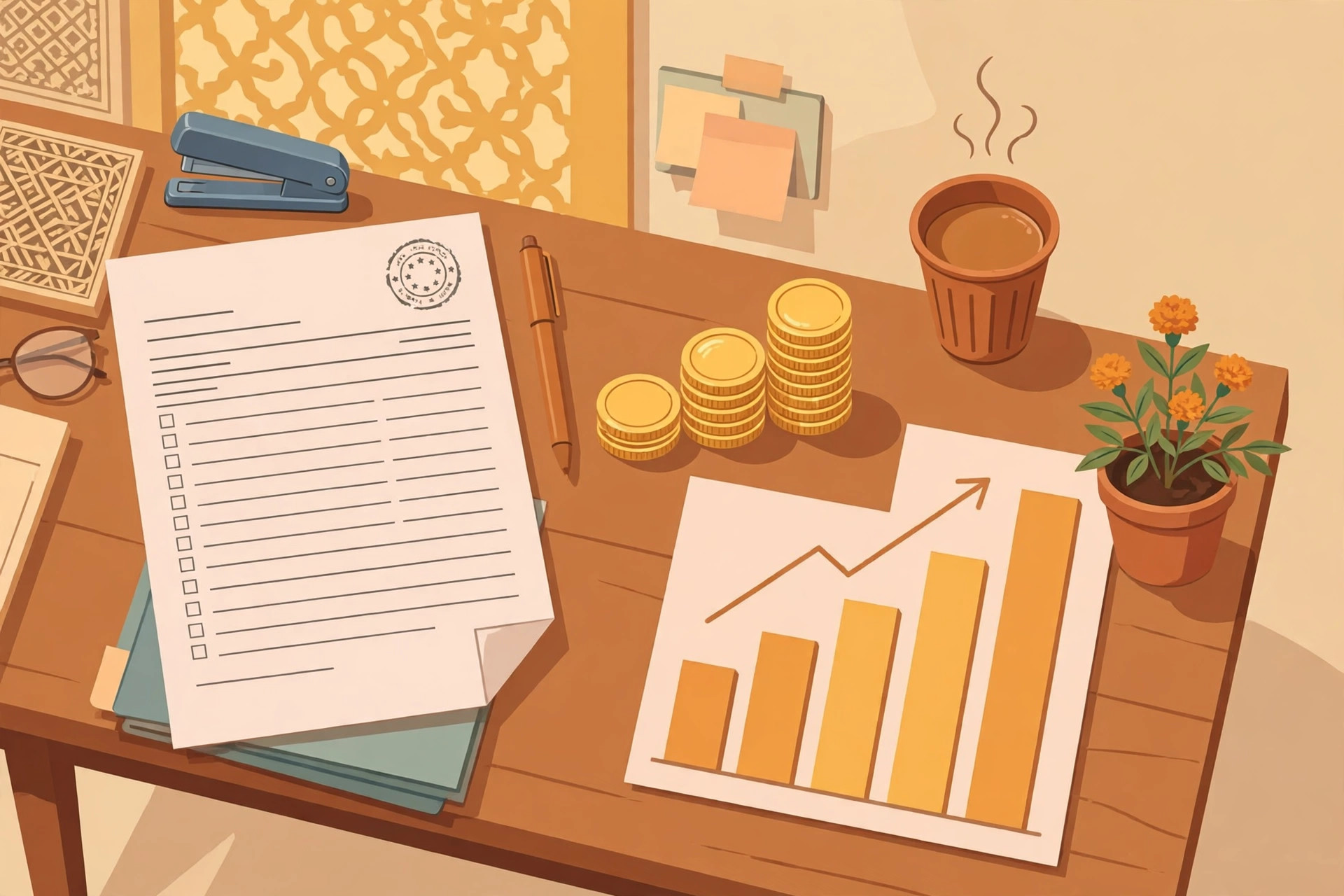
Editorial illustration: a government office desk with a payslip, rising coins and a growth chart, representing the DA increase.
Key Takeaways
The Union Cabinet approved a 3 percentage point DA and DR hike on 28 October 2026, taking the rate from 60% to 63% of basic pay or pension.
The hike applies retrospectively from 1 July 2026, so eligible employees and pensioners also receive arrears from July.
About 48.54 lakh central government employees and 68.71 lakh pensioners benefit, at an estimated annual cost of Rs 10,016.10 crore.
The gain equals 3% of basic pay only: Rs 540 a month on a basic of Rs 18,000, Rs 1,062 on Rs 35,400, and Rs 1,347 on Rs 44,900.
The decision covers central government staff only; state government employees need their own state's DA order.
What happened
On Wednesday, 28 October 2026, the Union Cabinet approved a 3 percentage point increase in Dearness Allowance (DA) for central government employees and Dearness Relief (DR) for pensioners. The decision was announced after the Cabinet meeting by Information and Broadcasting Minister Ashwini Vaishnaw and was reported the same day by The Hindu, The Tribune, The Economic Times and other national news organisations, quoting the Press Information Bureau release.
The increase takes the DA and DR rate from 60 per cent to 63 per cent of basic pay or pension. It applies retrospectively from 1 July 2026, which means eligible employees and pensioners are entitled to the higher rate from that date, with arrears for the months between July and the actual payment.
According to the government, about 48.54 lakh central government employees and 68.71 lakh pensioners will benefit — more than 1.17 crore people in total. The combined additional cost to the exchequer is estimated at Rs 10,016.10 crore per year.
What DA and DR actually are
Dearness Allowance is not a bonus or a special gift. It is a cost-of-living adjustment paid to government employees on top of their basic pay, designed to protect their purchasing power as prices rise. Dearness Relief is the equivalent payment for pensioners, calculated on their basic pension.
Both are expressed as a percentage of basic pay or pension, not of total salary. That distinction matters: if your basic pay is Rs 18,000, a 3 percentage point increase adds Rs 540 a month, not 3 per cent of your full take-home salary. Allowances such as house rent allowance are calculated separately and are not part of this calculation.
The rates are revised twice a year, generally with effect from 1 January and 1 July, based on the accepted formula linked to the 7th Central Pay Commission's recommendations and movements in the consumer price index. The previous revision, approved in April 2026, raised DA by 2 percentage points, from 58 per cent to 60 per cent, with effect from 1 January 2026.
How much more money will employees get
The gain depends entirely on basic pay. The Economic Times illustrated the effect across pay levels: an employee at Level 1 with a basic pay of Rs 18,000 was receiving about Rs 10,800 as DA at 60 per cent and will now receive Rs 11,340, a rise of Rs 540 a month. For a basic pay of Rs 35,400, the additional DA works out to Rs 1,062 a month, and for Rs 44,900 it is Rs 1,347 a month, as reported by Mathrubhumi.
Because the hike is retrospective from 1 July 2026, employees should also receive arrears for July, August, September and October, once the formal government order is issued and payroll systems are updated. The exact month in which the arrears appear in salary slips depends on each department's payroll cycle, so employees should check their payslip rather than assume a single payment date.
For pensioners, the same 3 percentage point increase applies to Dearness Relief on basic pension. A pensioner with a basic pension of Rs 20,000, for example, would see DR rise from Rs 12,000 to Rs 12,600 a month, plus arrears from July.
Why the government revises DA twice a year
Inflation erodes the real value of a fixed salary. If prices rise by, say, 5 per cent in a year and pay stays flat, an employee can buy 5 per cent less with the same money. DA is meant to close that gap, at least partly, by linking a portion of pay to measured price changes.
The formula uses the All India Consumer Price Index for Industrial Workers, averaged over twelve months, and converts it into a percentage of basic pay. That is why DA moves in steps rather than every month: the government waits for a stable twelve-month average, then announces one revision covering the whole half-year.
This system also explains why DA percentages can look large — 63 per cent of basic pay sounds dramatic — while the actual protection is modest. Basic pay is only one part of total salary, and the DA percentage accumulates over years of inflation since the last pay commission. The 3 percentage point step is the latest instalment in that long adjustment, not a sudden windfall.
What it means for the economy
At Rs 10,016 crore a year, the hike is a significant but manageable addition to government spending, and it puts money directly into the hands of more than a crore of households. Announced just ahead of Diwali, as several reports noted, it is timed to support festive-season spending, which tends to flow into consumer goods, travel and local markets.
For the broader economy, the effect is two-sided. Higher take-home pay supports demand, which businesses welcome. At the same time, the additional expenditure adds to the fiscal bill at a time when the government is also funding large schemes — the same Cabinet meeting approved a Rs 10,000 crore container manufacturing scheme and Rs 7,395 crore for the PM Viksit Gram Swaraj Yojana. The DA increase, however, is a formula-driven entitlement rather than a discretionary stimulus, so it does not signal a change in fiscal policy.
What to watch next
Three things remain for employees and pensioners to track. First, the formal order from the Department of Expenditure, which will confirm the implementation schedule and arrears payment. Second, the payslip itself — the revised DA line and the arrears entry should both appear, and any discrepancy should be raised with the drawing and disbursing officer. Third, state governments, which typically follow the central pattern for their own employees after their own cabinet decisions; state employees should not assume the central order applies to them automatically.
The next DA revision, due with effect from 1 January 2027, will be announced in the first half of next year and will again depend on inflation data. Employees should treat each revision as a cost-of-living adjustment, not a pay rise — its purpose is to keep real income steady, not to increase it.
Conclusion
The 3 percentage point DA and DR hike, from 60 per cent to 63 per cent with effect from 1 July 2026, is a routine but meaningful adjustment for over 1.17 crore central government employees and pensioners. It adds a few hundred to a few thousand rupees a month depending on basic pay, plus arrears from July, at an annual cost of about Rs 10,016 crore to the exchequer. The key for beneficiaries is practical: check the formal order, verify the payslip, and remember that DA protects purchasing power against inflation rather than raising real income. For state government employees, the next step is their own state's announcement.
Frequently Asked Questions (FAQ)
What is the new DA rate after the October 2026 hike?
Dearness Allowance for central government employees and Dearness Relief for pensioners rise from 60% to 63% of basic pay or pension, with effect from 1 July 2026, following the Union Cabinet decision of 28 October 2026.
How much extra money will I get from the 3% DA hike?
The gain is 3% of your basic pay, not of your total salary. For example, on a basic pay of Rs 18,000 it adds Rs 540 a month, on Rs 35,400 it adds Rs 1,062, and on Rs 44,900 it adds Rs 1,347.
Will I receive arrears for the DA hike?
Yes. Because the hike applies retrospectively from 1 July 2026, eligible employees and pensioners are entitled to arrears for July onwards. The exact month the arrears appear depends on each department's payroll cycle, so check your payslip.
Does this DA hike apply to state government employees?
No. This Cabinet decision covers central government employees and pensioners only. State governments usually announce their own DA revisions separately, so state employees should wait for their state's order.