Home > Economy > Why Is Gold Price Falling in India? Global Correction, Rupee and Import Duty Explained
Why Is Gold Price Falling in India? Global Correction, Rupee and Import Duty Explained
By Vijay Pawar · 2026-11-11 · 7 min read · Economy
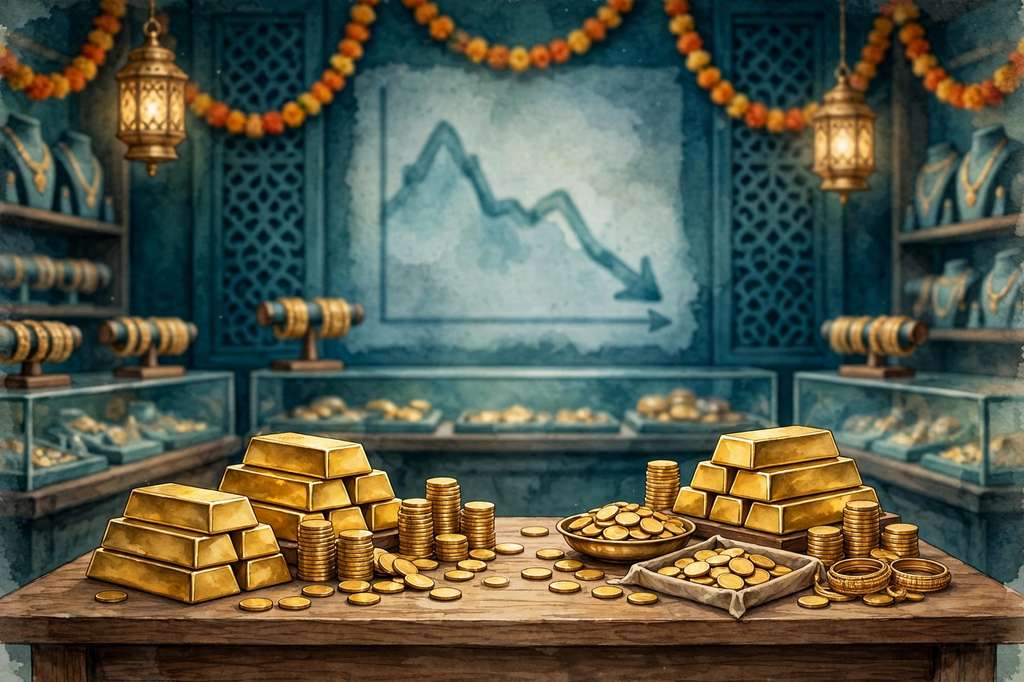
Editorial illustration: gold bars and coins on a wooden table in an Indian jewellery shop, with a downward-trending chart arrow behind them — no text, no real person, no logos.
Key Takeaways
Global gold prices fell 21.4% from their 30 January 2026 peak as of 30 October 2026, according to an Axis Mutual Fund report.
In India the fall was limited to 14.9% in rupee terms, because the rupee weakened from around Rs 89 to Rs 96 per dollar.
The gold import duty was raised from 6% to 15% in March 2026, raising the landed cost of imported gold.
Profit-booking, unwinding of leveraged positions, the US-Iran conflict and expectations of higher-for-longer US interest rates drove the global correction.
Gold is still about 12.6% costlier than last Diwali, and Axis Mutual Fund maintains a bullish long-term outlook.
If you have been checking gold rates lately, you have probably asked the same question millions of Indians are searching right now: why is gold price falling in India? After a record-breaking run that took the yellow metal to all-time highs in January 2026, gold has corrected sharply — and the fall has been steep enough to become one of the most searched topics in the country this week. The short answer is that global gold prices have fallen by more than a fifth from their peak, while in India the decline has been smaller, cushioned by a weaker rupee and higher import duty. Here is the full picture, what is driving the fall, and what it means for buyers and investors.
How Much Has Gold Fallen?
According to a report by Axis Mutual Fund, international gold prices denominated in US dollars declined 21.4 percent from their peak recorded on 30 January 2026, as of 30 October 2026. In India, however, the fall in domestic gold prices was limited to 14.9 percent in rupee terms over the same period. That gap of more than six percentage points is the most important part of the story, because it explains why Indian buyers have felt a smaller correction than investors abroad.
The scale of the earlier rally makes the correction easier to understand. Gold had touched a peak of Rs 1,76,306 per 10 grams on 29 January 2026, and by early November it had retreated nearly 18 percent from that level. On 10 November, 24-carat gold in India was priced at Rs 14,411 per gram and 22-carat gold at Rs 13,210 per gram, with both falling further that day, while spot gold in international markets traded at around $4,110 an ounce, down about 1 percent. Despite the correction, gold is still far more expensive than it was a year ago: MCX data shows gold averaged around Rs 1,27,000 per 10 grams during Diwali and Dhanteras in 2025, compared with Rs 1,43,184 on 6 November 2026 — an increase of roughly 12.6 percent year on year.
Why Is Gold Price Falling in India and Around the World?
The Axis Mutual Fund report attributes the global correction largely to profit-booking and the unwinding of leveraged positions. After a long and steep rally, many traders decided to lock in gains. As prices retreated from their January peak, stop-loss triggers and margin calls intensified the selling pressure, accelerating the downward movement — a classic pattern after any sharp bull run.
Geopolitical and macroeconomic developments added to the pressure. The US-Iran conflict disrupted oil supplies and increased financial stress across the Gulf region, reducing the surplus funds available for investment in gold. It also raised concerns that some investors might liquidate their existing gold holdings to meet financial requirements. At the same time, higher oil prices fuelled inflation concerns and strengthened expectations that central banks, particularly the US Federal Reserve, could keep interest rates elevated for longer. Expectations of tighter monetary conditions pushed up US Treasury yields and supported the dollar, and a stronger dollar typically weighs on gold because the metal becomes more expensive for buyers using other currencies.
Why India's Fall Is Smaller: The Rupee Cushion
The first reason Indian gold prices have fallen less than global prices is the rupee. India imports a substantial portion of its gold requirements, so a weaker domestic currency increases the cost of imported gold and cushions the impact of falling international prices. The rupee weakened from around Rs 89 to around Rs 96 against the US dollar during 2026, and that depreciation alone absorbed a meaningful part of the global decline before it could reach Indian shop counters.
This is the same mechanism that works in reverse when the rupee strengthens: a stronger rupee makes imported gold cheaper and pulls domestic prices down faster. For now, the weak rupee is acting as a shock absorber for Indian gold buyers and investors, which is why the domestic correction of 14.9 percent looks modest next to the 21.4 percent global fall.
The Import Duty Shield
The second cushion is import duty. The government increased the gold import duty from 6 percent to 15 percent in March 2026. The higher duty raised the landed cost of imported gold, providing additional support to domestic prices even as international bullion markets witnessed a significant correction. Together, the weaker rupee and the higher duty explain almost the entire gap between the global and Indian declines.
This matters for anyone trying to read the market: the gold price in India is not simply the international price converted into rupees. It is the international price plus the exchange rate, plus import duty, plus GST and making charges. When two of those components move up at the same time as the global price falls, the retail price in India falls more slowly — exactly what has happened in 2026.
What About Festive Demand?
One factor that has limited the fall in India is strong festive demand. The correction encouraged bargain-seeking buyers to return to jewellery stores during the Diwali season, and the India Bullion and Jewellers Association expected Dhanteras gold sales to increase by around 10 percent compared with the previous year. [India's festive gold buying was already at record levels this Diwali, with jewellery sales of about Rs 62,000 crore in just two days](https://indiaask.tech/question.php?slug=diwali-gold-sales-62000-crore-two-days-explained), and the price dip gave many families a reason to buy sooner rather than later.
That demand, however, works both ways. Strong buying supports prices in the short term, but it cannot reverse a global correction on its own. If international prices keep falling, Indian prices will follow — just more slowly, because of the rupee and duty cushions. The festive season therefore explains why the correction has felt gentler in India, not why it has stopped.
What Does This Mean for Buyers and Investors?
For buyers planning a wedding or a festival purchase, the correction is straightforward good news: gold is cheaper than it was at the January peak, even though it remains well above last year's levels. Comparing today's rate with the [gold rates seen during Dhanteras 2026](https://indiaask.tech/question.php?slug=gold-price-today-india-dhanteras-2026-explained) can help judge whether the current price is genuinely attractive or simply less extreme than the peak.
For investors, the picture is more mixed. Axis Mutual Fund maintains a bullish long-term outlook on gold, suggesting the correction is a pause rather than the end of the rally. But the same report shows how quickly sentiment can turn: profit-booking, margin calls and a stronger dollar can erase a fifth of the price in nine months. Anyone investing in gold — whether through jewellery, coins, sovereign gold bonds or gold ETFs — should treat the metal as a long-term holding, not a quick trade, and should remember that the rupee and import duty can change the domestic return significantly from the global one.
There is also a practical point about timing. Gold prices in India change through the day with international markets and the rupee, and local rates also vary by city and include GST and making charges. A single day's rate is a snapshot, not a trend, so buyers should compare rates over a few days and across jewellers before deciding.
Conclusion
So why is gold price falling in India? Globally, gold is correcting after a historic rally, driven by profit-booking, the unwinding of leveraged positions and pressure from a stronger dollar and higher-for-longer interest rates, with the US-Iran conflict adding to the selling. In India, the fall has been softer — 14.9 percent against a 21.4 percent global decline — because a rupee that slipped from around Rs 89 to Rs 96 per dollar and an import duty raised from 6 percent to 15 percent have cushioned domestic prices, while strong festive demand has supported buying at lower levels. The correction has made gold cheaper than at its January peak, but it is still about 12.6 percent costlier than last Diwali, and the long-term outlook, according to Axis Mutual Fund, remains positive. For buyers, it is a better moment to purchase than the peak was; for investors, it is a reminder that even gold corrects — and that in India, the rupee and duty matter almost as much as the global price itself.
Sources: [Moneycontrol](https://www.moneycontrol.com/news/business/personal-finance/gold-falls-21-4-globally-but-rupee-depreciation-limits-india-s-decline-to-14-9-14076173.html/amp) and [The Statesman](https://www.thestatesman.com/business/gold-loses-21-from-january-peak-but-indias-gold-prices-fall-15-report-1503660966.html/amp), both reporting the Axis Mutual Fund report on 10 November 2026.
Why is gold price falling in India in November 2026?
Global gold prices fell 21.4 percent from their peak on 30 January 2026, as of 30 October 2026, according to a report by Axis Mutual Fund. In India the fall was smaller, at 14.9 percent in rupee terms, because a weaker rupee and higher import duty cushioned domestic prices.
What caused the global gold price correction in 2026?
The report attributes the correction mainly to profit-booking after a long rally and the unwinding of leveraged positions, with stop-loss triggers and margin calls accelerating the selling. The US-Iran conflict, higher oil prices and expectations that the US Federal Reserve will keep interest rates higher for longer also pushed up the dollar and Treasury yields, which weighed on gold.
Why has gold fallen less in India than in global markets?
India imports most of its gold, so a weaker rupee raises the cost of imported gold. The rupee weakened from around Rs 89 to around Rs 96 against the US dollar in 2026. On top of that, the gold import duty was raised from 6 percent to 15 percent in March 2026, which raised the landed cost of gold and supported domestic prices.
Is it a good time to buy gold now, and will prices fall further?
Gold is cheaper than at its January 2026 peak of Rs 1,76,306 per 10 grams, but it is still about 12.6 percent costlier than last Diwali — around Rs 1,43,184 per 10 grams on 6 November 2026 against an average of about Rs 1,27,000 during Diwali 2025. Axis Mutual Fund maintains a bullish long-term outlook, but prices can keep correcting if global prices fall further, so buyers should compare rates over a few days rather than acting on a single day's rate.