Integrated Pest Management for Farmers Explained: Cultural, Biological and Chemical Controls That Work Together
Key Takeaways
- IPM combines cultural, biological and chemical controls, with chemicals as the last resort, not the first response.
- Regular scouting and an economic threshold decide whether control is worth its cost.
- Crop rotation, timely sowing, sanitation and balanced nutrition make fields less inviting to pests.
- Protecting predators and using biological controls keeps pest populations low over time.
- Chemical use must follow the label dose, rotate modes of action, and be recorded for future decisions.
Integrated Pest Management for Farmers Explained: Cultural, Biological and Chemical Controls That Work Together
Pests are a normal part of farming, not a sign of failure. Insects, diseases and weeds appear every season, and the question is never how to eliminate them completely. The question is how to keep their damage below the level where it hurts income, without spending more on control than the crop is worth, and without damaging the soil, water, pollinators and the farmer's own health. Integrated Pest Management, or IPM, is the practical answer to that question. It combines several methods, uses chemicals only when needed, and treats the field as a living system rather than a target to be sprayed.
Many farmers know IPM by its pieces — crop rotation, resistant varieties, pheromone traps, neem sprays, or a well-timed insecticide — without seeing how the pieces fit. The fit is the point. A single method used alone often fails: a chemical alone breeds resistance, a resistant variety alone can be overcome, and a biological control alone may act too slowly in a severe outbreak. Together, layered in the right order, they are stronger and cheaper than any one of them.
The First Principle: Watch Before You Act
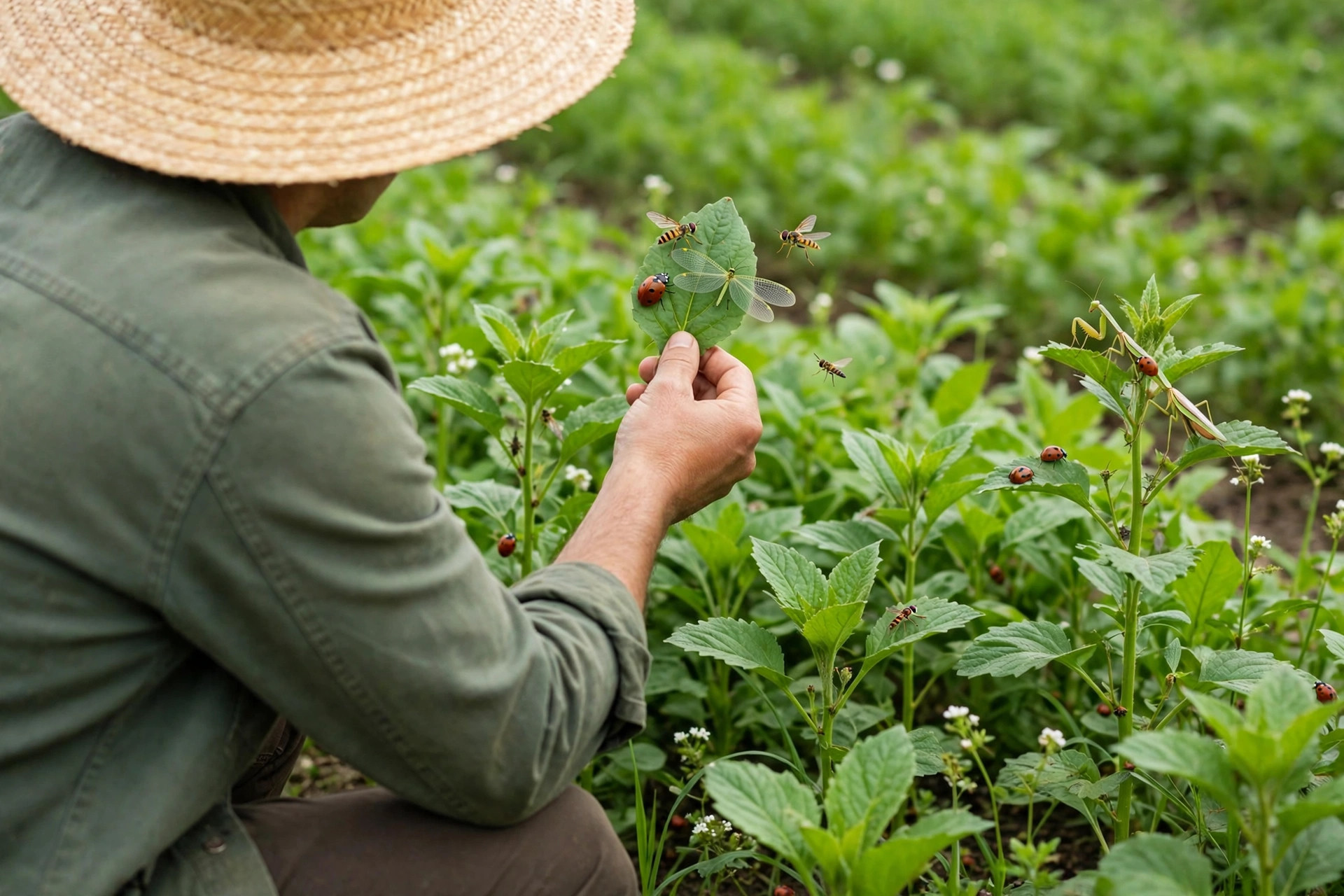
IPM begins with observation. Walk the field regularly, at least twice a week during vulnerable stages, and look at both sides of leaves, stems, flowers and young fruit. Count what you see. Are there a few insects, or a rapidly growing population? Are natural enemies present — ladybirds, spiders, lacewings, parasitic wasps? Is damage limited to a few plants, or spreading across the field?
This habit changes decisions. A farmer who sprays on a calendar date may spray when pests are absent, wasting money and killing useful insects. A farmer who scouts may find that the pest population is small, that predators are already controlling it, or that only one corner of the field needs attention. Simple tools help: yellow sticky traps for sucking pests, pheromone traps that catch male moths of a specific pest, and a notebook recording date, crop stage, pest numbers and weather. Over a season, those notes reveal patterns — which pest arrives first, after which rain, and at which crop stage — that make next season's decisions faster and better.
Every pest also has an economic threshold, a level of damage beyond which the cost of control is less than the loss from doing nothing. Below that level, control is not worth it. This is not neglect; it is arithmetic. Tolerating a few insects preserves predators and saves money for the moment when intervention really matters.
Cultural Controls: Making the Field Less Inviting
Cultural controls are farming practices that make life harder for pests and easier for the crop. They cost little, they work before pests arrive, and they are the foundation of IPM. Crop rotation is the classic example. Growing the same crop in the same field season after season lets its pests, diseases and weeds build up in the soil. Rotating with a crop from a different family breaks that cycle, because many pests cannot survive without their host.
Timely sowing matters too. A crop sown at the recommended time often escapes the peak period of a pest, or passes its most vulnerable stage before the pest population explodes. Field sanitation — removing and destroying infested plant parts, clearing crop residue that harbours pests, and managing weeds that act as alternate hosts — removes shelter and food for the next generation.
Spacing, irrigation and fertiliser also shape pest pressure. Overcrowded plants stay humid and invite disease. Excess nitrogen produces soft, lush growth that sucking insects love. Balanced nutrition, proper drainage and enough air movement between plants produce a sturdier crop that tolerates some damage and recovers faster. Choosing a resistant or tolerant variety, where one is available and suited to local conditions, is itself a cultural control, and often the cheapest one of all.
Biological Controls: Allies Already in the Field
Biological control means using living organisms to suppress pests. The most important biological controls are already present: predators that eat pests, parasitoids that lay eggs inside them, and pathogens that infect them. A field sprayed indiscriminately loses these allies first, because many predators are more sensitive to chemicals than the pests themselves. Protecting them is often as simple as avoiding broad-spectrum sprays when they are not needed, and leaving refuge strips of flowering plants or grasses at field borders where beneficial insects can feed and shelter.
Farmers can also augment biological control. Trichogramma wasps, which parasitise moth eggs, are released in some crops to reduce borer damage. Neem-based products, derived from the neem tree, act as feeding deterrents and growth disruptors rather than instant killers, and are gentler on many beneficial insects than synthetic chemicals. Microbial products based on bacteria or fungi that attack specific pests are available for certain crops, but they work best as part of a plan, applied at the right pest stage and under suitable weather, not as a last-minute rescue.
Biological controls need patience. They rarely wipe out a pest overnight. Their strength is steady suppression, keeping populations low over time, which is exactly what IPM aims for.
Chemical Controls: The Last Tool, Used Precisely
Chemicals still have a place in IPM, but as the last resort, not the first response. When scouting shows the pest has crossed its threshold, when cultural and biological measures cannot hold it, and when the crop stage makes delay risky, a well-chosen pesticide can save the crop. The discipline lies in how it is used.
Choose a product registered for that crop and pest, and read the label fully: dose, water volume, safety interval before harvest, and protective equipment. Use the recommended dose, not more — higher doses do not reliably kill more pests, but they do increase cost, resistance risk and harm to beneficial insects. Rotate chemical groups so the same mode of action is not used repeatedly, because repeated use of one chemical selects for resistant pests. Spray in the cooler hours, avoid spraying when bees are actively foraging on flowering crops, and never mix chemicals casually without label guidance.
Keep records of every spray: product, dose, date, crop stage and result. If a spray worked poorly, the record helps an extension worker diagnose whether the timing, dose or product choice was wrong. Store chemicals safely, away from food, feed and children, and dispose of empty containers as directed, never reusing them for water or food.
Conclusion
Integrated Pest Management is not a product to buy; it is a way of deciding. Scout first, build a field that discourages pests, protect and use natural enemies, and reach for chemicals only when the threshold is crossed, with the right product at the right dose. Farmers who practise it typically find their costs fall, their crops are steadier, and their fields keep more of the insects that help rather than harm. The field rewards patience and observation, and IPM is simply the discipline of giving it both.