Farmer Producer Organisations Explained: How Small Farmers Sell Together and Get Better Prices
Key Takeaways
- An FPO is a farmer-owned collective business, not a middleman.
- Aggregation, grading, storage timing and direct marketing together lift prices.
- Bulk input purchase cuts cost and the risk of spurious inputs.
- Success needs competent management, prompt payment and open accounts.
- Ask about payment timing, grading and accounts before joining an FPO.
Farmer Producer Organisations Explained: How Small Farmers Sell Together and Get Better Prices
A small farmer with two acres faces the market alone. He buys seed and fertiliser in small quantities at retail prices, hires transport for a few quintals, and sells to the nearest buyer, who knows the farmer has little choice and little time. A farmer producer organisation, or FPO, changes that arithmetic by bringing many such farmers together into one business they own. The FPO buys inputs in bulk, aggregates produce, grades and stores it, and negotiates with larger buyers as a single seller. The idea is simple: what one small farmer cannot do profitably, a hundred small farmers together often can.
What an FPO Is and Who Owns It
An FPO is a collective enterprise formed by farmers, usually as a producer company or a cooperative, in which the farmers themselves are the shareholders. Each member typically buys shares, elects a board of directors from among the members, and shares in the organisation's profits. Unlike a trader or a middleman, the FPO does not exist to buy cheap from farmers and sell dear to others. Its purpose is to return value to its members, whether through better prices, cheaper inputs, or services such as grading, storage and transport that an individual small farmer could not afford.
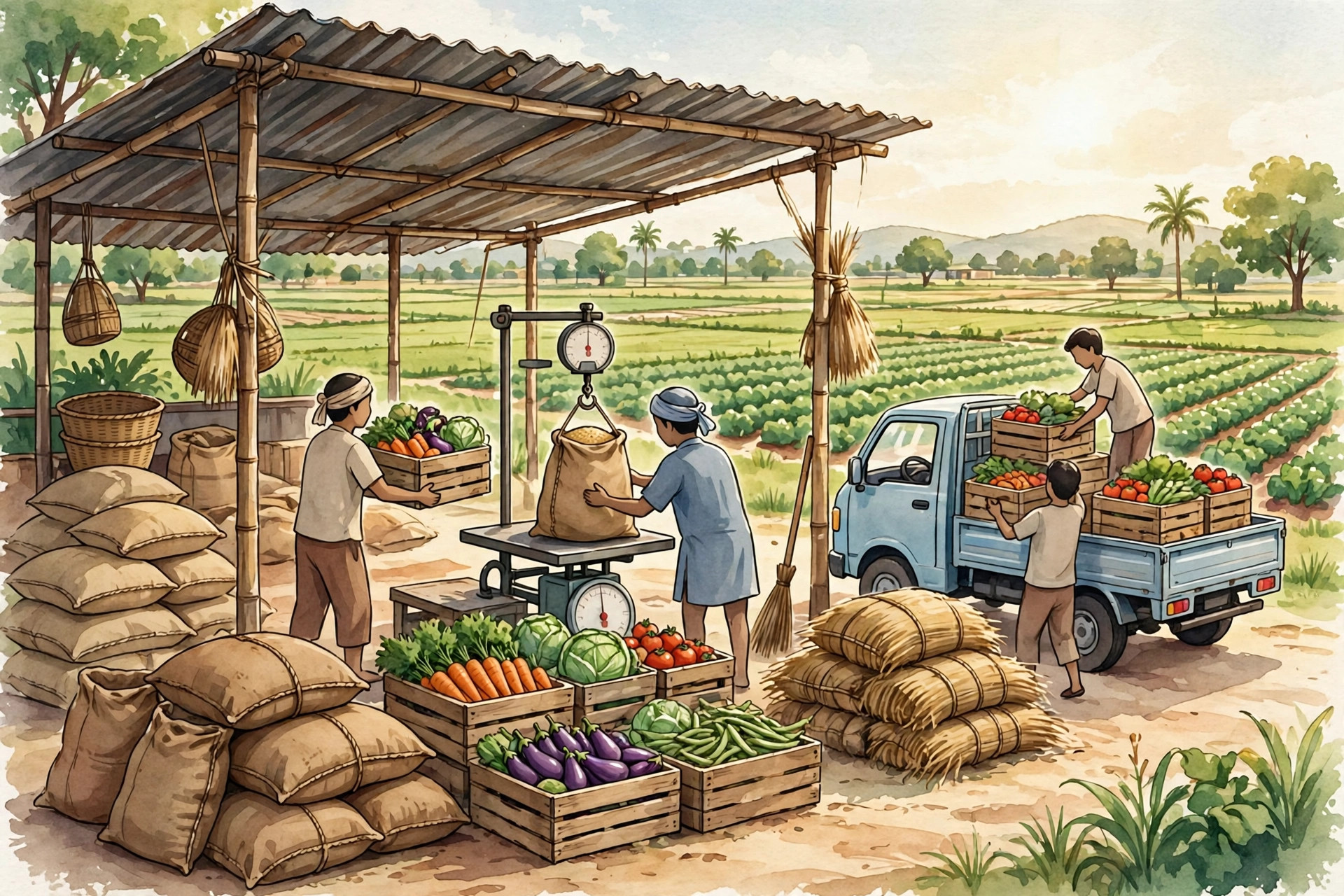
The scale is what makes the difference. A hundred farmers each producing a small quantity together offer a buyer a truckload, not a sack. That truckload can go to a processor, a retailer, a mandi auction or an institutional buyer that would never deal with individual smallholders. The FPO can also afford things a single farmer cannot: a weighing scale that is trusted by both sides, a small godown, a grading table, or a staff member who tracks prices and buyers full-time. Ownership matters here. When farmers own the organisation, they have a reason to supply it honestly and a right to question how it is run.
How an FPO Earns Its Members a Better Price
The price advantage of an FPO comes from several small gains that add up. First, aggregation: selling a large, uniform lot attracts buyers who pay more for reliability and volume. Second, grading: produce sorted by size and quality earns a premium over mixed, ungraded lots, because the buyer knows what he is getting. Third, timing: with storage, an FPO can hold produce for a short period when the market is flooded at harvest and sell when supply tightens, rather than forcing every member to sell on the same day at the lowest price. Fourth, direct marketing: by cutting out one or two layers of intermediaries, more of the final price stays with the producers.
Input supply is the other half of the gain. An FPO that buys seed, fertiliser and plant protection chemicals in bulk for hundreds of members negotiates wholesale rates and genuine quality, reducing both cost and the risk of spurious inputs. Some FPOs also arrange services: custom hiring of machinery, soil testing camps, or transport that collects produce from the village itself, saving each member a trip to the mandi. None of these gains is dramatic on its own. Together, they can shift a small farm's margins noticeably, especially for vegetables and other produce where grading and timing matter most.
How a Farmer Joins, and How an FPO Is Formed
Joining an existing FPO is usually straightforward. A farmer in the FPO's area becomes a member by buying a share, providing basic details such as landholding and crops grown, and agreeing to the organisation's rules, which typically include selling a part of the produce through the FPO and following agreed quality practices. Membership is voluntary, and a farmer who joins should understand what the FPO expects: regular supply, honest grading, and participation in meetings where decisions are made.
Forming a new FPO is a bigger task and usually begins with a group of farmers in nearby villages who already trust each other and grow similar crops. The group registers as a legal entity, opens a bank account, elects a board and appoints a chief executive or manager to run daily operations. Early support often comes from government schemes or promoting agencies that help with registration, training and initial working capital. The hardest part is rarely the paperwork. It is building the discipline of collective selling: members must resist the temptation to sell individually to a trader offering a slightly higher spot price on one day, because the FPO's bargaining power depends on assured volumes over the whole season.
The Difficulties Honest FPOs Face
Not every FPO succeeds, and the reasons are worth understanding before joining or forming one. The first is management. An FPO is a business, and it needs someone who can keep accounts, negotiate with buyers, manage stock and handle payments on time. A board of farmers without business experience, or a manager without accountability, can lose money quickly. The second is working capital. Buying inputs in bulk and holding produce for better prices both need money upfront, and an FPO that cannot pay members promptly will lose their trust and their produce.
The third difficulty is quality discipline. A single member mixing poor produce into a graded lot can spoil the FPO's reputation with a buyer and cost everyone the premium. Successful FPOs therefore invest in simple, transparent grading at the collection point, where every member can see how the grade is decided. The fourth is governance. When a few influential members dominate decisions, or accounts are not shared openly, ordinary members stop participating and the organisation hollows out. A healthy FPO holds regular meetings, shares its accounts in plain language, and rotates responsibilities so that knowledge does not sit with one person alone.
Questions to Ask Before Joining an FPO
A farmer considering membership should ask a few practical questions. What produce does the FPO handle, and does it match what I grow? How and when will I be paid after I deliver produce, and what deductions apply? What input services does it offer, and are the prices genuinely lower than the local shop? Who runs the FPO day to day, and can I see its accounts? How are grades decided at the collection point, and can I watch the weighing? What happens if the market falls after I deliver? There is no shame in asking these questions; a well-run FPO welcomes them, because informed members are the ones who stay. A farmer should also check whether the FPO is active in the current season, not just registered on paper, by talking to existing members about their experience in the last harvest.
Conclusion
Farmer producer organisations work on a plain insight: small farmers are weak sellers alone and strong sellers together. By aggregating produce, grading it, timing sales and buying inputs in bulk, an FPO can return value that no individual member could capture. But an FPO is a business, not a promise. Its success depends on honest grading, prompt payment, competent management, open accounts and members who supply it consistently. For a small farmer, joining a well-run FPO is often one of the most practical steps towards better prices. The right approach is to join with eyes open, ask the hard questions first, and judge the organisation by its last season's payments, not by its launch-day speeches.