Farm Ponds and Rainwater Harvesting Explained: Storing Rain to Protect Crops in Dry Spells
Key Takeaways
- A pond moves water from the wettest days to the driest ones, when it is worth most.
- The best site is a natural low point where runoff already collects.
- A silt trap and grassed bund protect the pond from filling with mud.
- Reserve pond water for critical crop stages, not for early full irrigation.
- Maintain the pond yearly, or it silts up within a few seasons.
Farm Ponds and Rainwater Harvesting Explained: Storing Rain to Protect Crops in Dry Spells
Most Indian farms receive their year's water in a few dozen rainy days and then face months of dry weather. A farm pond is a simple answer to that mismatch: a dug-out structure that catches rainwater and runoff, stores it, and makes it available when the crop needs it most. It is not a dam and not a borewell. It is a shallow reservoir on or near the farm, built with local labour and earth, that turns a passing downpour into a life-saving irrigation at the driest moment of the season. For rainfed farmers especially, a pond can be the difference between a crop that survives a dry spell and one that fails.
Why Store Rain on the Farm
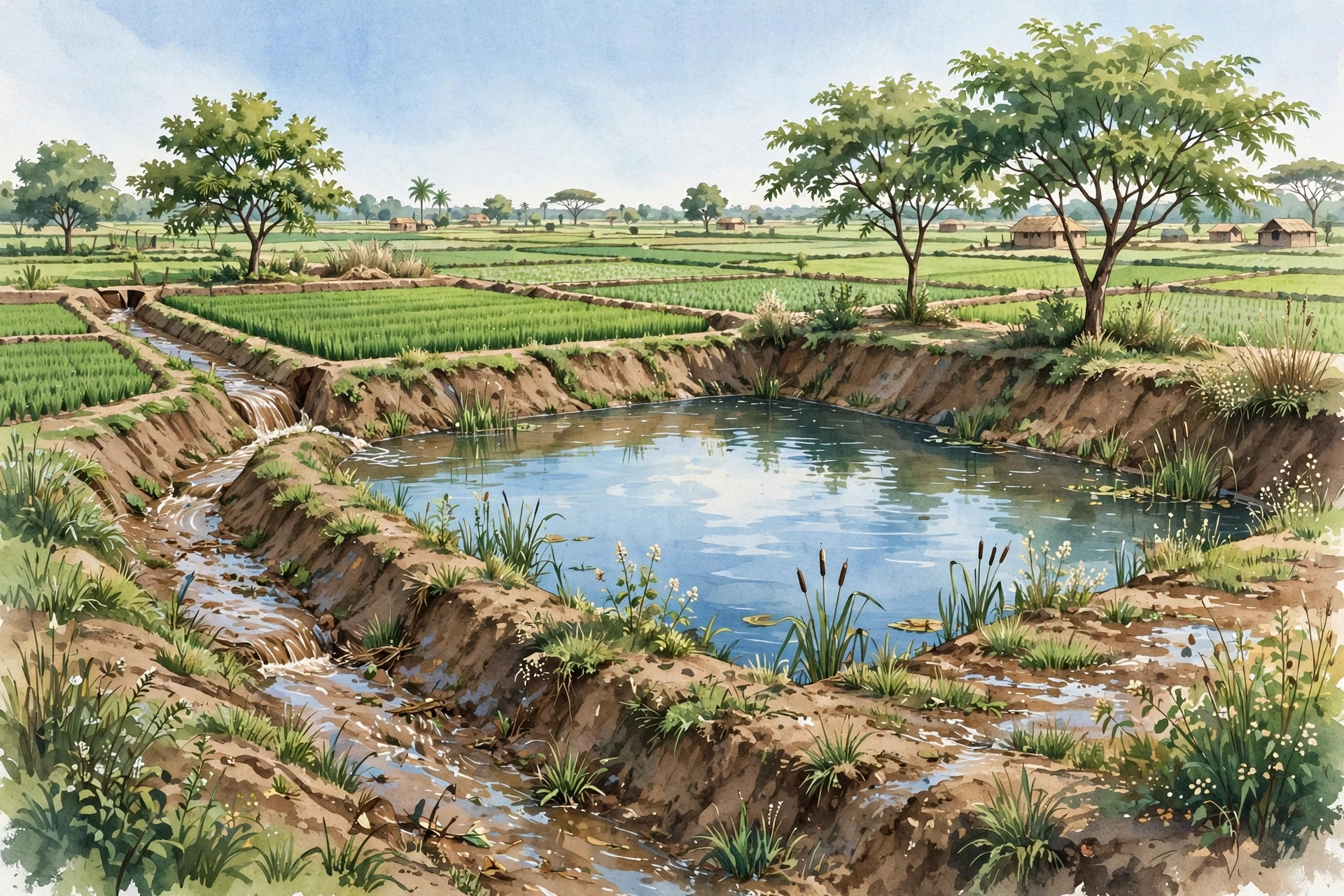
Rain that falls on a farm mostly does one of three things: it soaks into the soil, it runs off the surface, or it evaporates. In a heavy shower, the soil can only absorb so much at once, and the rest flows away down slopes, paths and field bunds. A pond placed at a low point of the farm intercepts some of that runoff before it leaves. The stored water is then available for a critical irrigation, for example at flowering or grain filling, when even one watering can protect a large part of the yield. It can also water a nursery, support a vegetable patch, or provide drinking water for livestock during a dry month.
There is a second benefit that is easy to overlook. A pond that holds water also slows runoff, which reduces soil erosion on slopes and gives water more time to seep into the ground nearby, recharging shallow groundwater. Over seasons, a farm with a pond often shows better moisture in the surrounding soil than a similar farm without one. The pond does not create water; it changes the timing of water, moving it from the wettest days to the driest ones, which is exactly when it is worth most.
Choosing the Site and Size
Site selection decides whether a pond works or becomes a muddy hole that never fills. The best site is a natural low point where runoff already collects, close to the fields that will use the water, and on soil that holds water reasonably well. Very sandy soil leaks, and very rocky ground is expensive to dig. A farmer should watch where water flows during a heavy rain before deciding; the path of the runoff is the best survey available, and it costs nothing. The pond should also be sited so that its overflow has a safe path out, because a pond that overtops its bund during a storm can wash the bund away and flood the field below.
Size depends on the catchment area feeding the pond, the soil, and what the water is for. A pond meant for one life-saving irrigation of a small plot can be modest; a pond meant to support a vegetable patch through a dry season needs to be larger. The shape matters too: a roughly square or rectangular pond with gently sloping sides is easier to dig, safer for people and animals, and loses less to evaporation than a very shallow, wide pan. Depth of a few metres is common, with the sides sloped so they do not collapse when the water level falls. Local knowledge matters here: a pond design that works on black cotton soil may need adjusting on red or sandy soil.
Building and Lining the Pond
Construction usually starts with marking the outline and digging, often with hired earth-moving machinery for a larger pond or by hand for a small one. The excavated earth is used to build a raised bund around the pond, which increases storage and keeps surface runoff from carrying silt straight in. A silt trap, a small shallow pit at the inlet where incoming water slows down and drops its sediment, protects the pond from filling up with mud over the years. Grass planted on the bund holds it together and stops it eroding in the first rains.
Whether to line the pond is a key decision. An unlined pond is cheaper and lets water seep into the ground, which helps recharge, but it may lose much of its stored water in sandy soil. Lining with a plastic sheet, clay or cement reduces seepage but costs more and needs care to avoid punctures. Many farmers start unlined, observe how long water stays through a dry spell, and line only if losses prove too high. The inlet and outlet deserve as much attention as the lining: a simple stone or concrete inlet stops the incoming stream from cutting a gully, and a controlled outlet lets the farmer release water gradually rather than losing it all at once.
Using Pond Water Wisely
Stored water is precious precisely because it is limited, so it should be used at the moment of greatest effect. The highest-value use is usually a life-saving irrigation at a critical crop stage, such as flowering or grain filling, when a short dry spell would otherwise cut yield sharply. The next best uses are a nursery, a small vegetable plot that earns regular income, or livestock water in a dry month. Using pond water for a full irrigation of a large area early in the season often empties the pond before the dry spell it was built for arrives.
How the water is lifted matters as well. A small pump, a gravity channel where the slope allows, or even a simple hose can deliver pond water to nearby fields. Where the pond sits lower than the fields, a pump is needed, and the farmer should weigh the pumping cost against the value of the irrigation it protects.
Common Problems and How to Avoid Them
The commonest failure is a pond that never fills because its catchment is too small or the inlet is poorly placed. Watching runoff paths before digging prevents this. The second is a pond that fills and then leaks away within weeks because the soil is too sandy and no lining was used; a simple test pit filled with water for a few days before full construction reveals this cheaply. The third is siltation: without a silt trap and a grassed bund, a pond can lose a large part of its depth in a few rainy seasons. The fourth is safety. A pond is a hazard for small children and stray animals, so a fenced or clearly marked bund, a gentle slope and a warning to children in the household are sensible precautions, not extras.
Conclusion
A farm pond is one of the oldest and most practical forms of rainwater harvesting: catch the rain where it falls, hold it through the dry weeks, and spend it at the moment it saves the most yield. Success depends less on size than on site, on a safe overflow, on a silt trap, and on the discipline to reserve the water for critical stages rather than spending it early. It will not replace irrigation where a farm has none, and it will not make a drought disappear. But for a rainfed farmer, a well-sited pond turns the season's heaviest rains into insurance for its driest days, and that insurance is often what carries a crop through to harvest.