Home > Economy > Container Manufacturing Promotion Scheme Explained: Rs 10,000 Crore, 7.5 Lakh TEUs and What It Means for India
Container Manufacturing Promotion Scheme Explained: Rs 10,000 Crore, 7.5 Lakh TEUs and What It Means for India
By IndiaAsk Editorial Team · 2026-10-28 · 10 min read · Economy
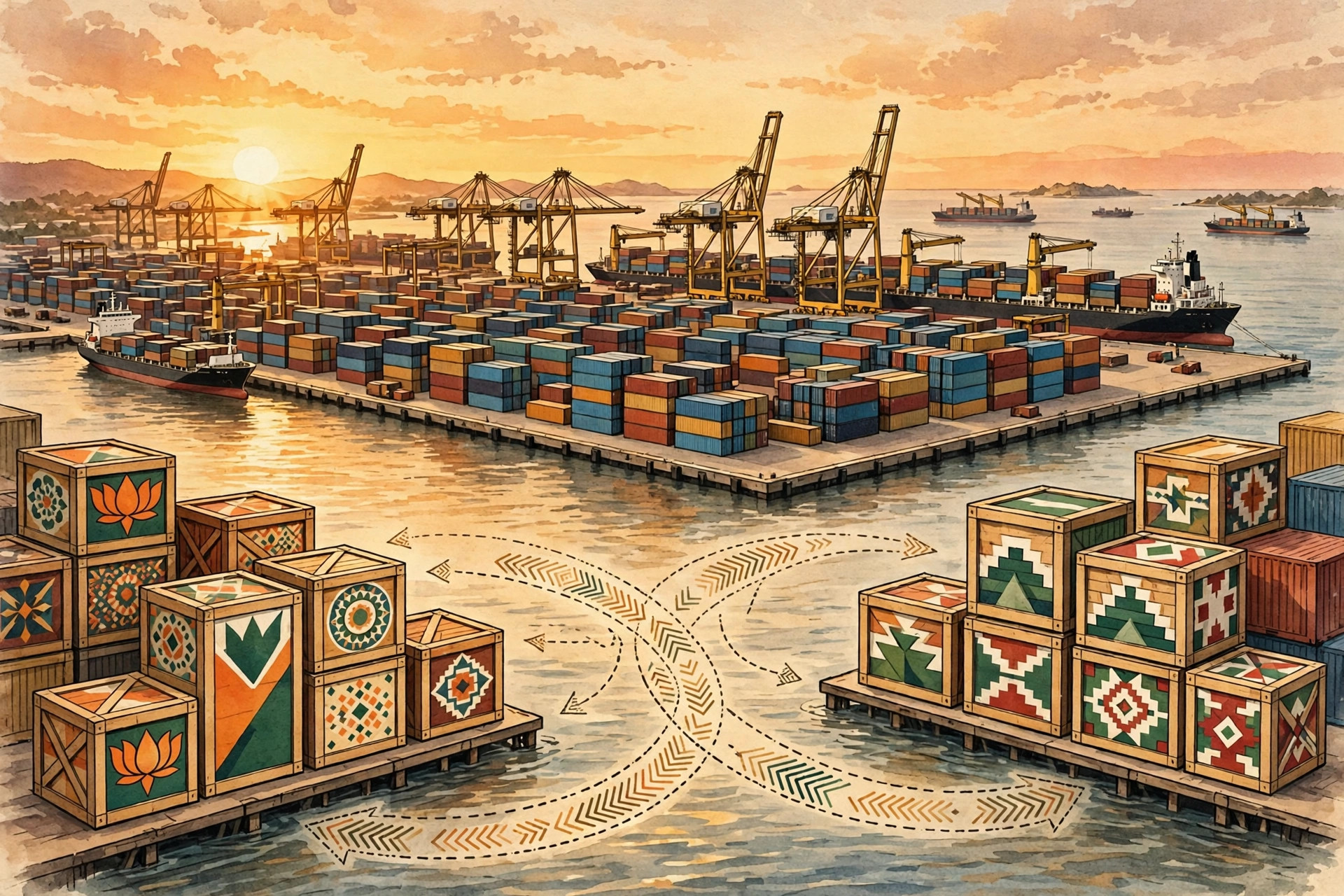
Original editorial illustration: colourful stacked shipping containers at a busy seaport at sunset, with a cargo ship, cranes and container frames in a factory yard.
Key Takeaways
The Union Cabinet approved the Container Manufacturing Promotion Scheme on 28 October 2026, with a Rs 10,000 crore outlay up to FY 2039-40.
The scheme aims to raise India's annual container manufacturing capacity nearly tenfold, from about 75,000 TEUs to 7.5 lakh TEUs.
Operational expenditure assistance of Rs 8,891 crore is the largest component, with Rs 859 crore for a 3% interest subsidy and Rs 150 crore for testing and certification.
The government estimates around 3,000 direct jobs and more than 50,000 indirect jobs, including in steel, corner castings, wooden frames and paints.
Cabinet approval turns the Union Budget 2026-27 announcement into an implementable programme; eligibility rules, plant investment and shipping-line orders will decide whether it succeeds.
What happened
On 28 October 2026, the Union Cabinet, chaired by Prime Minister Narendra Modi, approved the Container Manufacturing Promotion Scheme (CMPS) with a budgetary outlay of Rs 10,000 crore up to financial year 2039-40. Information and Broadcasting Minister Ashwini Vaishnaw announced the decision after the Cabinet meeting. Reuters reported the approval the same day, and the government statement described the scheme as a step towards building a globally competitive container manufacturing ecosystem in India, reducing import dependence and strengthening supply-chain resilience.
The scheme will support both new manufacturing facilities and the expansion of existing container manufacturing units. It is not a one-year subsidy or a single factory project. It is a long-horizon industrial programme, running for well over a decade, whose success will be judged by whether Indian factories can produce containers at competitive prices, in large numbers, and to the standards that global shipping lines accept.
The Cabinet cleared the container scheme alongside a Rs 1,856 crore scheme to promote sports goods manufacturing. Both were follow-ups to announcements in the Union Budget 2026-27, and both point in the same direction: building domestic manufacturing capacity in sectors where India has so far depended heavily on imports.
Why containers matter so much
A shipping container looks simple — a steel box with standard dimensions — but it is one of the most important pieces of equipment in world trade. Almost everything India exports and imports by sea travels in containers: textiles, engineering goods, pharmaceuticals, electronics, food products and much more. Without enough containers of the right type, in the right place, at the right time, exporters face delays, higher freight costs and cancelled bookings.
India's problem is that it makes very few of the containers it uses. Reports on the Cabinet decision note that India currently manufactures only a negligible share of the containers needed for its export trade, with the bulk sourced from abroad, principally China. Announcing the decision, Vaishnaw pointed to an even sharper concentration: about 95 per cent of global container production is concentrated in a single country. That leaves buyers everywhere exposed when supply chains are disrupted, shipping routes change, or one country's factories slow down.
The timing of the approval underlines the point. The government's statement and the Reuters report both link the decision to conflicts around the world that have disrupted maritime trade, forced ships onto longer detours and squeezed container availability. When routes lengthen, ships spend more days at sea, containers take longer to return, and shortages appear quickly. A country that cannot make its own containers has little control over that bottleneck. The CMPS is, in that sense, as much a supply-chain security measure as an industrial policy.
How the Rs 10,000 crore will be spent
The scheme has four components, according to the government statement and detailed reporting of it. The largest by far is operational expenditure assistance, worth Rs 8,891 crore. This is support for eligible manufacturers linked to the containers they actually make and sell to global standards — in other words, help that rewards production rather than promises. Its purpose is to bridge the cost-competitiveness gap: Indian producers starting out cannot yet match the scale and costs of established global manufacturers, and this assistance is meant to close part of that gap while they build volume.
The second component is interest subvention assistance of Rs 859 crore, offering a 3 per cent per annum interest subsidy on eligible term loans for new facilities and for expanding existing capacity. Building a container plant needs heavy investment in land, machinery, steel-handling equipment and testing facilities, and cheaper credit lowers the hurdle for firms willing to invest.
The third component is testing and certification assistance of Rs 150 crore, for common testing infrastructure. This matters more than it may sound. A container is not just a box; it must pass strength, stacking, weather and safety tests before a shipping line will use it. Shared facilities, including dynamic longitudinal impact testing, let manufacturers prove their products meet international standards without each firm building every testing facility on its own.
The fourth component is land leasing support, with reports of the approval noting concessional leases on land at major ports. Locating factories near ports cuts the cost and time of moving finished containers to ships, which is a practical advantage for a bulky, heavy product that is expensive to transport empty over long distances.
Taken together, the design is deliberately weighted towards operating support rather than one-time capital grants. Almost 89 per cent of the three quantified components goes to operational expenditure assistance. The message to manufacturers is that the government will help most while they are producing and selling, not merely while they are building a plant.
The capacity and jobs targets
The headline target is ambitious. The government aims to raise India's annual domestic container manufacturing capacity nearly tenfold, to 7.5 lakh twenty-foot equivalent units (TEUs) a year, from about 75,000 TEUs today. A TEU is the standard measure of container capacity, equal to one 20-foot container, so the target describes a very large expansion in physical output.
The government estimates the scheme will generate around 3,000 direct jobs and more than 50,000 indirect jobs. Those figures are projections, not jobs already created, and they depend on factories actually being built, orders being won and production ramping up. The indirect jobs would come through ancillary industries that supply container makers: specialised steel, corner castings, wooden frames and industrial paints, among others. If the ecosystem grows as planned, the employment effect would spread well beyond the factory floor, into steel, components, logistics and port services.
It is important to keep the scale in perspective. A capacity target is not the same as production achieved, and the scheme's own timeline stretches to 2039-40. Reports of the approval also note that supported facilities are expected to be commissioned within three years of approval in principle, and that minimum local content requirements will rise over time — 70 per cent through financial year 2031-32 and 90 per cent from 2032-33, according to detailed reporting. Those conditions are designed to ensure the scheme builds a genuinely domestic supply chain, rather than one that merely assembles imported parts.
Background: from Budget announcement to Cabinet approval
The container scheme was first announced in the Union Budget 2026-27. Cabinet approval on 28 October 2026 is the formal step that turns that announcement into an implementable programme, with money allocated, components defined and guidelines to follow. That sequence — Budget announcement, then Cabinet clearance months later — is normal for a scheme of this size, because the details of eligibility, subsidy rates and testing standards need to be worked out before money can be released.
There are already early signs that Indian-made containers can meet international requirements. Reporting on the sector notes that the first Indian-made container for international trade was rolled out for the shipping line Maersk in July 2026, at Dadri in Uttar Pradesh, with a further order of 1,000 Indian-made containers reported. That is a small beginning against the scale of India's trade, but it shows the gap is one of scale and cost, not of basic capability.
The broader policy context is the push for self-reliance in manufacturing — Atmanirbhar Bharat — and the longer-term Viksit Bharat 2047 vision, both cited in coverage of the Cabinet decisions. Container manufacturing fits that agenda neatly: it is a strategic input for exports, it supports the logistics sector, and it reduces a specific import dependence that recent supply-chain shocks exposed.
What it means for exporters, ports and workers
For exporters, the most direct benefit, if the scheme works, would be better availability of containers and less vulnerability to global shortages and price spikes. Exporters in sectors such as textiles, engineering and food processing are often the first to feel a container squeeze, because they cannot ship on schedule when boxes are scarce. A larger domestic manufacturing base would not remove global freight cycles, but it would give India an additional source of supply closer to its own ports.
For ports and logistics firms, more domestic production could mean steadier container availability at Indian ports and more business for port-side services. Factories located near ports, supported by land leasing concessions, would shorten the journey from factory to ship and could help ports plan capacity with greater confidence.
For workers and supplier industries, the opportunity lies in new factory jobs and in demand for steel, castings, timber products and paints. However, container manufacturing is capital-intensive and increasingly automated, which is why the direct jobs estimate — about 3,000 — is modest compared with the indirect figure of over 50,000. The larger prize is the supplier ecosystem and the skills it builds in steel fabrication, quality testing and industrial production.
For consumers, the effect would be indirect and gradual. Cheaper, more reliable logistics can, over time, lower the cost of traded goods, but no one should expect the scheme to change prices in shops next month. Its horizon is measured in years, not weeks.
What to watch next
Cabinet approval is the starting gun, not the finish line. The next steps that will decide whether the CMPS succeeds are practical and detailed. First, the government will need to publish eligibility criteria: which manufacturers qualify, what minimum plant sizes apply, and how operational assistance is calculated per container. Second, manufacturers will need to commit investment and commission plants within the expected timeframe. Third, shared testing and certification facilities must be set up so that Indian containers can be certified to global standards quickly and credibly.
Industry watchers will also be looking at the price gap. The central question is whether the combination of interest subsidy, operating assistance and port land concessions is enough to make Indian containers competitive with imports once support tapers off. If Indian producers can win repeat orders from global shipping lines, the scheme will have created a self-sustaining industry. If they cannot, the capacity target may be reached on paper without a lasting export business.
Finally, the local content trajectory matters. Moving from 70 per cent to 90 per cent local content by 2032-33 would mean Indian suppliers of steel, castings and components must scale up alongside the container plants themselves. That is the difference between an assembly operation and a full manufacturing ecosystem, and it is the part of the scheme that will take the longest to build.
Conclusion
The Container Manufacturing Promotion Scheme is a Rs 10,000 crore bet that India can build, at scale, a product it has long imported: the humble shipping container. Its design — heavy on operating support, backed by cheaper credit, shared testing and port land — is aimed squarely at the cost gap that has held Indian producers back. Its targets — 7.5 lakh TEUs a year, 3,000 direct jobs and over 50,000 indirect jobs — are ambitious, and they are projections to be earned over the coming decade, not achievements already banked.
For a country whose exports depend on containers it does not make, the strategic logic is clear. Whether the scheme delivers will depend on factory investment, certification, orders from shipping lines and the growth of a domestic supplier base. The Cabinet decision on 28 October 2026 opens that long test; the results will be visible, factory by factory and order by order, in the years to 2039-40.
Frequently Asked Questions (FAQ)
What is the Container Manufacturing Promotion Scheme (CMPS)?
It is a Union Cabinet-approved scheme, cleared on 28 October 2026, with a Rs 10,000 crore outlay up to FY 2039-40. It aims to build a globally competitive container manufacturing ecosystem in India, reduce import dependence and strengthen supply-chain resilience, by supporting new factories and the expansion of existing units.
How much container capacity does India aim to build under the scheme?
The government aims to raise annual domestic container manufacturing capacity nearly tenfold, from about 75,000 TEUs today to 7.5 lakh twenty-foot equivalent units (TEUs) a year.
How is the Rs 10,000 crore divided?
The largest quantified component is operational expenditure assistance of Rs 8,891 crore, followed by interest subvention assistance of Rs 859 crore offering a 3 per cent annual interest subsidy on eligible term loans, and testing and certification assistance of Rs 150 crore. The scheme also includes land leasing support, including concessional land at major ports.
How many jobs is the scheme expected to create?
The government estimates around 3,000 direct jobs and more than 50,000 indirect jobs, including in ancillary industries such as specialised steel, corner castings, wooden frames and paints. These are projections, not jobs already created.