Home > General Knowledge > Viksit Bharat Buildathon 2025 Winners: Who Won, What Did They Build, and Why Did It Enter the Guinness World Records?
Viksit Bharat Buildathon 2025 Winners: Who Won, What Did They Build, and Why Did It Enter the Guinness World Records?
By IndiaAsk Editorial Team · 2026-10-30 · 7 min read · General Knowledge
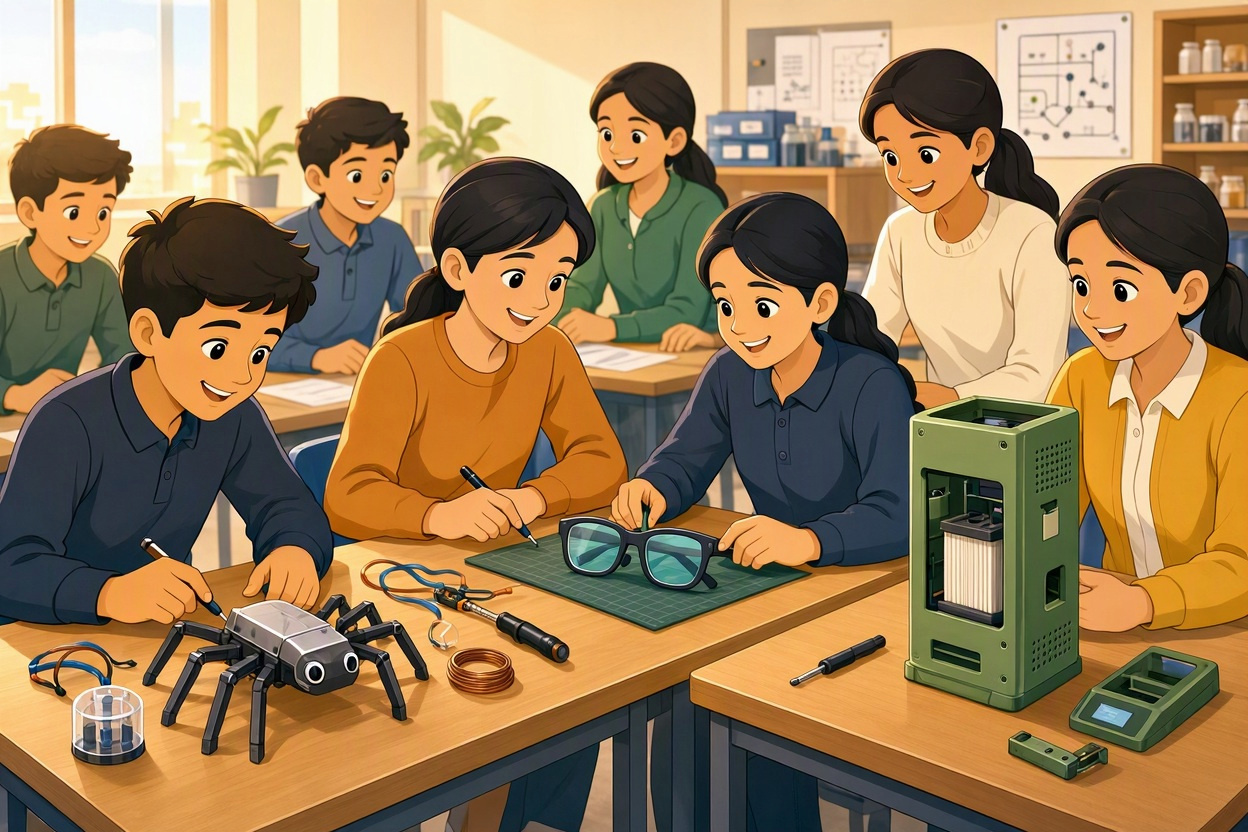
Original editorial illustration: school students in a workshop building science projects, including a small spider-shaped robot and an air-purification model, with no text, logos or recognisable person.
Key Takeaways
Viksit Bharat Buildathon winners: 10 national teams were felicitated in New Delhi on 28 October 2026 by Union Minister of State for Education Jayant Chaudhary.
Winning projects included Vadiffuse, a spider-shaped bomb-diffusing robot from Assam; EchoLens, affordable bone-conduction smart glasses from Uttar Pradesh; and the Urban Breathing Pole, an air-purification concept from Gujarat.
The Buildathon entered the Guinness World Records as the 'Largest Innovation Solution Competition' with 2,87,967 submissions across its Idea and Prototype tracks.
National prize money totalled Rs 17.5 lakh: Rs 2.5 lakh each for the five Prototype Track winners and Rs 1 lakh each for the five Idea Track winners, within a total award pool of over Rs 1 crore.
Organised by the Department of School Education and Literacy with NITI Aayog's Atal Innovation Mission and AICTE, the competition was open to Classes 6 to 12 and judged through district, state and national tiers.
What happened
The Viksit Bharat Buildathon winners were felicitated in New Delhi on 28 October 2026, when Union Minister of State for Education Jayant Chaudhary honoured the 10 national winning teams of the Viksit Bharat Buildathon 2025. The winning projects came from school students across the country and ranged from a spider-shaped bomb-diffusing robot to affordable bone-conduction smart glasses and an urban air-purification system. At the same function, the Guinness World Records certification for the Buildathon as the "Largest Innovation Solution Competition" was also presented, marking a milestone for school-level innovation in India.
The competition was organised by the Department of School Education and Literacy (DoSEL) under the Union Ministry of Education, in collaboration with NITI Aayog's Atal Innovation Mission (AIM) and the All India Council for Technical Education (AICTE). It was launched in September 2025 for school students of Classes 6 to 12, with the aim of getting young students to identify real-world problems around them and build practical solutions, rather than only learning about science and technology from textbooks.
Viksit Bharat Buildathon winners: who won and what did they build?
The 10 national winning teams came from Assam, Delhi, Gujarat, Jharkhand, Jammu and Kashmir, Kerala, Madhya Pradesh, Odisha, Tamil Nadu and Uttar Pradesh. Three of the best-known winning projects show how varied the entries were.
The team from PM SHRI Kendriya Vidyalaya in Tinsukia, Assam, won for Vadiffuse, a spider-shaped robot designed to diffuse bombs. The idea behind a spider-shaped design is movement over uneven ground: a robot that can walk rather than roll can, in principle, reach places a wheeled machine cannot. The project is a student prototype, not a device in service with security forces, but it shows the kind of high-stakes, real-world problem students chose to tackle.
Students from Step by Step School in Rohillapur, Gautam Buddh Nagar, Uttar Pradesh, were recognised for EchoLens, affordable bone-conduction smart glasses. Bone-conduction technology sends sound through the bones of the skull rather than through the ear canal, leaving the ears open to surrounding sound. Making such glasses affordable is the key idea: assistive technology often exists, but at prices that put it out of reach for many families.
The project from PM SHRI Kendriya Vidyalaya No. 1 in Surat, Gujarat, was the Urban Breathing Pole, an air-purification concept designed for urban environments. Indian cities face serious air pollution for much of the year, and the concept imagines purification built into street-level urban infrastructure rather than only inside homes.
Other national winners included Team Quantumquesters from Pathippaga Chemmal K Ganapathy Government Higher Secondary School in Chennai, Tamil Nadu, for an "Instant Thermo Flask", and a team from Modern Public School, Shalimar Bagh, Delhi, for an innovation in renewable energy. The full set of 10 national winners covers both working prototypes and early-stage ideas, which is why the competition ran two separate tracks.
Why the Guinness World Record matters
The Buildathon entered the Guinness World Records as the "Largest Innovation Solution Competition" with 2,87,967 project submissions across its Idea and Prototype tracks. That number is the headline figure, and it is worth understanding what it does and does not mean.
It means nearly 2.9 lakh submissions were received from school students across the country, which is an unusually large response for a school innovation programme. It does not mean nearly 2.9 lakh finished products were built: the Idea Track recognised concepts proposed to solve practical problems, while the Prototype Track assessed functional working models. The record is about the scale of participation, certified by Guinness World Records, and it was presented at the felicitation function itself.
The scale also reflects the structure behind the competition. Solutions were evaluated through a three-tier assessment framework at the district, state and national levels, led by multidisciplinary expert panels. From that funnel, 10 national awardees, 100 state awardees and 1,000 district awardees were selected. A competition that can filter almost 2.9 lakh entries down to a credible national top 10 needs that kind of tiered system; without it, judging at this scale would not be workable.
The four pillars behind the competition
The Buildathon was centred around four foundational pillars: Atmanirbhar Bharat (self-reliant India), Swadeshi (indigenous products and solutions), Vocal for Local (promoting local products and talent), and Samriddh Bharat (a prosperous India). Those themes shaped what students built. The winning projects are not abstract science experiments; they are attempts to solve Indian problems with locally workable solutions, from affordable assistive devices to cleaner city air and renewable energy.
This framing also connects the competition to a wider policy push: getting school students to think like problem-solvers and entrepreneurs early, rather than only as exam-takers. The involvement of AIM, which runs school-level Atal Tinkering Labs, and AICTE, which oversees technical education, points in the same direction — the Buildathon is meant to feed a pipeline from school curiosity to technical skill.
How much prize money did the winners get?
The 10 national winning teams were awarded a total cash prize of Rs 17.5 lakh. Under the Prototype Track, each of the five top winning teams was awarded Rs 2.5 lakh, recognising their functional working models. Each of the five winning teams under the Idea Track received Rs 1 lakh, to encourage the incubation and scaling of their creative concepts.
The award pool across district, state and national levels exceeded Rs 1 crore in total. The national prize money is modest by startup standards, and it is best understood as seed encouragement rather than funding: Rs 2.5 lakh can help a student team refine a prototype, and Rs 1 lakh can help an idea team build a first working version. The larger prize is arguably the recognition itself, which helps student teams attract mentors, school support and, later, incubation.
At the same function, the minister also launched ULLAS guidelines, a separate adult-literacy-related initiative. The Buildathon felicitation and the ULLAS launch were part of the same event, but they are different programmes, and the Buildathon's own story stands on the student winners and the record.
What this means for students and schools
For students, the Buildathon's message is practical: a good idea from a classroom can reach a national stage. The winners came from Kendriya Vidyalayas, a government higher secondary school in Chennai, a private school in Delhi and a school in Gautam Buddh Nagar — a mix that suggests the competition reached beyond a few elite city schools.
For schools, the lesson is about what to encourage. The winning entries were not the most complicated technology for its own sake; they were solutions tied to a visible problem — safety, accessibility, pollution, energy, everyday convenience. Teachers and mentors who want to prepare students for the next edition of such competitions would do better to start from a problem students can observe in their own surroundings than from a gadget looking for a use.
For parents, there is a simpler takeaway: innovation competitions at school level are now a real, nationally recognised route. They carry certificates, prize money and, at the national level, public recognition by the Education Ministry. They do not replace board exams or regular study, but they are a credible addition to a student's record.
What happens next
The 2025 edition has concluded with the national felicitation, and the Idea Track winners now face the harder part: turning concepts into working models. Whether projects like the Urban Breathing Pole or EchoLens progress beyond prototypes will depend on mentorship, further funding and incubation support — things a school competition can start but cannot finish on its own.
The record itself sets a benchmark for the next edition. Any future Buildathon will be measured against 2,87,967 submissions, and organisers will need to show that scale can grow without the judging quality falling. For now, though, the story of this edition is complete: nearly 2.9 lakh entries, 10 national winners, and a Guinness World Record for the largest innovation solution competition.
Conclusion
The Viksit Bharat Buildathon 2025 winners — from a bomb-diffusing robot in Assam to smart glasses in Uttar Pradesh and an air-purification concept in Gujarat — show school innovation in India at its most practical. The competition's Guinness World Record reflects extraordinary participation, its tiered judging gives the winners credibility, and its Rs 17.5 lakh in national prizes gives the top teams a start. The real test now is whether these student ideas grow into products that matter outside the competition hall.
Frequently Asked Questions (FAQ)
Who won the Viksit Bharat Buildathon 2025?
The 10 national winning teams of the Viksit Bharat Buildathon 2025 were felicitated in New Delhi on 28 October 2026 by Union Minister of State for Education Jayant Chaudhary. They came from Assam, Delhi, Gujarat, Jharkhand, Jammu and Kashmir, Kerala, Madhya Pradesh, Odisha, Tamil Nadu and Uttar Pradesh, and their projects included a spider-shaped bomb-diffusing robot (Vadiffuse, from Assam), affordable bone-conduction smart glasses (EchoLens, from Uttar Pradesh) and an urban air-purification concept (Urban Breathing Pole, from Gujarat).
What is the Guinness World Record for the Viksit Bharat Buildathon?
The Viksit Bharat Buildathon 2025 entered the Guinness World Records as the 'Largest Innovation Solution Competition' with 2,87,967 project submissions across its Idea and Prototype tracks. The record reflects the scale of participation, certified by Guinness World Records and presented at the felicitation function — it does not mean 2,87,967 finished products were built, since the Idea Track recognised concepts while the Prototype Track assessed working models.
How much prize money did the Viksit Bharat Buildathon winners get?
The 10 national winning teams shared Rs 17.5 lakh in total. Each of the five Prototype Track winners received Rs 2.5 lakh for a functional working model, and each of the five Idea Track winners received Rs 1 lakh to develop their concept further. The total award pool across district, state and national levels exceeded Rs 1 crore.
Who organised the Viksit Bharat Buildathon and who could take part?
The competition was organised by the Department of School Education and Literacy under the Union Ministry of Education, in collaboration with NITI Aayog's Atal Innovation Mission and the All India Council for Technical Education. It was launched in September 2025 for students of Classes 6 to 12, centred on four pillars: Atmanirbhar Bharat, Swadeshi, Vocal for Local and Samriddh Bharat. Entries were judged through district, state and national tiers, producing 1,000 district awardees, 100 state awardees and 10 national awardees.