Spain High-Speed Train Collision Explained: 64 Killed Near Toledo, the Red Signal Question, and What Happens Next
Key Takeaways
- On 28 October 2026 a Renfe high-speed train struck a stationary Iryo train near Urda and Los Yebenes in Toledo province, about 130 km south of Madrid.
- At least 64 people were killed and more than 100 were injured, with 58 taken to hospital, 15 in critical condition, according to regional officials.
- The Iryo train had stopped on Adif's instructions because of a signal fault, and Transport Minister Oscar Puente said the Renfe train was authorised to proceed despite an active red signal.
- Puente called the control centre's decision to resume traffic before the signalling system was restored 'inexplicable'; the full cause is still under investigation.
- The crash is Spain's worst rail disaster since the 2013 Santiago de Compostela derailment, which killed 80 people, and it suspended Madrid-Andalusia high-speed services.
On the morning of 28 October 2026, two high-speed trains collided on the Madrid-Seville line in central Spain, killing at least 64 people and injuring many more. The crash happened near Urda and Los Yebenes, in Toledo province, about 130 kilometres south of Madrid, and it quickly became one of the deadliest rail disasters in Europe in recent years.
Spanish officials warned that the death toll could still rise as rescue teams searched through derailed carriages. The regional government of Castilla-La Mancha said more than 100 people were injured, with 58 taken to hospital, 15 of them in a critical condition. Those figures were provisional: in the first hours after a disaster of this scale, counts change as the injured are moved to hospitals and wreckage is cleared, and officials were careful to describe the toll as approximate rather than final.
What happened on the Madrid-Seville line
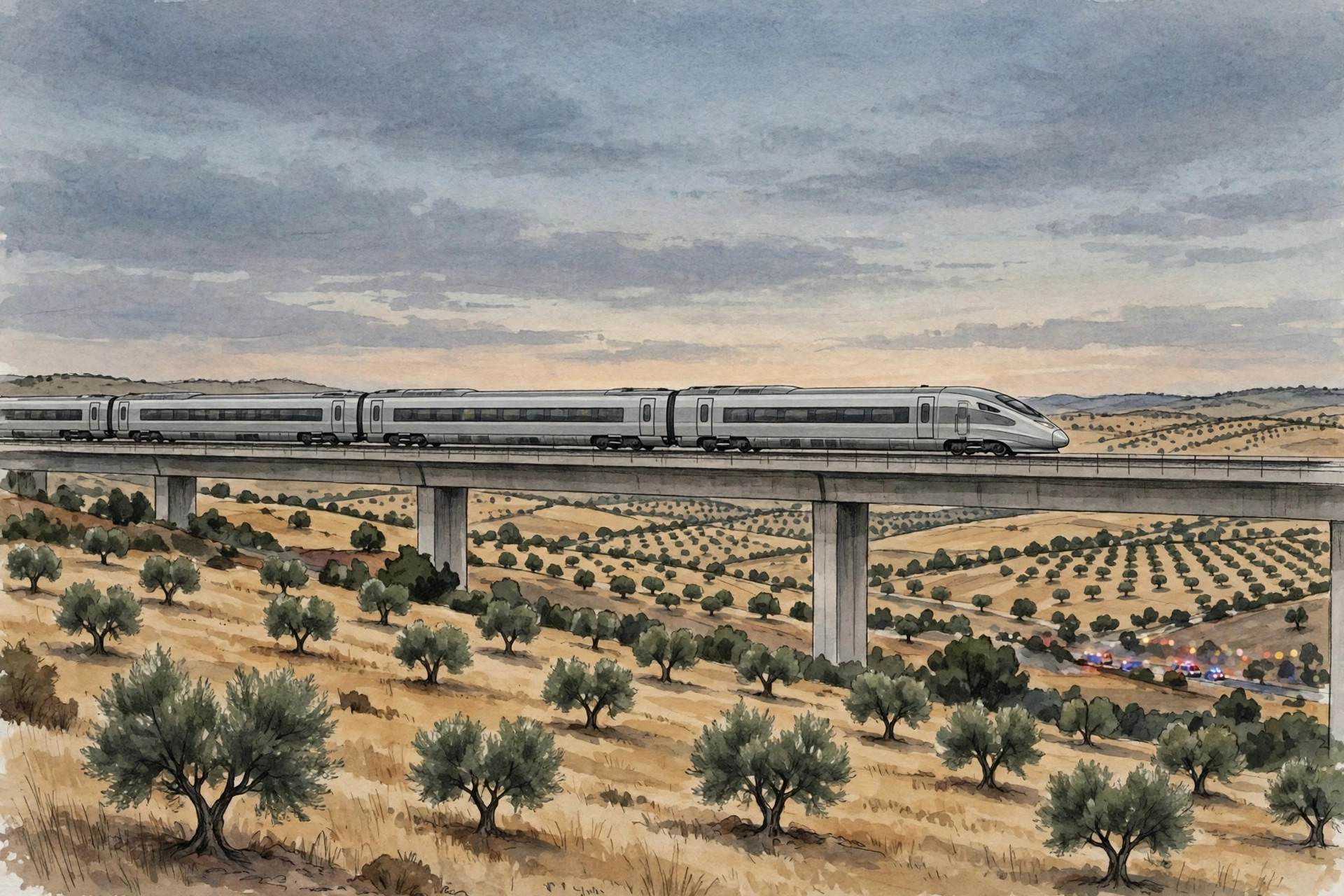
The two trains were travelling in the same direction, from Madrid towards Seville in southern Spain. One was operated by Renfe, Spain's state-owned railway company; the other was operated by Iryo, a private high-speed operator. According to regional officials and reports from the scene, the Iryo train had stopped on the track, and the Renfe train then struck it from behind.
The impact derailed several carriages from both trains. Some carriages came to rest on an embankment below the elevated line, tangled in broken metal and debris. Emergency services rushed to the rural site: helicopters hovered overhead, ambulances and funeral vans lined nearby roads, and forensic teams worked alongside firefighters and Spain's military emergency unit. Passengers who escaped walked along a road near the scene, some with bandaged injuries, while volunteers handed out water donated by neighbouring towns.
The Renfe train was carrying about 397 passengers and the Iryo train about 147, a combined total of roughly 544 people. That so many survived a high-speed rear-end collision is itself a reflection of how the trains' structures absorbed part of the impact, but for the passengers in the carriages nearest the point of collision, there was little protection.
High-speed services between Madrid and Andalusia, the southern region that includes Seville, were suspended after the crash, stranding travellers and forcing rail operators to reorganise services while the line was closed for rescue and investigation.
The red signal question at the centre of the investigation
The most consequential question raised within hours of the crash was not only what happened, but why a moving high-speed train was allowed to proceed towards a stationary train on the same track.
A person briefed on the disaster told Reuters that the Iryo train had stopped near Toledo on instructions from Adif, Spain's rail infrastructure manager, because of a signal fault. Spain's transport minister, Oscar Puente, then gave a more detailed and striking account: the Renfe train had been authorised to continue its journey despite an active red signal indicating that another train was stationary ahead. He said the red signal had been activated after a computer communications failure automatically halted rail traffic, and he described the control centre's decision to resume traffic before that system had been restored as "inexplicable".
That word matters. A red signal is the most basic safety instruction in railway operation: stop, because the section ahead is not clear. When signalling systems fail, railways fall back on procedures — stopping trains, checking the line, and only then authorising movement, usually slowly and with extra caution. The investigation will therefore have to establish, step by step, who authorised the Renfe train to move, what information the control centre had at that moment, whether the driver was told about the stationary train ahead, and whether any automatic protection system that should have stopped the train was working.
It is important to be clear about what is known and what is not. The minister's statement establishes that a clearance was given despite a red signal, and that a signalling or communications failure preceded the crash. It does not, on its own, establish who was at fault, whether the failure was technical, human, or a combination of both, or whether any individual broke a rule. Those are exactly the questions an official investigation — examining signalling logs, voice recordings from the control centre, the trains' data recorders, and the sequence of authorisations — is meant to answer. Until that work is complete, any claim about a single cause would be premature.
Reaction in Spain and the scale of the disaster
Prime Minister Pedro Sanchez said he was "shocked by the serious train accident" and that he remained in constant contact with the transport minister. The regional leader of Castilla-La Mancha, Emiliano Garcia-Page, visited the scene and raised the reported toll from an earlier figure of 31 to about 64, while warning that it would probably grow further as search teams worked through the wreckage.
The scale of the loss makes this Spain's worst rail disaster since 2013, when 80 people were killed after a train derailed near Santiago de Compostela in north-western Spain. It is also the second deadly railway accident in Spain in 2026, according to reports of the crash, a fact that will intensify public and political scrutiny of rail safety even though the two accidents may have very different causes.
For the families of the dead and injured, the immediate questions are practical and painful: identification of victims, hospital treatment, and support for relatives travelling to Toledo province. For the wider public, the questions are about trust: high-speed rail in Spain, as in other countries, carries millions of passengers a year precisely because it is regarded as safe, fast, and reliable. A disaster caused, even in part, by a signalling failure and a disputed clearance strikes at that trust in a way that a freak accident might not.
Why signalling failures are so dangerous on high-speed lines
High-speed trains travel at speeds where a driver cannot simply stop on sight. At 250 kilometres per hour or more, a train needs a very long distance to come to a halt, far longer than the distance a driver can see ahead. That is why high-speed railways do not rely on the driver's eyesight alone. They rely on signalling systems that divide the track into sections, keep trains separated, and tell each driver — through lineside signals and in-cab displays — whether the way ahead is clear, and at what speed to proceed.
When that system works, two trains cannot normally be authorised into the same section. When it fails, the fallback is human procedure: stop everything, find out what is happening, and move trains only under strict, slow, and closely supervised conditions. The danger zone is the transition — the moment when normal working is suspended, information is incomplete, and pressure builds to get trains moving again. Investigators in Spain will be looking closely at exactly that transition: what failed, what the control centre knew, what it decided, and whether the rules for degraded working were followed.
This is a lesson that applies well beyond Spain. Every country expanding high-speed or semi-high-speed rail, including India, faces the same trade-off between keeping trains running during a fault and stopping them until the fault is understood. The safest answer is usually the slower one, and the Spanish minister's own word — "inexplicable" — suggests that, in this case, the decision to resume traffic will be difficult to defend if the facts turn out as first reported.
What happens next
Three things will happen in parallel in the coming days and weeks. First, rescue and recovery will continue until every carriage has been searched and every victim accounted for, and the final casualty figures will be confirmed. Second, the railway investigation will reconstruct the sequence of events from technical records, a process that takes time and should not be rushed into a simple verdict. Third, Spain's government and rail operators will face decisions about the Madrid-Seville line itself: when it is safe to reopen, what interim safety measures are needed, and whether signalling procedures for degraded working need to change.
Passengers' confidence will depend less on reassurance than on transparency about those findings. If the investigation shows a clear failure — technical, procedural, or both — the public will expect it to be named and fixed. If it shows a more complicated chain of events, that complexity itself needs to be explained honestly, rather than reduced to a single headline.
For now, the confirmed facts are stark enough. On 28 October 2026, a stationary high-speed train and a moving high-speed train ended up on the same stretch of track near Toledo, and at least 64 people died. How that was allowed to happen is the question Spain must now answer — for the families of the victims, and for every passenger who boards a high-speed train expecting the system to keep them apart from the train ahead.
Conclusion
The Toledo crash is a tragedy first and a safety warning second. It reminds us that the most advanced rail networks are only as safe as the systems and decisions that govern them when something goes wrong. A signal fault should be an inconvenience, not a catastrophe — and the gap between those two outcomes is filled by procedures, discipline, and the willingness to keep trains stopped until it is genuinely safe to move them. Spain's investigation will determine whether that gap was respected on 28 October. Until then, the toll — at least 64 dead, scores injured, and a community in mourning — stands as the measure of what was lost.