Rabi Season Crop Planning: Wheat, Mustard and Gram Choices, Sowing Windows and Input Planning
Key Takeaways
- Start rabi planning with the field — previous crop, soil, drainage and levelling — before choosing a seed variety.
- Wheat suits assured irrigation, mustard suits lighter soils with less water, and gram suits rainfed patches with the least irrigation.
- Timely sowing, correct seed rate and sowing depth protect emergence and grain filling better than extra fertiliser later.
- Budget water, nutrients and plant protection together, and split nitrogen to match crop demand rather than applying it all at once.
- Check the day's mandi bhav on eNAM or the local mandi board before selling, since prices move with arrivals and stocks.
Rabi Season Crop Planning: Wheat, Mustard and Gram Choices, Sowing Windows and Input Planning
Rabi is the winter cropping season in India, and for millions of farming families it is the season that decides the year's income. Sown after the monsoon crop is harvested, rabi crops grow through the cool months and are harvested in spring. Wheat, mustard and gram (chana) dominate this season across the north and central plains, but a good rabi season is not decided by luck. It is decided weeks before sowing, in choices about variety, field preparation, water, seed rate and input budgeting. This guide explains how to plan those choices in a practical, step-by-step way, without promising a fixed yield or price. Local conditions — soil type, irrigation availability, previous crop and weather — always matter more than any general advice.
The first principle of rabi planning is timing. Rabi crops need cool weather during growth and a dry, warm period at harvest. Sow too late and the crop faces heat stress at grain filling; sow too early and it may face excess moisture or pest pressure. That is why sowing windows are treated as windows, not single dates. Farmers who plan backwards from the expected harvest period, the availability of labour and machinery, and the irrigation schedule usually manage the season better than those who sow whenever the field happens to be free.
Start With the Field, Not the Seed Packet
Before choosing a variety, look at what the field just grew and what it needs. A field that grew paddy will hold more moisture and may need extra time to dry and be levelled. A field that grew cotton or soybean may have different leftover nutrients and weed pressure. Soil testing, where available through a soil health card or a local lab, helps avoid blanket fertiliser use. Even without a lab report, a farmer can note simple things: does water stand in patches, is the soil sandy or heavy clay, and did the last crop show yellowing or stunting in particular spots?
Field preparation for rabi is about creating a fine, level seedbed that holds moisture but drains well. For wheat, a well-pulverised bed helps roots establish quickly. For mustard, which has a small seed, a finer bed and shallow sowing matter even more, because a seed buried too deep may fail to emerge. For gram, good drainage is critical, since waterlogging encourages root rot. Levelling also improves irrigation efficiency: on an uneven field, some parts get too much water and others too little, which shows up later as uneven growth.
Crop rotation is another field-level decision. Growing wheat on the same field year after year increases weed and disease pressure. Rotating wheat with mustard or gram, or with a pulse, breaks pest cycles and improves soil structure. Gram, being a legume, fixes atmospheric nitrogen through root nodules, which can benefit the following crop. Planning rotation across two or three seasons, not just one, is one of the cheapest ways to protect long-term productivity.
Choosing Between Wheat, Mustard and Gram
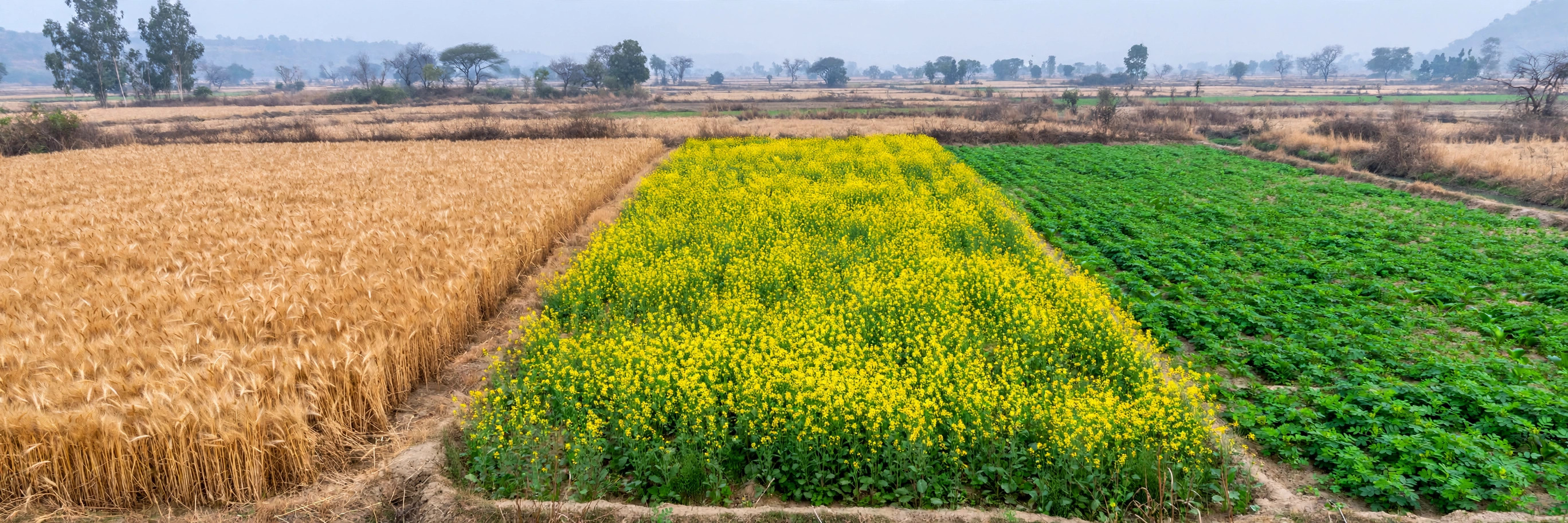
Wheat is the staple rabi cereal and usually the safest choice where irrigation is assured and the farmer wants a familiar market. It responds well to fertiliser and irrigation, but it also needs more water and more inputs than the other two. Within wheat, varieties differ in duration, rust resistance and grain quality. Short-duration varieties suit late-sown conditions, while longer-duration varieties suit timely sowing in well-irrigated areas. The local agricultural university or Krishi Vigyan Kendra recommendation for the district is a better guide than a variety that performed well in a different state.
Mustard is an oilseed crop that needs less water than wheat and fits well in areas with limited irrigation or lighter soils. It is also sensitive to frost and to aphid attack, so monitoring matters. Its oil market and its use as a rotation crop make it attractive, but its yield can swing more with weather at flowering. Farmers who grow mustard should plan for timely sowing, because late-sown mustard faces higher aphid pressure and heat at pod filling. Mustard also benefits from sulphur in many soils, a nutrient that is often overlooked when only nitrogen, phosphorus and potassium are applied.
Gram is a pulse crop that thrives on residual moisture and needs the least irrigation of the three. It suits rainfed and partially irrigated areas, and its protein-rich grain has steady household and market demand. Gram is, however, vulnerable to pod borer and to wilt in some soils. Seed treatment and choosing a wilt-tolerant variety for the area reduce that risk. Because gram needs less water, it can be a smart choice on fields where irrigation is uncertain, provided the farmer accepts that its yield ceiling is lower than irrigated wheat.
A practical approach for many small farms is not to put the whole farm into one crop. Splitting area — for example, wheat on the best-irrigated field, mustard on a lighter field, and gram on a rainfed patch — spreads weather, pest and market risk. That diversification is a form of insurance that costs nothing extra at sowing time.
Sowing Windows, Seed Rate and Spacing
Sowing windows vary by region, but the logic is the same everywhere. Timely sowing gives the crop the longest cool period for tillering and grain filling. For wheat in much of north India, the main window falls in the late autumn months, with late sowing extending into early winter for fields vacated late by paddy or cotton. Mustard is generally sown a little earlier than wheat, because it needs time to establish before cold sets in. Gram sowing often overlaps with mustard, depending on moisture availability.
Seed rate and spacing are often treated as minor details, but they shape the whole crop. Too high a seed rate creates crowded plants that compete for light and nutrients and invite disease. Too low a rate leaves gaps that weeds fill. Using certified or good-quality seed, treating it where recommended, and calibrating the seed drill or checking manual sowing depth saves more yield than an extra bag of fertiliser applied later. Shallow sowing for mustard, medium depth for wheat, and careful placement for gram are worth getting right on the first day, because emergence problems cannot be fully corrected later.
Farmers should also plan for the gap between sowing and first irrigation. The first irrigation, often called the crown root initiation stage for wheat, is critical. If canal water or electricity for pumping is uncertain, it is better to know that before sowing than to discover it when the crop is already stressed. Keeping a simple calendar — sowing date, expected first irrigation, fertiliser splits and expected harvest — on paper or on a phone helps the whole family track the season.
Input Planning: Water, Nutrients and Plant Protection
Input planning means budgeting money and timing, not just buying bags. Water is the first input to plan. Wheat typically needs several irrigations, mustard fewer, and gram the fewest, but the exact number depends on soil, rainfall and temperature. Where water is scarce, choosing mustard or gram over wheat is itself a water-saving decision. Mulching, field bunding and avoiding over-irrigation also save water without reducing yield.
Nutrients should follow the crop and the soil, not a neighbour's formula. Nitrogen drives vegetative growth, phosphorus supports root development and early growth, and potassium supports stress tolerance and grain filling. Splitting nitrogen — part at sowing and part at tillering or later stages — usually works better than applying it all at once, because it reduces losses and matches crop demand. Micronutrient deficiencies, such as zinc in some wheat areas, show up as specific symptoms and are best confirmed before blanket application.
Plant protection planning starts before pests appear. Clean seed, rotation, timely sowing and field sanitation reduce pressure. Regular field walks, especially at flowering and pod formation for mustard and gram, catch aphids, pod borers and diseases early, when control is cheaper and more effective. Chemical control, where needed, should follow local recommendations, correct dosage and safety precautions, including waiting periods before harvest. Keeping records of what was sprayed and when also helps if a buyer or an extension officer asks later.
Budgeting ties all of this together. A simple input budget — seed, fertiliser, irrigation cost, labour, machinery hire and plant protection — compared with a realistic expected output range, not an optimistic one, tells the farmer whether the plan is affordable. If the budget does not fit, it is better to reduce area under a high-input crop than to sow the full area and run out of inputs halfway through the season.
Harvest, Storage and Selling Decisions
Rabi planning does not end at sowing. Harvest timing affects grain quality and losses. Harvesting too early gives shrivelled grain; harvesting too late risks shattering, lodging and weather damage. For wheat, harvesting when grain is hard and moisture is low preserves quality. For mustard, harvesting when most pods have turned yellow-brown avoids shattering losses. For gram, harvesting when plants are dry and pods rattle reduces threshing losses.
After harvest, drying, cleaning and storage decide how much of the crop actually reaches the market in good condition. Damp grain stored in a closed space invites fungus and insects. Simple steps — drying on a clean surface, winnowing, using clean bags or bins, and keeping storage dry and ventilated — protect quality. Farmers who can wait for a better market window should check the day's mandi bhav on eNAM or the local mandi board before deciding when and where to sell, rather than relying on rumour or last season's price. Prices move with arrivals, stocks and demand, so a check on the day of sale matters more than a price remembered from months ago.
Conclusion
Good rabi planning is unglamorous work: checking the field, choosing a variety suited to the area, sowing in the window, spacing seed correctly, budgeting water and nutrients, and watching the crop through the season. Wheat offers familiarity and a strong market where irrigation is assured. Mustard offers lower water use and an oilseed option on lighter soils. Gram offers low water need and soil benefits where irrigation is limited. The best plan for a given farm is rarely the same crop on every field. It is a mix that fits water, soil, labour and risk appetite, written down before sowing and adjusted only when the field or the weather gives a clear reason to change. Plan early, sow on time, and let the season's work follow the plan rather than improvising at each stage.