PM Vishwakarma Yojana Explained: Who Qualifies, What Support Artisans Get, and How to Apply
Key Takeaways
- The scheme is for traditional artisans in listed trades working in the informal sector.
- Benefits come as a package: certificate, training, toolkit support, loans, and marketing help.
- Training adds modern tools and quality standards to existing traditional skill.
- Loans are given in stages and must be repaid; timely repayment unlocks a larger second loan.
- Apply through a CSC under the trade you genuinely practise, not through a paid middleman.
India is full of people whose hands carry centuries of skill: the carpenter who can read a piece of wood like a book, the potter whose wheel has spun in the family for generations, the blacksmith, the tailor, the goldsmith, the mason, the basket weaver. For a long time, these traditional artisans and craftspeople worked without formal recognition, formal training certificates, or easy access to credit. The PM Vishwakarma Yojana was created to change that, by giving traditional workers an identity, skill training, modern tools, and financial support in one package.
This article explains who qualifies, what support artisans actually get, and how to apply, in plain language. Where a rule or amount could change over time, you should always check the official portal or your nearest Common Service Centre (CSC) before acting, because this guide is meant to explain the scheme, not replace the official notification.
Who Is PM Vishwakarma For?
The scheme is aimed at people who practise a traditional trade with their hands and tools, usually as a self-employed worker or in a small family-run setup. It is not a general employment scheme and it is not meant for large businesses. It focuses on a defined list of traditional trades. The well-known list includes carpenters, boat makers, armourers, blacksmiths, hammer and tool-kit makers, locksmiths, goldsmiths, potters, sculptors, stone breakers, cobblers and shoe makers, masons, basket, mat and broom makers, coir weavers, doll and toy makers, barbers, garland makers, washermen, tailors, and fishing-net makers.
The exact list of trades and the detailed eligibility conditions are published on the official portal, and they are worth checking before you apply, because a trade that sounds similar to yours may or may not be on the list. In general, the applicant should be an adult engaged in the trade in the informal sector, working on their own or in a small setup rather than as a regular salaried employee of a large organisation. The scheme is intended for people whose livelihood genuinely depends on that traditional craft.
A useful way to think about it is this: if your daily income comes from making, repairing, or finishing something by hand in one of the listed trades, you are the kind of person the scheme was designed for. If you only do the work occasionally as a hobby, it probably is not.
What Support Do Artisans Get?
The support comes as a package, not a single payment, and each part solves a different problem that artisans commonly face.
First, recognition. Enrolled artisans receive a PM Vishwakarma certificate and an identity card. This may sound like a formality, but it matters. A certificate turns years of informal experience into something a bank, a customer, or a government office can recognise. It is proof that you are a skilled worker in a recognised trade.
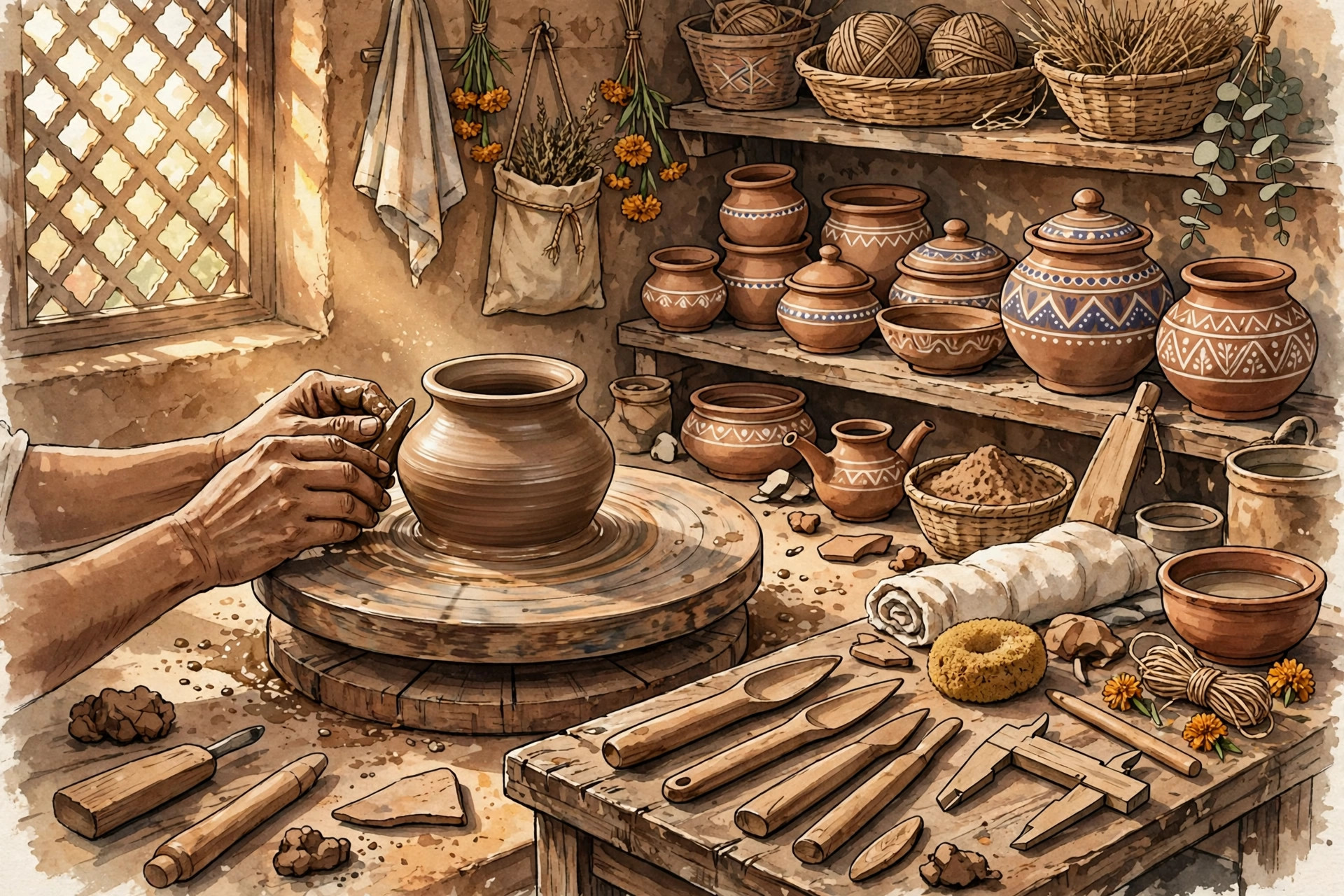
Second, skill training. Artisans get basic and advanced training in their trade, with an emphasis on modern tools, better techniques, quality standards, and safety. Training is not about replacing traditional skill; it is about adding to it. A potter may learn a more efficient kiln technique, a carpenter may learn to use a modern tool safely, a tailor may learn finishing standards that help sell in a wider market. A daily stipend is provided during training days, which is important because taking days off work to learn is otherwise unaffordable for many artisans.
Third, a toolkit incentive. After training, artisans receive support towards buying modern toolkits for their trade. Good tools change the quality and speed of work directly, and many artisans otherwise keep using worn-out tools because new ones are expensive. The toolkit support is meant to remove that barrier.
Fourth, credit support. Artisans can access collateral-free enterprise development loans in stages, starting with a smaller first loan and a larger second loan after successful repayment of the first. The interest on these loans is concessional, meaning lower than a typical unsecured loan, and the government provides an interest subvention, which is a subsidy on the interest. Because the loans are designed for small working-capital and equipment needs, the amounts are modest and practical rather than large business loans. Exact loan amounts, interest rates, and repayment terms should be confirmed on the official portal, since they can be revised.
Fifth, incentives for digital transactions and marketing support. Artisans receive an incentive for adopting digital payments, which encourages customers to pay digitally and helps build a transaction record. The scheme also aims to help with marketing, including linking artisans to wider markets and platforms, so that a crafts person is not limited only to customers in their own village or neighbourhood.
How to Apply, Step by Step
Applying is meant to be done with help, not alone in front of a complicated form. The usual route is through a Common Service Centre or an enrolment centre, where an operator helps you fill in the application and upload documents.
Start by confirming that your trade is on the eligible list and that you meet the basic conditions. Carry proof of identity, proof of address, and any documents that show you practise the trade, such as an occupation certificate if you have one. A bank account and a mobile number linked to it are important, because payments and loan processes run through the bank account.
At the centre, your details are entered, your trade is selected, and your application is submitted. You may be asked to verify your identity through Aadhaar-based verification. After submission, keep the acknowledgement or application reference safely. Verification of your application and trade may follow, and once approved, you receive your certificate and identity card and become eligible for the training and other benefits in sequence.
One practical tip is to go to a CSC rather than paying a middleman. If anyone asks you for a large fee to "guarantee" approval, be cautious. The application process itself is designed to be accessible, and no agent can guarantee selection. If you are unsure about a document, ask at the CSC or the local district industries or panchayat office, which can usually point you to the right help.
Common Mistakes and Realistic Expectations
A common misunderstanding is that enrolment means an immediate cash payment. It does not. The benefits come in stages: recognition first, then training, then toolkit support, then credit, with each stage depending on completing the previous one. Another misunderstanding is that the loan is a grant. It is a loan that must be repaid, and repaying the first loan on time is what unlocks the second, larger loan.
Another mistake is applying under the wrong trade. If your actual daily work is tailoring but you apply as a carpenter because someone suggested it, verification can fail and you may lose time. Apply under the trade you genuinely practise. Finally, remember that the scheme supports your trade; it does not by itself bring customers. Combining the training and tools with good quality work, fair pricing, and digital payment acceptance is what turns support into higher income.
Conclusion
PM Vishwakarma Yojana is best understood as a ladder for traditional artisans: recognition at the bottom, skill and tools in the middle, and affordable credit and market access at the top. For a carpenter, potter, blacksmith, tailor, or any other listed artisan, it offers a practical route to upgrade a traditional livelihood without abandoning the craft. Check your trade on the official portal, apply through a CSC, complete the training, and use the credit carefully. That sequence, more than any single benefit, is what makes the scheme useful.