54th PRAGATI Meeting Explained: Rs 16,000 Crore Projects, Railway Stations, Ekta Malls and Bulk Drug Parks
Key Takeaways
- Prime Minister Narendra Modi chaired the 54th PRAGATI meeting on 28 October 2026, reviewing projects worth over Rs 16,000 crore across 31 States and Union Territories.
- The review covered Railways, PM Ekta Malls and Bulk Drug Parks, with an emphasis on outcomes rather than outlays.
- Redeveloped railway stations should work as multimodal hubs with seamless metro and transport links; Ahmedabad station was specifically reviewed.
- Ekta Malls should act as marketplaces for local products and artisans, linked with tourism and local businesses.
- Bulk Drug Parks in Andhra Pradesh, Gujarat and Himachal Pradesh were reviewed for domestic production of APIs and essential inputs, and Chief Secretaries were asked to review welfare schemes with District Magistrates every month.
On 28 October 2026, Prime Minister Narendra Modi chaired the 54th meeting of PRAGATI at Seva Teerth in New Delhi, reviewing infrastructure projects worth more than Rs 16,000 crore across 31 States and Union Territories. The Prime Minister shared a summary of the meeting on 29 October 2026, and the Prime Minister's Office (PMO) issued an official account of the discussions the same week. The projects under review covered the Railways, PM Ekta Malls and Bulk Drug Parks, three areas the government considers crucial to economic growth and public welfare.
PRAGATI meetings do not usually make headlines for a single new announcement. Their importance lies in something quieter: they are the forum where the Prime Minister directly reviews whether big projects are actually moving, where they are stuck, and who is responsible for unblocking them. This explainer looks at what was discussed at the 54th meeting, what PRAGATI is, and why the directions given there matter for railway passengers, artisans, medicine manufacturing and people waiting for welfare benefits.
What happened at the 54th PRAGATI meeting
PRAGATI stands for Pro-Active Governance and Timely Implementation. It is an information and communications technology-enabled, multi-modal platform that brings together the Central Government and State Governments to resolve implementation bottlenecks and improve the delivery of projects and welfare schemes.
At the 54th meeting, the Prime Minister reviewed infrastructure projects spanning the Railways, Ekta Malls and Bulk Drug Parks across 31 States and Union Territories, with a combined cost exceeding Rs 16,000 crore. According to the PMO's account, reported by DD India, The New Indian Express and The Economic Times, the review focused on meeting deadlines, strengthening inter-agency coordination and resolving issues promptly.
The Prime Minister's own summary, posted on 29 October 2026, listed four focus areas: projects worth over Rs 16,000 crore across 31 States and Union Territories; faster redevelopment of railway stations as multimodal hubs; boosting self-reliance in pharmaceutical manufacturing; and Ekta Malls to empower artisans and local businesses. He summed up the approach in one line: "The focus is clear... substantive outcomes, timely execution and long lasting benefits for people."
That phrase, "outcomes rather than outlays", also appeared in the official reporting of the meeting. It is worth pausing on, because it captures what PRAGATI is supposed to do. An outlay is money allocated or spent. An outcome is what a citizen actually experiences: a station that is easier to use, a medicine that is made in India rather than imported, a local product that finds a buyer. The meeting's message was that spending alone is not the measure of success.
Railway stations as multimodal hubs
One of the clearest directions from the meeting concerned railway stations. During the review of the redevelopment of Ahmedabad railway station, the Prime Minister called for expediting the modernisation of major railway stations across the country to enhance passenger convenience and make travel easier.
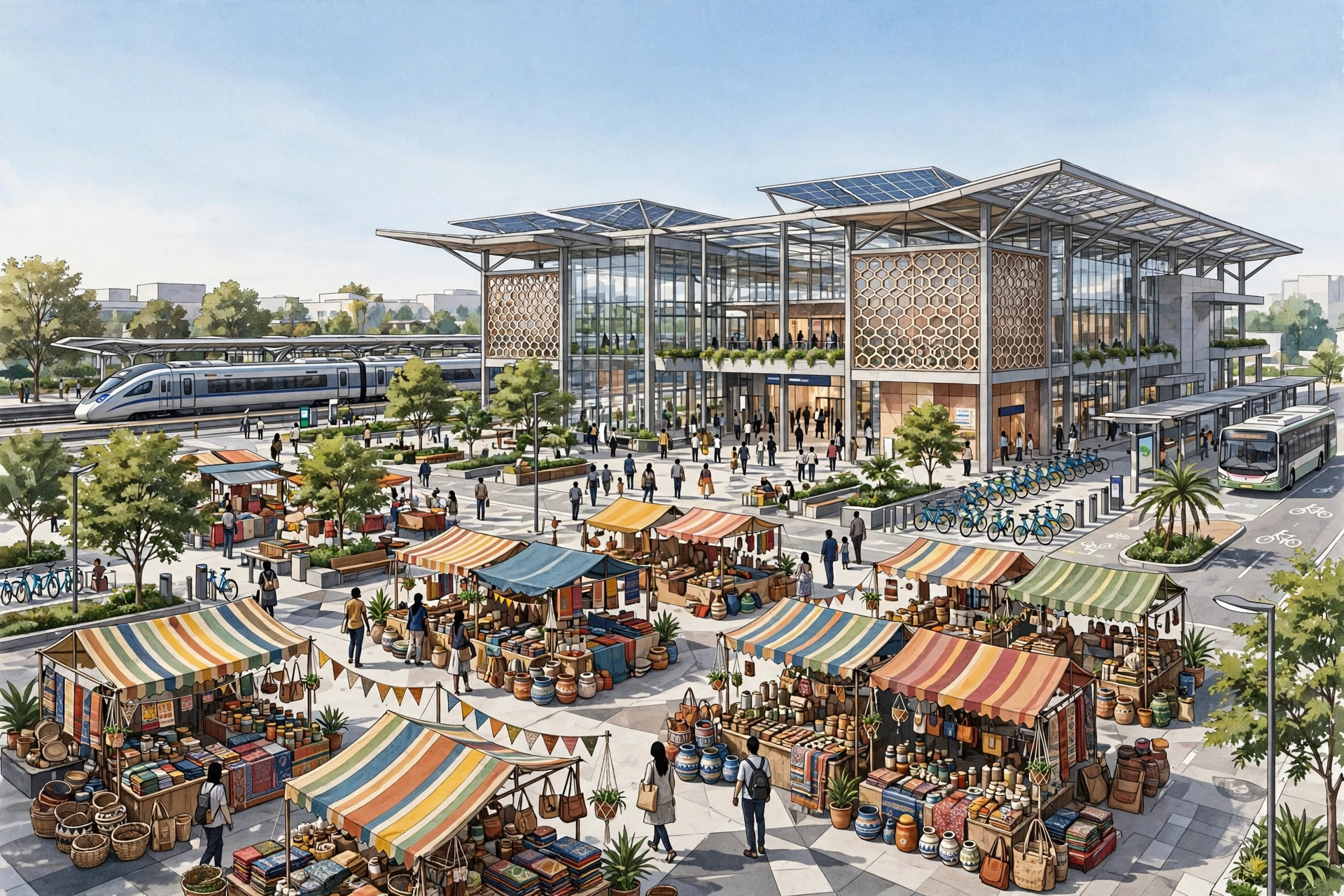
The key idea is that a redeveloped station should function as a multimodal transport hub, providing seamless connectivity with metro services and other transport networks. In practice, that means a passenger should be able to arrive by train and switch to a metro, bus or taxi without a long, confusing walk or a second ticket maze. Stations, in this vision, stop being just places where trains halt and become connection points for a whole journey.
This matters beyond comfort. India is redeveloping a large number of major stations, and these are expensive, complex projects involving railways, state governments, city authorities and private partners. Delays in any one part, land, utilities, clearances or construction sequencing, can hold up the whole project. A PRAGATI review is designed to surface exactly those blockages in one room, with the Prime Minister asking the concerned ministries and state governments to resolve them in mission mode.
The Prime Minister also called for close monitoring of projects at the senior-most level, and for a proactive work culture with greater ownership at every level. Officials were urged to anticipate implementation challenges, take timely decisions and fix clear accountability for completing projects on schedule.
Ekta Malls: markets for local products and artisans
The second major theme was PM Ekta Malls. The Prime Minister emphasised that these malls should serve as marketplaces for local products, strengthen artisans' livelihoods and help them expand their businesses.
He called for integrating the malls with tourism and local enterprises, noting that rising demand could generate employment opportunities in rural production, packaging, storage and transportation. He also stressed that Chief Secretaries should regularly review progress and ensure the timely completion of the malls.
The logic here connects two different goals. For artisans and small producers, the hardest problem is often not making a product but finding a reliable buyer at a fair price. A dedicated marketplace in a prominent location, linked to tourist footfall, can provide that visibility. For the local economy around it, the benefits spread further: someone has to produce, package, store and transport the goods, and each of those steps can mean work.
The caution, as with any infrastructure project, is that a mall is only useful if it is completed on time, well located and genuinely stocked with local products rather than generic goods. That is presumably why the meeting stressed both timely completion and regular review by Chief Secretaries, the top civil servants in each state.
Bulk Drug Parks and self-reliance in medicines
The third theme was pharmaceutical self-reliance. Reviewing Bulk Drug Parks in Andhra Pradesh, Gujarat and Himachal Pradesh, the Prime Minister underscored the importance of prioritising domestic production of active pharmaceutical ingredients (APIs) and essential inputs.
APIs are the key ingredients that make a medicine work. India is one of the world's largest producers of finished medicines, but it still imports a large share of the APIs and intermediates used to make them, particularly from China. That dependence became a strategic concern during supply disruptions, and reducing it has been a stated policy goal for several years. Bulk Drug Parks are industrial clusters designed to bring API and intermediate manufacturers together with shared infrastructure, testing facilities and utilities, making domestic production more competitive.
The meeting therefore linked an industrial policy, building the parks, to a health-security goal: ensuring that essential medicines can be produced at home even when global supply chains are disrupted. The Prime Minister also emphasised stronger Centre-State coordination for these projects, since land, power, water and environmental clearances typically involve state authorities.
Welfare delivery: monthly reviews by Chief Secretaries and District Magistrates
Beyond the three project groups, the meeting carried a direction on welfare delivery. The Prime Minister directed Chief Secretaries to review the implementation of schemes with District Magistrates every month to identify gaps and ensure that eligible beneficiaries receive their entitlements on time.
This is a practical, administrative instruction, but it matters to ordinary citizens. Many welfare problems are not about whether a scheme exists but about whether an eligible person is actually enrolled, whether documents are accepted, and whether payments or benefits arrive without repeated visits to government offices. A monthly review at the level of the Chief Secretary and the District Magistrate is meant to catch those gaps early, district by district, rather than waiting for complaints to accumulate.
The Prime Minister also referred to the Aspirational Districts and Aspirational Blocks Programmes, highlighting the importance of convergence, regular monitoring and local accountability in accelerating development in underserved areas. Convergence means different schemes and departments working together in the same district or block instead of in isolation. He noted that sustained efforts to strengthen governance and improve welfare delivery had helped nearly 25 crore people move out of multidimensional poverty, a claim reported from the official account of the meeting.
Why PRAGATI matters, and what it cannot do by itself
PRAGATI was launched in March 2015 as a direct review mechanism between the Prime Minister's Office and project officers on the ground, using video links to district collectors and secretaries. Over more than a decade and 54 meetings, it has become a routine instrument for tracking central projects and schemes.
Its strength is accountability at the top: when the Prime Minister reviews a project, delays become visible and officials are pressed to give timelines. Its limitation is equally clear. A review meeting can unblock a clearance or set a deadline, but it cannot by itself build a station, stock a mall or commission a drug park. Those outcomes depend on the follow-through by ministries, states and implementing agencies in the months after the meeting.
Readers should therefore treat the 54th meeting as a checkpoint, not a completion certificate. The projects reviewed are worth more than Rs 16,000 crore, but the meeting did not announce that they are finished. What it did was restate deadlines, assign responsibility for resolving bottlenecks, and set the test by which the projects will be judged: not how much was spent, but what citizens can actually use.
What to watch next
Three things are worth watching after this meeting. First, whether the railway station redevelopment programme, including Ahmedabad station, shows visible progress towards multimodal integration with metro and bus services. Second, whether Ekta Malls open on schedule with genuinely local products and artisan participation. Third, whether the Bulk Drug Parks in Andhra Pradesh, Gujarat and Himachal Pradesh move towards production of APIs and essential inputs, reducing import dependence.
If those three tracks advance, the 54th PRAGATI meeting will have done its job. If they stall, the next PRAGATI review will be the place where the same questions return, and that, in a sense, is the point of the platform: to keep asking until the project is delivered.
Conclusion
The 54th PRAGATI meeting, chaired on 28 October 2026 and summarised by the Prime Minister on 29 October, reviewed over Rs 16,000 crore of projects across 31 States and Union Territories. Its directions were practical rather than grand: finish railway stations as multimodal hubs, make Ekta Malls real markets for artisans, build domestic capacity for essential pharmaceutical ingredients, and review welfare schemes every month at the district level. The underlying message was that governance should be judged by outcomes, not outlays. For citizens, the test of this meeting will not be found in the meeting itself, but in stations, markets, medicine supplies and welfare delivery in the months ahead.