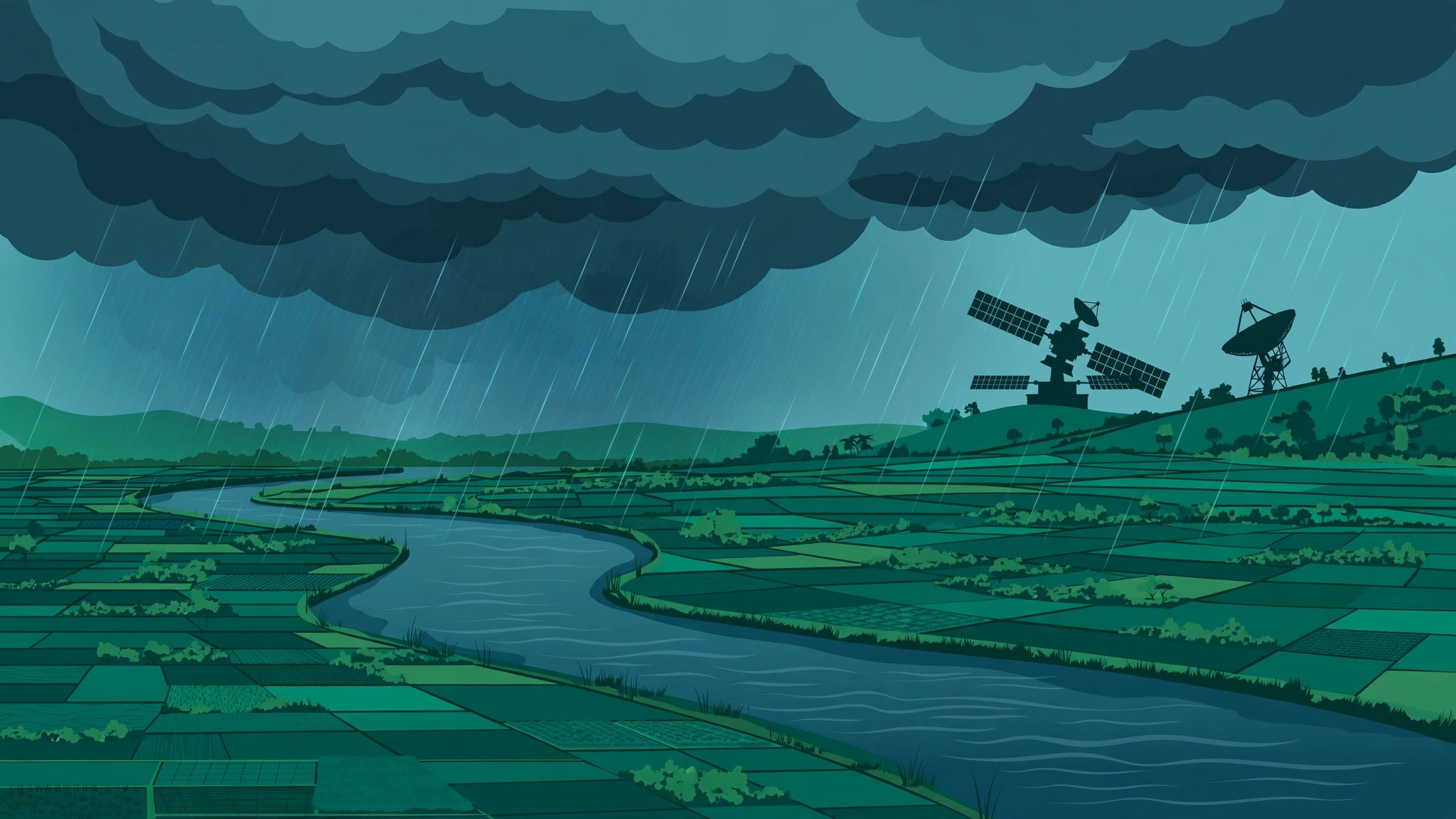
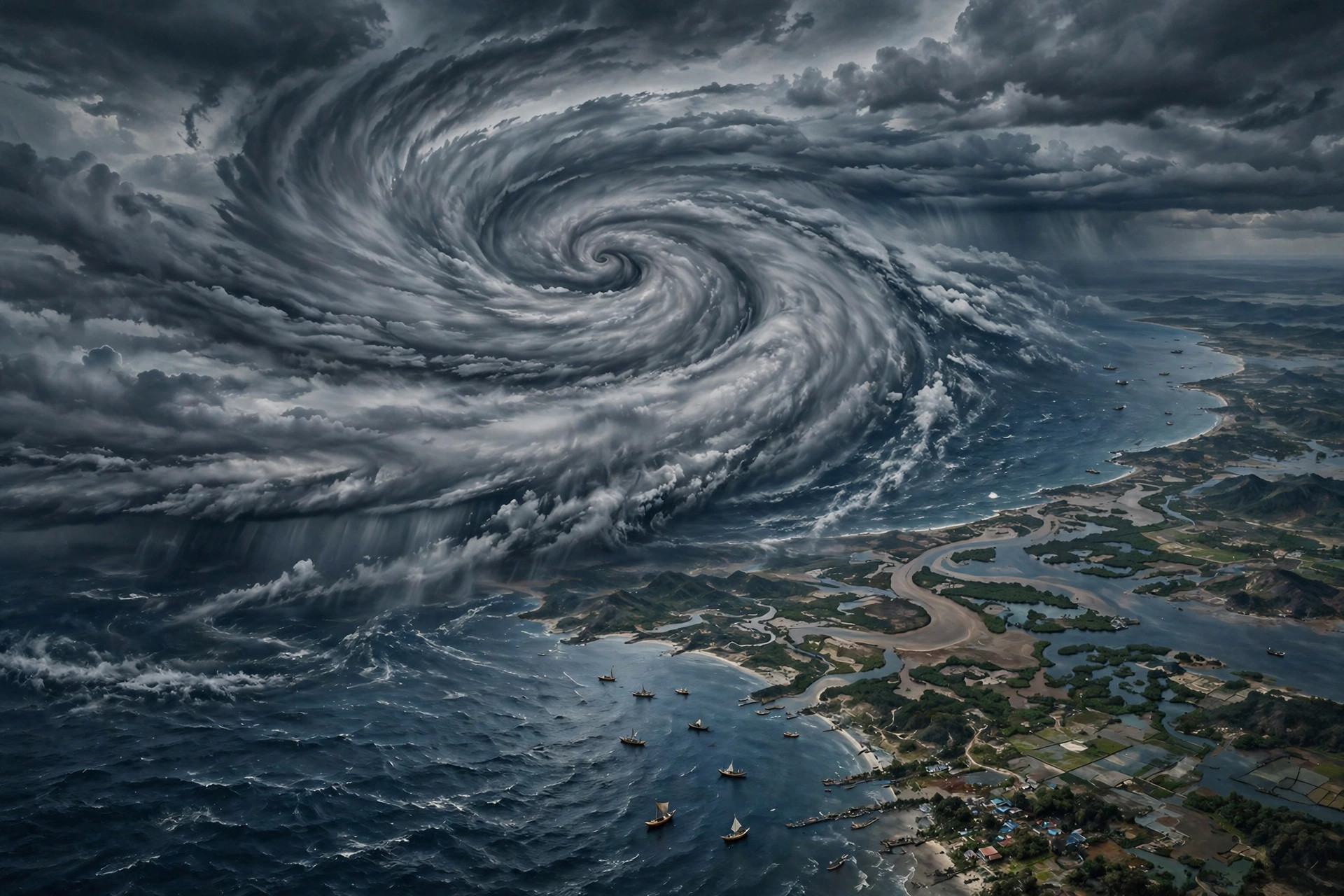
The India Meteorological Department carries the main responsibility for monsoon forecasting in India.
The monsoon is driven by the temperature difference between the fast-heating land and the relatively cool sea.
Forecasts combine long-term data, satellite images, ground stations, radars and numerical weather models run on supercomputers.
A monsoon forecast is never 100% accurate — it is given in categories and probabilities, such as normal, above normal or below normal.
Long-range forecasts help plan sowing for the season; short-range forecasts help with irrigation, harvesting and flood warnings.
Forecasting the monsoon in India is not just a weather prediction exercise. It is a vital scientific task for millions of farmers, for water management and for the economy. The India Meteorological Department carries the main responsibility for this work, and it uses many kinds of data, satellite images and mathematical models to estimate when the monsoon will arrive, how much rain it will bring and how it will spread across the country.
What Drives the Monsoon
The monsoon process begins with the difference in temperature between land and sea. In summer, the land of the Indian subcontinent heats up quickly, while the sea remains relatively cool. Warm air rises over the land, and moist air from the sea begins to flow towards it. These winds bring monsoon rainfall. Many factors influence this process, such as El Nino and La Nina conditions in the Pacific Ocean, the temperature pattern of the Indian Ocean, the amount of snow over the Himalayas and changes in global atmospheric pressure.
For a forecast, scientists first look at long-term data. They analyse statistically how monsoon rainfall, sea temperatures and atmospheric pressure have related to each other over past decades. Alongside this, modern numerical weather prediction models are run, in which the equations of atmospheric and ocean physics are solved on supercomputers. These models start from the current state of the weather and estimate the weather for the coming days and weeks.
Satellites, Stations and Models
Satellites play a very large role in this work. Satellites continuously send images of cloud movement, sea temperature, moisture and wind direction. In India, weather satellites together with ground weather stations, radars and automatic stations form a large network of data. These data are fed into the models, which makes forecasts more accurate. Even so, a monsoon forecast is never one hundred percent accurate, because the atmosphere is an extremely complex and sensitive system in which small changes can produce large results.
Long-Range and Short-Range Forecasts
Monsoon forecasts are usually issued at two levels. First, a long-range forecast for the whole season, which states how much total rainfall this year may be above or below normal. Second, short-range and medium-range forecasts, which give information about how much rain will fall in which region over the next few days. Both are important for farmers — the first helps in planning sowing, and the second helps in decisions about irrigation, harvesting and storage.
Uncertainty in forecasts is also stated clearly. For example, rainfall is described in categories such as normal, above normal or below normal, along with the probability that the forecast will prove correct. This transparency is necessary so that farmers, governments and traders do not depend on a single number alone, but understand the risk and make decisions accordingly.
In recent years, forecast accuracy has improved, but challenges remain. Because of climate change, rainfall patterns are shifting, with sudden heavy rainfall in some areas and drought events increasing in others. Scientists are therefore now paying more attention not only to total rainfall, but also to its distribution, heavy rainfall events and local forecasts. Understanding the monsoon is thus not only a subject of meteorology, but the foundation of India's food security and rural economy.
The use of monsoon forecasts is no longer limited to agriculture. Water management in reservoirs, flood warnings, planning of power generation and drainage preparation in cities also depend on these forecasts. When a forecast indicates heavy rainfall in a region, local authorities can prepare in advance and alert people. Similarly, when low rainfall is expected, the government can plan drought relief, drinking water supply and crop insurance measures in advance, which reduces damage.
For students and citizens, the most useful way to read a monsoon forecast is to look beyond a single percentage figure. A forecast that says rainfall will be ninety-eight percent of the long-period average sounds precise, but it does not tell you whether rain will arrive on time in your district, whether it will fall evenly through the season, or whether a few very heavy days will do most of the work. That is why district-level forecasts, weekly updates and warnings about extreme events matter more in daily life than the seasonal headline number. A good habit is to check the forecast for your own region, note the probability attached to it, and treat it as a planning aid rather than a promise.
Frequently Asked Questions (FAQ)
Who issues the monsoon forecast in India?
The India Meteorological Department (IMD), which uses satellite data, weather stations and mathematical models.
What effect does El Nino have on the monsoon?
During El Nino, Pacific Ocean temperatures rise, which can often weaken the monsoon in India; La Nina often has the opposite effect.
Is a monsoon forecast completely accurate?
No. The atmosphere is extremely complex, so forecasts are given in terms of probabilities and categories, not with one hundred percent certainty.
What is the difference between long-range and short-range forecasts?
A long-range forecast gives total rainfall for the whole season, while a short-range forecast gives region-wise weather information for the next few days.