INDIA Bloc Ramlila Maidan Rally on 1 November Explained: Timings, Security, and Why the Opposition Is Protesting Over SIR
Key Takeaways
- The INDIA bloc rally is scheduled for 1 November 2026 at Ramlila Maidan, Delhi, from 10 am to 5 pm, with preparations intensifying on 29 October.
- The opposition is protesting against alleged electoral irregularities and the SIR, and demanding the resignation of Chief Election Commissioner Gyanesh Kumar — allegations, not court findings.
- The Congress claims around 10 lakh people could attend, while Delhi Police expects about 50,000 and will deploy around 3,500 personnel.
- Police conditions require the rally to end by 5 pm, immediate dispersal, and no overnight stay at the venue.
- After 1 November, the bloc has planned a Chalo Delhi March on 25-26 November, with six yatras from different states towards the capital.
What is happening at Ramlila Maidan
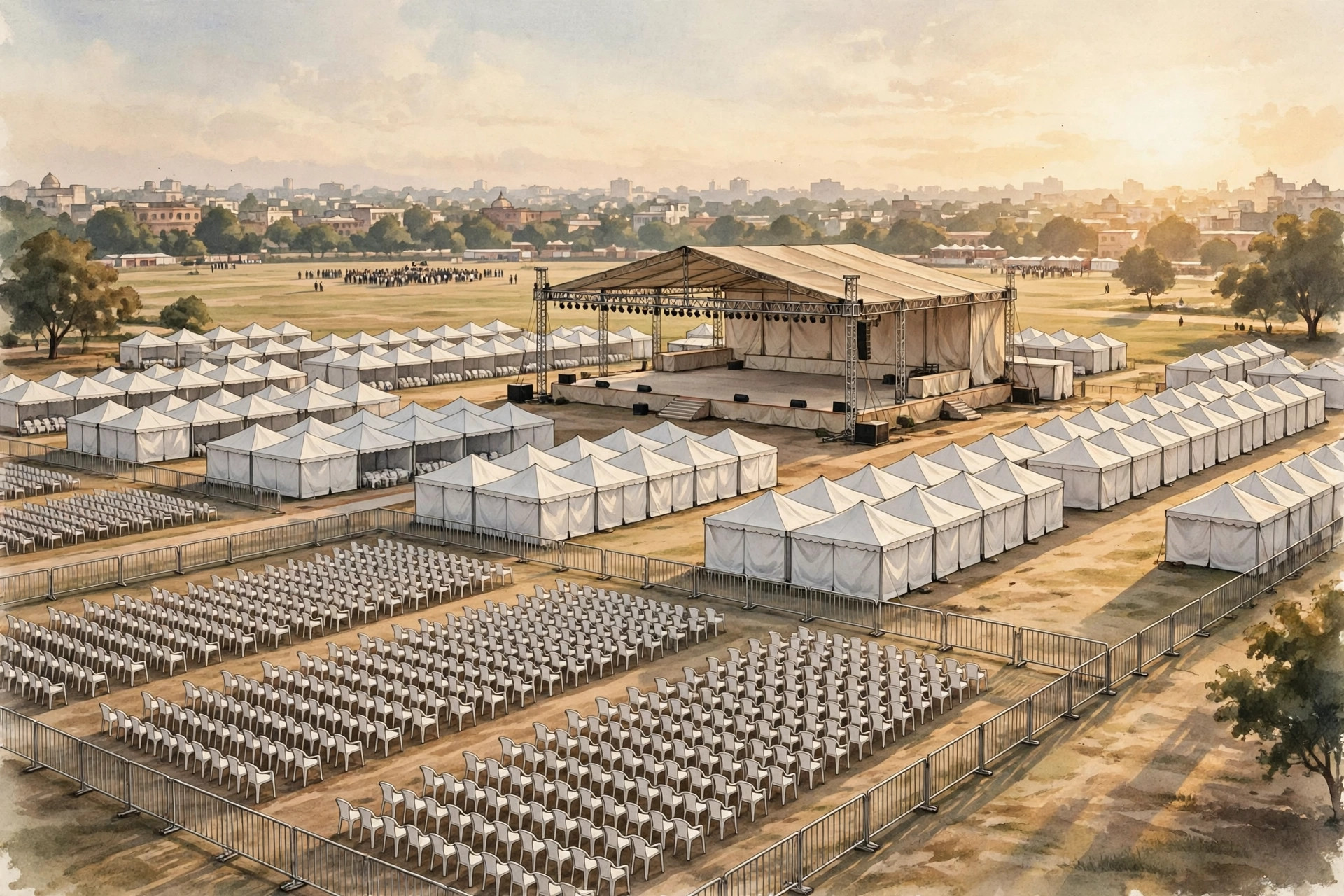
Preparations intensified at Delhi's Ramlila Maidan on Thursday, 29 October 2026, for a large opposition rally scheduled for Sunday, 1 November 2026. The rally has been organised by the INDIA bloc, the alliance of opposition parties led in this campaign by the Congress, and it is planned to run from 10 am to 5 pm. Workers were seen putting up a large tent over the main stage, arranging a second stage for state units of alliance parties, laying out rows of white canopy tents, installing metal barricades to manage crowd movement, and bringing in plastic chairs by the truckload.
On Thursday evening, Congress general secretary Priyanka Gandhi Vadra, organisation general secretary K. C. Venugopal and MP Pawan Khera visited the ground to inspect the arrangements. Their visit was the most visible sign yet that the event has moved from announcement to execution, with three days still to go before the rally itself. The Congress has been coordinating with its state units to bring workers to Delhi, and leaders from states neighbouring the capital have been asked to mobilise supporters in large numbers.
Why the opposition is holding this rally
The rally is part of the opposition's campaign against what it calls "vote chori" — its allegation of irregularities in the functioning of the Election Commission and in the Special Intensive Revision (SIR) of electoral rolls. The bloc is demanding the resignation of Chief Election Commissioner Gyanesh Kumar. These are the opposition's allegations and political demands; they should not be read as findings by a court or by the Election Commission, which has defended its revision exercise and its procedures in the courts.
The immediate trigger for the campaign is the SIR, a door-to-door revision of voter lists that involves enumeration forms, verification of entries, and the publication of draft rolls from which names can be added, corrected or deleted. Opposition parties argue that the process risks deleting genuine voters, particularly people who have moved home for work, while the Election Commission maintains that revision is a routine exercise to clean up the rolls and that no eligible voter will be left out. That disagreement — over deletions, deadlines and forms — is now playing out simultaneously in the courts, in Parliament's politics, and on the streets.
Leader of Opposition in the Lok Sabha Rahul Gandhi has appealed to students and civil society groups as well as party workers to join the gathering, describing it as a movement to defend democracy and the Constitution. The framing matters because the Congress is presenting 1 November not as a single-party event but as a joint show of strength by the wider INDIA bloc, whose ability to act together has been questioned at various points since the alliance was formed.
How big will it be, and how is security arranged
The expected crowd size is itself a point of difference. The Congress has claimed that around 10 lakh people could attend, and Venugopal has spoken of at least one million citizens marching for the cause. Delhi Police, by contrast, expects a gathering of approximately 50,000 people. The gap between the two figures is normal for large political rallies — organisers tend to project maximum mobilisation, while police plan on the basis of permissions, venue capacity and past turnouts — but it means the actual turnout on Sunday will be closely watched as a measure of the campaign's reach.
For security and crowd management, Delhi Police has said around 3,500 personnel will be deployed. More than 200 CCTV cameras, body-worn cameras and surveillance-equipped vehicles will monitor the venue, the ground has been divided into 14 zones each overseen by senior officers, and ten companies of reserve forces have been called in. The scale of the deployment reflects both the size of the expected crowd and the sensitivity of a protest directed at the Election Commission in the heart of the capital.
The conditions Delhi Police has set
The rally is taking place under a police no-objection certificate (NOC) that comes with strict conditions. According to the clearance issued by the Deputy Commissioner of Police, Central District, the organisers sought use of Ramlila Maidan from 25 October to 3 November, and the police clearance is subject to permission from the land-owning authority and to compliance with a series of conditions.
The most important conditions are about time and overnight stay. The rally must conclude by 5 pm on 1 November, participants must begin dispersing immediately afterwards, the event cannot be extended under any circumstances, and participants will not be allowed to stay overnight at Ramlila Maidan before or after the rally. Police can revoke the clearance if organisers fail to follow the conditions, including restrictions on speeches and marches. For anyone planning to attend, the practical message is simple: arrive in time for the 10 am start, expect a hard 5 pm finish, and do not plan to remain at the venue overnight.
The road to 1 November
The rally did not emerge overnight. On 5 October, Venugopal announced the 1 November rally against the Chief Election Commissioner amid the ongoing agitation over SIR. On 12 October, opposition leaders, activists and civil society members took part in a March for Democracy in Delhi, and a joint petition challenging the revision exercise was filed in the Supreme Court. The following day, Rahul Gandhi hosted INDIA bloc leaders at his residence, after which the opposition reiterated its intention to continue the campaign.
In the run-up to the rally, Priyanka Gandhi Vadra and Venugopal met Congress leaders from Uttar Pradesh and Haryana at the party headquarters in New Delhi to review mobilisation, with state leaders including Uttar Pradesh Congress president Aradhana Misra-Mona and Haryana leaders involved in the discussions. Venugopal later said the Ramlila Maidan rally would be the culmination of a Delhi Chalo march reaching the capital on 1 November. The state-level meetings explain why buses and workers from neighbouring states are expected to form a large part of the crowd.
The legal track running alongside the protest
The street campaign is running in parallel with a legal challenge. On 29 October itself, the Supreme Court heard petitions about voter deletions in Delhi and suggested that the Election Commission consider extending the deadline for enumeration, claim and objection forms, noting that it is yet to decide on the legality of "logical discrepancies" used in automated roll scrubbing. In an earlier order, the court had asked the Commission to extend deadlines and simplify enrolment for Delhi voters.
The two tracks are distinct and should not be confused. The court decides questions of law and procedure — deadlines, forms and the handling of deleted names — while the rally is a political act aimed at building public pressure. A court direction can change what the Election Commission must do; a rally can change the political atmosphere in which those decisions are received. Both, however, turn on the same underlying question: how to revise voter lists thoroughly without wrongly removing eligible voters.
What it means, and what to watch on Sunday
For the opposition, the rally is a test of coordination and mobilisation. A large, peaceful turnout with leaders from several alliance parties on one stage would support the Congress claim that the SIR campaign has united the bloc. A thin crowd, or one dominated by a single party, would undercut that claim and raise questions about how far the campaign travels beyond the Congress organisation. For the government and the Election Commission, the event is a political challenge rather than a legal one: the Commission's processes are already before the courts, and a rally cannot by itself change a court order or an electoral roll.
Three things are worth watching on 1 November. First, the turnout and the mix of parties and groups present, compared with both the Congress claim of 10 lakh and the police estimate of 50,000. Second, whether the event stays within its police conditions — ending by 5 pm, dispersing promptly, and avoiding an overnight stay at the venue. Third, what the leaders actually announce: whether the rally produces a concrete next step, such as the planned Chalo Delhi March on 25–26 November involving six yatras from different states towards the capital, or whether it remains a show of protest without a follow-up programme.
For ordinary voters, the most useful part of this story is not the crowd estimate but the underlying process. If your name is missing from a draft roll, or if you have moved home, the remedy lies in the claims and objections process and in contacting your booth-level officer — not in attending a rally. The Supreme Court's ongoing hearings and the Election Commission's camps are the places where individual enrolment problems get resolved. The rally, meanwhile, will show how much political force the opposition can gather behind its demand for the Chief Election Commissioner's resignation, an outcome that would require a political or constitutional process far beyond a single day's demonstration.
Conclusion
Ramlila Maidan is ready, the police deployment is set, and the stage is literally built. On 1 November, from 10 am to 5 pm, the INDIA bloc will try to turn its months-long campaign against alleged electoral irregularities and the SIR into a visible, mass event in central Delhi. The preparations of 29 October — the tents, the barricades, the inspection by senior Congress leaders — show an event being taken seriously by its organisers. Whether it becomes the million-strong demonstration the Congress promises, the 50,000-strong gathering the police expect, or something in between, will be known only on Sunday evening. What is already clear is that the argument over voter lists has moved beyond courtrooms and into the capital's most famous protest ground, and it is unlikely to end when the tents come down.