Home > General Knowledge > India's Record 114 Medals at Asian Para Games 2026 Explained: The Stars, the Numbers and Why It Matters
India's Record 114 Medals at Asian Para Games 2026 Explained: The Stars, the Numbers and Why It Matters
By IndiaAsk Editorial Team · 2026-10-25 · 7 min read · General Knowledge
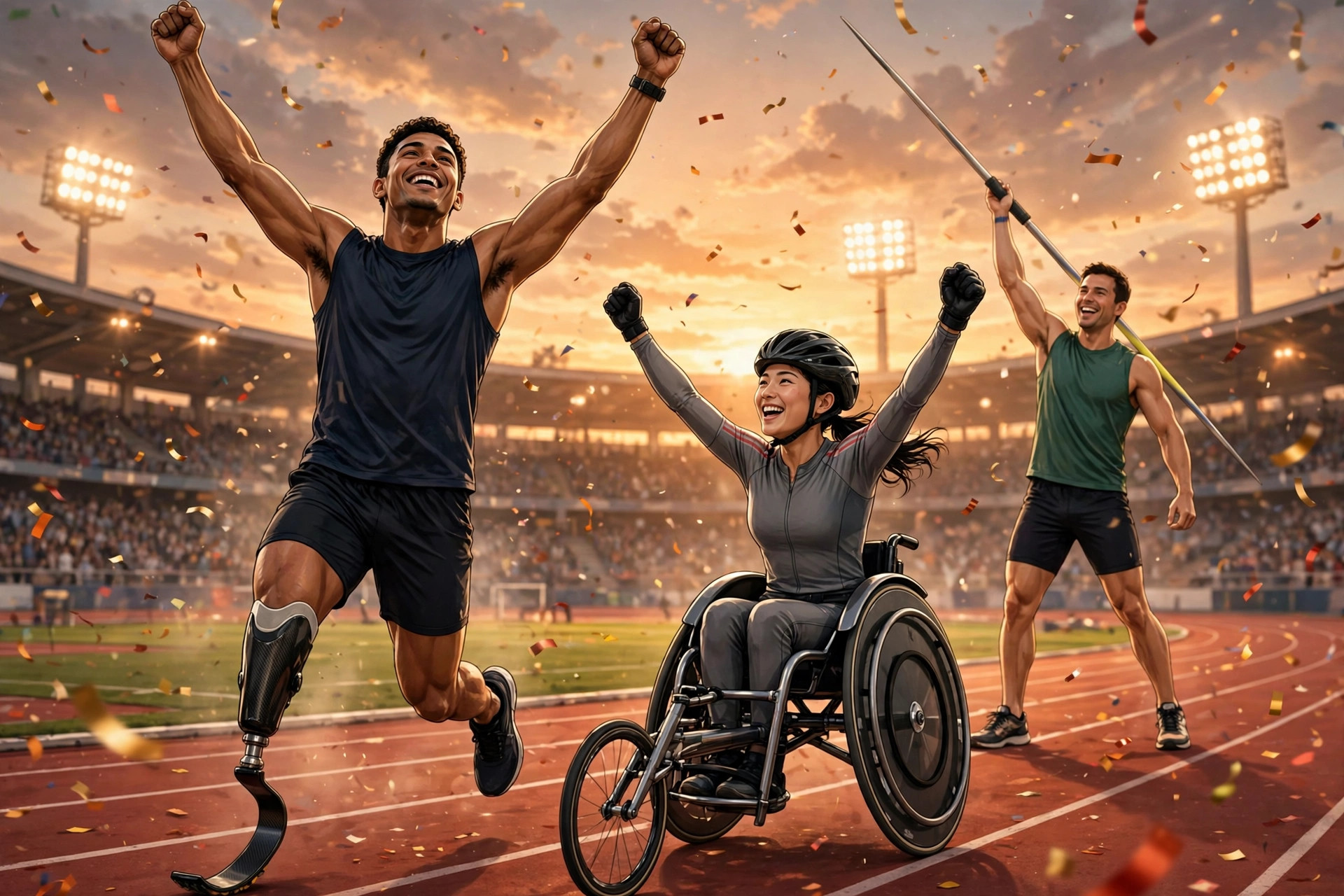
Editorial illustration: para-athletes celebrating in a stadium at sunset after India's record medal haul at the Asian Para Games 2026 in Aichi-Nagoya, Japan.
Key Takeaways
India won a record 114 medals at the Asian Para Games 2026 in Aichi-Nagoya — 30 gold, 35 silver and 49 bronze — finishing fourth overall.
The haul beat the previous best of 108 medals from Hangzhou 2023, and came from a smaller contingent than the one sent to Hangzhou.
Para-athletics led the way with 65 medals, followed by para-badminton with 16 and para-swimming with 11.
Sumit Antil led a javelin podium sweep, Simran Sharma won a sprint double, and Mona Agarwal set a world record on her way to two shooting golds.
India's rise runs from just 14 medals at the inaugural Asian Para Games in 2010 to 114 in 2026.
What happened in Aichi-Nagoya
India has finished the Asian Para Games 2026 in Aichi-Nagoya, Japan, with a record medal haul of 114 medals — 30 gold, 35 silver and 49 bronze — and fourth place in the overall standings. It is India's best-ever performance at the Games, surpassing the previous best of 108 medals, including 27 gold, achieved at the 2023 edition in Hangzhou, China. Prime Minister Narendra Modi congratulated the contingent on Sunday 25 October, calling the achievement "an occasion of immense pride and joy for the entire nation" and praising every member of the team for their determination.
The result is significant not only for the total, but for how it was achieved. India crossed the 100-medal mark for the second consecutive edition of the Games, and did so with a smaller contingent than the one that competed in Hangzhou. Reports of the campaign put the travelling team at 167 athletes, against more than 300 in Hangzhou. In other words, a leaner squad produced a bigger return — a sign, commentators noted, that the depth of India's para-sport system is improving, not just its headline stars.
Where the medals came from
Para-athletics was India's biggest contributor by a wide margin, accounting for 65 medals: 22 gold, 19 silver and 24 bronze. Para-badminton followed with 16 medals, including three gold, five silver and eight bronze, while para-swimming added 11 medals, including three silver and eight bronze. Para-archery contributed six medals, including three gold, and shooting added five medals, with two gold, two silver and one bronze. Para-table tennis added seven bronze medals, powerlifting two silver medals, and judo two medals, one silver and one bronze.
That spread matters. A medal table built on one sport can be fragile; India's 2026 table rested on athletics, racket sports, swimming, archery and shooting together. It also featured record-breaking performances across several of those sports, rather than a single golden day.
The standout performers
Javelin thrower Sumit Antil successfully defended his gold medal and led a podium sweep in his event, underlining India's strength in the discipline. Mahendra Gurjar took silver with a Games-record effort of 59.03 metres in the T42 category, while Sandip Sanjay Sargar claimed bronze with a Games-record throw of 64.48 metres in the T44 category. In men's club throw F51, Pranav Soorma won gold with a Games-record throw of 32.87 metres, beating the previous mark of 29.47 metres, with Dharambir taking bronze at 27.71 metres. Soorma also won discus gold with an Asian-record effort, completing a double.
Sprinter Simran Sharma delivered one of the most memorable track performances of the Games, winning gold in both the women's 100m and 200m T12 events. She improved on the two silvers she had won at the previous Games, and her 100m victory came in a Games-record 12.02 seconds. In para-shooting, Mona Agarwal won gold in the women's 50m rifle 3 positions SH1 with a score of 357.5, setting world and Asian Para Games records, and became the first Indian para-shooter to win a medal in the event at the Asian Para Games. She had already won the 10m air rifle standing SH1 gold, making it a golden double.
Archer Sheetal Devi staged a golden comeback in the women's individual compound final, beating Singapore's Nur Syahidah Alim, and also won women's compound doubles silver and mixed-team gold. High jumper Nishad Kumar went beyond his speciality, winning gold in both the men's T47 long jump, with 7.11 metres, and the high jump, with a Games-record clearance of 2.04 metres, despite a troublesome knee. Elsewhere, Navdeep Singh took bronze in men's javelin throw F40/41 with 42.55 metres, Rakeshbhai Bhatt won bronze in men's 200m T37 in 25.02 seconds, and Sandeep finished his campaign with one gold, one bronze and a world record after bronze in men's 100m T44 in 11.67 seconds.
Para-table tennis added a bronze through Jehan Dorab Madan and Shubham Wadhwa in men's doubles Class MD4, with Madan, at 50, the oldest member of the Indian contingent to win a medal at the 2026 edition. In para-swimming, Himanshu Nandal secured bronze in men's 100m freestyle S11 in 1:05.90, taking his medal tally at the Games to three bronze medals.
Background: from 14 medals to 114
India's rise in para-sport has been steep. At the inaugural Asian Para Games in 2010, India won just 14 medals. Sixteen years later, the country finished fourth among Asia's para-sport nations with 114. The 2026 campaign continued a run of improvement across successive editions, and the fact that it came from a smaller squad than Hangzhou's makes the comparison with 2023 especially striking: fewer athletes, more medals, and more golds.
That progress did not happen by accident. It reflects years of investment in coaching, classification, equipment and competition exposure for para-athletes, as well as the visibility that Paralympic success has brought. Athletes such as Soorma, who rebuilt his life through education and sport after a spinal cord injury at 16, and Agarwal, a Paris Paralympics bronze medallist who trained for the 50m event with a rented rifle, show how far individual journeys in Indian para-sport now reach — from grassroots hardship to world records.
Why this result matters beyond sport
First, it changes expectations. A second consecutive 100-plus medal haul means India's para-sport performances are no longer treated as a surprise; they are a standard the system will now be judged against. Second, it strengthens the case for continued funding and infrastructure — accessible training facilities, better equipment, more domestic competitions and support staff — because the return on that investment is now visible in the medal table.
Third, it matters for representation. Every record, every podium sweep and every comeback story in Nagoya was watched back home, and for young Indians with disabilities, seeing athletes like Sheetal Devi, Nishad Kumar and Simran Sharma win at the highest level of Asian competition is a powerful signal that elite sport is open to them. The Prime Minister's message captured that mood, saying each athlete had "inspired countless Indians with their accomplishments".
What comes next
The immediate question is whether this momentum carries into the next Paralympic cycle. The challenge for administrators will be to widen the base further — finding new talent, keeping athletes supported between Games, and converting silver and bronze medals into gold. The challenge for the athletes is the familiar one: rest, recover, and then begin the long build towards the next major championship, with a new personal best as the target rather than a past medal.
For now, though, the numbers speak for themselves. From 14 medals in 2010 to 114 in 2026, from a squad of more than 300 in Hangzhou to a smaller team beating that record in Nagoya, India has produced its finest Asian Para Games campaign — and set a new benchmark for everything that follows.
Conclusion
India's 114-medal haul at the Asian Para Games 2026 — 30 gold, 35 silver and 49 bronze, and fourth place overall — is a record that rests on breadth as much as brilliance: 65 medals from para-athletics, strong returns from badminton, swimming, archery and shooting, and world and Games records from athletes across the squad. A smaller contingent than in 2023 delivered a bigger result, and the standout stories — from Sumit Antil's podium sweep to Mona Agarwal's world record and Simran Sharma's sprint double — show a para-sport movement that has grown from 14 medals in 2010 into one of Asia's leading forces. The task now is to protect that progress and build on it.
Frequently Asked Questions (FAQ)
How many medals did India win at the Asian Para Games 2026?
India won a record 114 medals — 30 gold, 35 silver and 49 bronze — finishing fourth in the overall standings at the Aichi-Nagoya Asian Para Games 2026.
Was this India's best-ever performance at the Asian Para Games?
Yes. The 114-medal haul surpassed India's previous best of 108 medals, including 27 gold, achieved at the 2023 edition in Hangzhou, China.
Which sport contributed the most medals for India?
Para-athletics, with 65 medals: 22 gold, 19 silver and 24 bronze. Para-badminton was next with 16 medals, followed by para-swimming with 11.
Who were some of India's standout performers in Nagoya?
Sumit Antil defended his javelin gold in a podium sweep, Simran Sharma won the women's 100m and 200m T12 sprint double, Mona Agarwal won two shooting golds including a world record, Pranav Soorma won two titles with records, and Sheetal Devi won compound archery gold.