Home > Economy > India–New Zealand Free Trade Agreement Takes Effect: What Zero Duty, New Visas and Apple Quotas Mean
India–New Zealand Free Trade Agreement Takes Effect: What Zero Duty, New Visas and Apple Quotas Mean
By IndiaAsk Editorial Team · 2026-10-25 · 10 min read · Economy
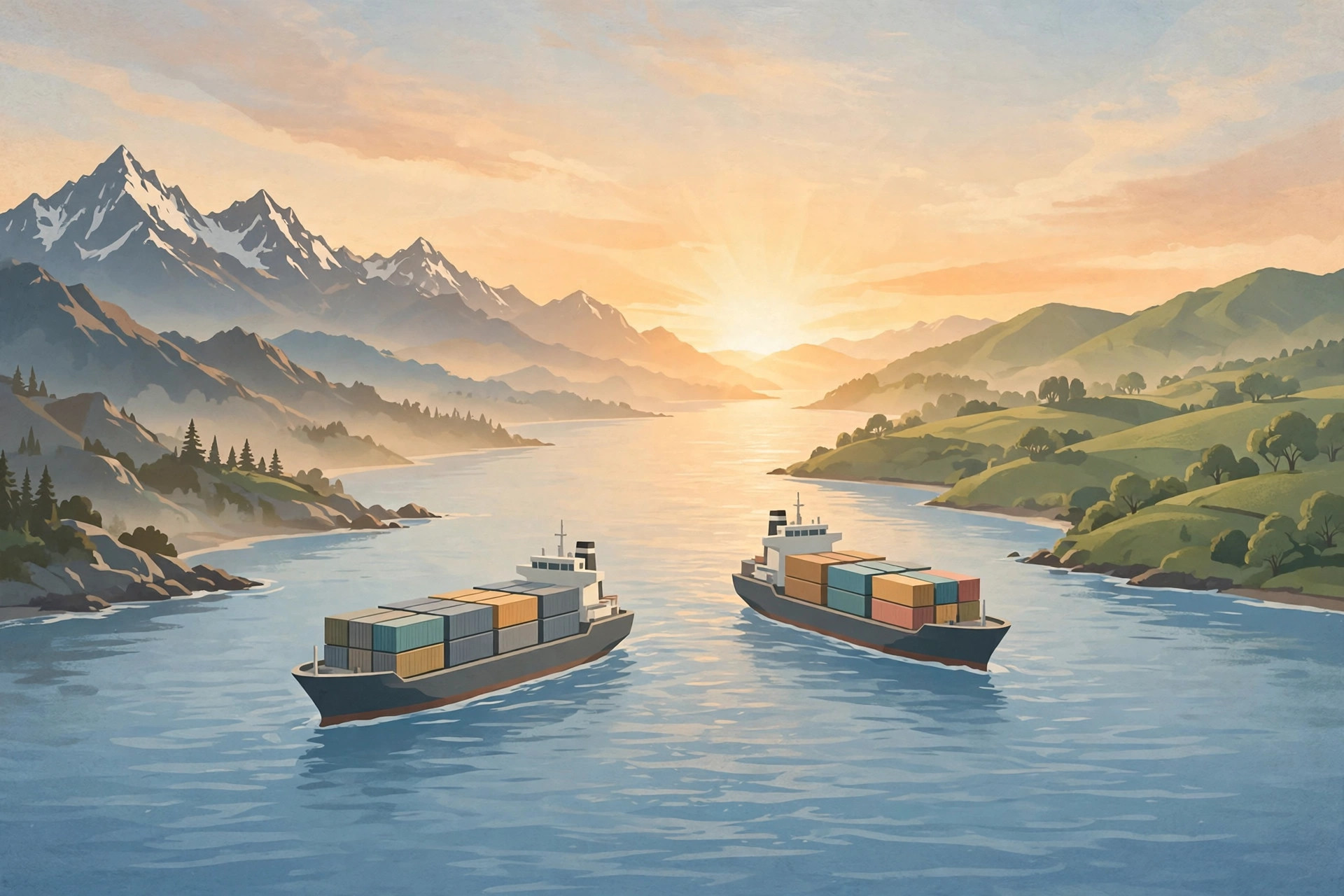
Editorial illustration: the India–New Zealand Free Trade Agreement took effect on 20 October 2026, opening duty-free access for Indian goods in New Zealand and staged access for New Zealand goods in India.
Key Takeaways
The India–New Zealand FTA entered into force on 20 October 2026, after being signed on 27 April 2026.
New Zealand removed duty on Indian goods across all tariff lines, removing tariffs that had peaked at 10 per cent.
India opens about 70 per cent of tariff lines in stages, but dairy, sugar and edible oils stay excluded and apples, kiwifruit, Manuka honey and albumins face quotas.
Indian students gain a guaranteed 20-hour-a-week work right and post-study work of up to two to four years depending on qualification.
Zero duty is not automatic: goods must meet product-specific origin rules notified on 12 October 2026, backed by a customs data-sharing pact signed on 21 October.
The India–New Zealand Free Trade Agreement (FTA) came into force on 20 October 2026, turning a signed trade deal into live rules at the border. From that day, New Zealand removed import duty on Indian goods across all of its tariff lines, while India began opening its market to New Zealand goods in stages, with sensitive farm products kept outside the tariff cuts. Days later, the two countries also signed a customs data-sharing arrangement to help businesses actually claim the new benefits. For exporters, students, farmers and shoppers, the agreement matters less as a headline and more as a set of practical changes: lower duties on some goods, new visa pathways, and paperwork that must be exactly right before any saving is claimed.
What happened on 20 October
New Zealand's Ministry of Foreign Affairs and Trade confirmed that the agreement entered into force on 20 October 2026, a month after the two sides exchanged ratification documents in Wellington on 21 September. The deal had been signed in New Delhi on 27 April 2026 by New Zealand Trade and Investment Minister Todd McClay and India's Commerce Minister Piyush Goyal, after negotiations that were relaunched in March 2025 and concluded within months. New Zealand's Parliament passed the implementing legislation in September 2026.
Entry into force is the moment a trade agreement stops being a promise and starts changing customs treatment. Goods arriving on or after that date can qualify for the preferential duty rates, provided they meet the agreement's rules of origin and the importer holds valid proof of origin. That distinction matters: a lower duty is not automatic for every shipment between the two countries, only for goods that genuinely qualify under the rules.
India's Commerce and Industry Ministry said New Zealand would charge no duty on any tariff line for Indian goods from day one, removing tariffs that had peaked at 10 per cent. The agreement also opens about 118 services sectors to Indian firms, sets aside 5,000 temporary employment visas and 1,000 working-holiday visas a year, and commits New Zealand to facilitating US$20 billion of investment. The two sides aim for NZ$7 billion of bilateral trade by 2030.
What changes for Indian exporters
The clearest immediate gain is for Indian goods exporters. New Zealand's duty-free access covers textiles, garments, leather goods, carpets, ceramics, engineering goods and automotive components, among other manufactured products. For a textile or garment exporter, the removal of a duty of up to 10 per cent changes the landed cost a New Zealand buyer sees, which can make an Indian quote competitive against suppliers that already enjoyed duty-free access under their own agreements with New Zealand.
That advantage is real but limited in one important respect: a large share of New Zealand's tariff lines were already duty-free, so the headline of "100 per cent of lines at zero duty" does not mean every Indian exporter suddenly gains 10 per cent. The gain is concentrated in the lines that actually carried a duty before, which is why exporters should check their own product's old duty rate rather than assuming a uniform benefit.
The second practical point is origin. India's Finance Ministry notified the origin rules on 12 October 2026, and the Directorate General of Foreign Trade notified tariff rate quotas for items such as apples, kiwifruit, Manuka honey and albumins. Both took effect on 20 October. Under the origin rules, a product must satisfy a product-specific test — for example, on how much of its value was created in India or New Zealand, or how its inputs were processed — before it can claim the preferential rate. Bilateral cumulation allows qualifying materials from either country to count towards origin, which helps manufacturers that source inputs across the two markets.
On 21 October, the day after entry into force, India and New Zealand signed a Memorandum of Cooperation for the electronic exchange of trade-related origin data. According to the Finance Ministry release reported at the time, the arrangement lets customs authorities in both countries exchange origin information electronically, helping them verify whether goods qualify for preferential treatment. In practice, that should mean fewer disputes at the border and more certainty for businesses, because the origin of a shipment can be checked against data rather than argued over paper alone.
What changes for New Zealand exporters — and Indian farmers
The agreement is not one-sided, and its most debated part is on India's import side. India will open about 70 per cent of its tariff lines, covering nearly 95 per cent of New Zealand's exports. On day one, New Zealand's tariffs story runs in reverse: 57 per cent of what New Zealand sells to India became tariff-free immediately, rising to 82 per cent as the deal phases in, with a further round of cuts due on 1 January 2027.
The 33 per cent tariff on sheepmeat was eliminated on day one, along with duties on wool and coal, and more than 95 per cent of forestry and wood exports now enter India tariff-free. Tariffs on key fish and seafood lines are phased out over seven years, and most industrial products become tariff-free within ten years. New Zealand's ministry says the average tariff applied to its current exports will fall to just 3 per cent once the agreement is fully in effect.
For Indian buyers, that phased opening could eventually mean cheaper inputs such as wool and timber, and more choice in products such as wine. Wine, however, shows how carefully the deal was negotiated: wine priced below US$5 per 750 ml bottle remains subject to 150 per cent duty, while wine priced from US$5 to below US$15 falls from 150 per cent to 100 per cent immediately and to 50 per cent by year ten, and wine priced at US$15 or more falls immediately to 75 per cent and to 25 per cent by year ten.
The protections for Indian agriculture are equally specific. Dairy, sugar and edible oils remain excluded from tariff concessions altogether — a deliberate carve-out for sectors where Indian policymakers judged that import competition would hurt domestic producers most. Apples, kiwifruit, Manuka honey and albumins receive concessions only through tariff rate quotas, which cap the quantity that can enter at the lower rate. For apples, the duty falls from 50 per cent to 25 per cent within a quota starting at 32,500 tonnes and rising to 45,000 tonnes from year six, with concessional access applying only during April to August and subject to a minimum import price of US$1.25 per kilogram.
Those safeguards do not end the debate. Growers in apple-producing regions such as Kashmir and Himachal Pradesh have reason to watch import volumes closely, because even a capped quota of cheaper apples during the April–August window could pressure local prices in that season. The quota, the seasonal window and the minimum price are designed to limit that pressure, but their effectiveness will only be visible in the first few import seasons — which is why the agreement's early trade data, rather than its signing-day claims, will be the real test.
What changes for students and workers
Beyond goods, the agreement's services and mobility chapters may matter more to ordinary Indians than any tariff line. New Zealand has committed to 118 services sectors, creating openings in information technology, healthcare, education, financial services and telecommunications.
For students, the agreement guarantees Indian students at New Zealand tertiary institutions the right to work up to 20 hours a week — a floor that holds even if New Zealand's general policy changes later, since current policy allows up to 25 hours. Neither side may cap student numbers under the agreement, and each side agrees to grant student visas to people accepted by recognised institutions who meet the usual immigration requirements.
After graduation, post-study work periods depend on the qualification: up to two years for a bachelor's degree, three years for a bachelor's degree with first-class honours in a STEM field including ICT, three years for a master's degree, and four years for a PhD. The PhD period is one year longer than New Zealand's previous setting, which is a genuine gain for doctoral graduates. Students should still read the conditions carefully — the three-year STEM bachelor's period, for example, is tied to first-class honours, not to every STEM degree.
Alongside study pathways, the annual quotas of 5,000 temporary employment visas and 1,000 working-holiday visas give young workers and professionals a structured route that did not exist under a trade agreement before. These are annual quotas, not guarantees for any individual applicant, and the usual immigration requirements — including qualifications, health and character checks — still apply.
What this means for shoppers and businesses
For shoppers in India, the effects will be gradual rather than dramatic. Most New Zealand goods that become cheaper will do so in stages over seven to ten years, and importers still pay freight, insurance and other costs that a tariff cut does not touch. New Zealand's goods and services tax, for example, still applies to imports into New Zealand, just as India's domestic taxes still apply on its side. A tariff cut lowers one line in a buyer's landed-cost calculation, not the whole bill.
For businesses, the first 30 days after entry into force are about preparation, not celebration. Exporters should confirm their product's HS code, check the product-specific origin rule, document where their inputs come from, and set up a proof-of-origin process before quoting a New Zealand buyer a duty-free price. A quote that assumes zero duty for goods that fail the origin test will unravel at the border, and the buyer — not the customs department — will bear the surprise.
The broader economic meaning is also worth stating plainly. The agreement is India's latest operational free trade agreement and part of a wider push to diversify export markets at a time when global trade is unsettled. Its target of NZ$7 billion in bilateral trade by 2030 and US$20 billion in facilitated investment gives the deal a measurable ambition, but trade agreements are judged by shipments, jobs and prices over years, not by targets announced in week one.
Conclusion
The India–New Zealand FTA coming into force on 20 October 2026 is a substantive, verifiable change in how the two countries trade: zero duty for Indian goods in New Zealand, staged opening for New Zealand goods in India, protected farm sectors, capped quotas for sensitive fruits, and new study and work pathways. Its benefits are real but uneven — strongest for exporters whose goods actually carried a duty, and for students and graduates who gain clearer post-study rights — and its risks are concentrated in the farm sectors that the quotas and exclusions were designed to protect. Readers, exporters and students should treat the agreement as a rulebook to be checked product by product and visa by visa, not as a blanket promise. The next chapter will be written in customs data, import volumes and visa numbers, and those figures deserve more attention than the ceremony that launched them.
Frequently Asked Questions (FAQ)
When did the India–New Zealand Free Trade Agreement come into force?
The agreement entered into force on 20 October 2026. From that date, New Zealand removed import duty on Indian goods across all of its tariff lines, while India began opening its market to New Zealand goods in stages.
Are all farm products covered by the FTA?
No. Dairy, sugar and edible oils remain excluded from tariff concessions altogether. Apples, kiwifruit, Manuka honey and albumins get concessions only within tariff rate quotas — for example, apples enter at 25 per cent duty instead of 50 per cent within a quota starting at 32,500 tonnes, only during April to August and above a minimum import price of US$1.25 per kilogram.
What does the FTA offer Indian students in New Zealand?
Indian students at New Zealand tertiary institutions are guaranteed the right to work up to 20 hours a week under the agreement. After graduation, post-study work is available for up to two years for a bachelor's degree, three years for a first-class honours STEM bachelor's or a master's degree, and four years for a PhD.
Does zero duty apply automatically to every shipment between India and New Zealand?
No. The preferential duty applies only to goods that meet the agreement's product-specific rules of origin, and the importer must hold valid proof of origin. India's origin rules were notified on 12 October 2026, and India and New Zealand signed a customs data-sharing arrangement on 21 October 2026 to help verify origin electronically.
Read Next on IndiaAsk
A tariff cut lowers only the duty line in a landed cost — domestic taxes still apply, and GST is the tax that shapes prices inside India. What Is GST and How Does It Work?