Battery Swapping vs Charging Your EV in India: Which Suits Your Daily Ride?
Key Takeaways
- Charging keeps one battery with one vehicle and refills it slowly, usually overnight at home.
- Swapping exchanges a drained battery for a charged one in minutes, but depends entirely on nearby stations.
- Home charging depends on parking, a socket and housing society permission.
- Swapping shifts battery-ageing worry to the network, but ties you to subscription terms and coverage.
- The right choice follows your parking spot, daily distance and real routes.
Battery Swapping vs Charging Your EV in India: Which Suits Your Daily Ride?
Ask two electric two-wheeler riders in India how they keep their vehicles running, and you may get two completely different answers. One plugs in at home every night and starts each morning with a full battery, without ever thinking about it. The other pulls into a swapping station, exchanges a drained battery for a charged one in a few minutes, and rides on. Both are convinced their way is simpler. Both are right, for their own kind of riding. The question is not which system is better in the abstract. It is which one fits the way you actually live, ride and park.
Charging and swapping solve the same problem in opposite ways. Charging keeps one battery with one vehicle and refills it slowly, usually where the vehicle sleeps. Swapping treats the battery as a shared resource: you do not own the refill, you borrow it, and you exchange it when it runs low. That single difference shapes everything else, from cost and convenience to who worries about battery ageing and what happens when you move house. Understanding it clearly is more useful than any list of features.
How home and public charging actually works in daily life
For most private owners, charging is beautifully boring. You come home, plug in, and forget about it until morning. The scooter or bike charges while you sleep, eat and rest, so the time it takes does not feel like waiting at all. Public charging works differently. You ride to a charger, wait while the battery fills, and plan your day around that stop. That can be perfectly fine on a longer trip or an occasional top-up, but it feels very different from home charging if you need it every day.
The catch with home charging is that it depends on where you live and park. A house with a ground-floor parking spot and a nearby socket makes it easy. A flat in a multi-storey building with basement parking, shared meters, or a landlord who has not agreed to a charging point makes it harder. Some housing societies have clear rules and dedicated points; others are still figuring it out. Before assuming home charging will work, it is worth checking the practical details: where the socket is, who pays for the electricity, whether the cable route is safe, and whether the society allows it. Those unglamorous questions decide whether charging feels effortless or becomes a daily negotiation.
How battery swapping changes the ownership feeling
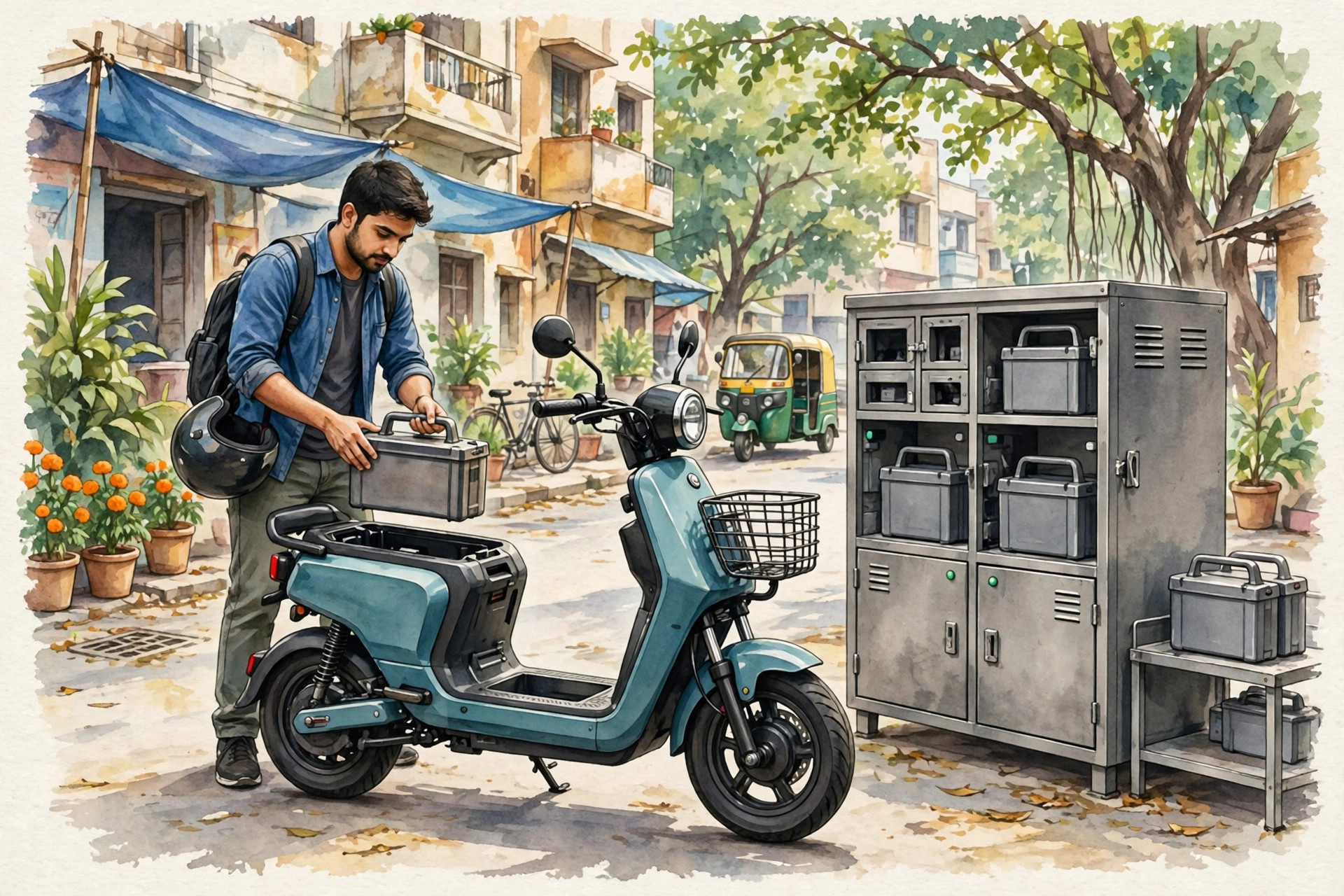
Swapping removes the home-charging problem entirely. You do not need a socket at your parking spot, and you do not wait hours for a charge. Instead, you need swapping stations along the routes you actually ride. In dense city areas where stations are close together, that can feel liberating. A delivery rider who covers long distances all day, for example, can keep working without long breaks, swapping whenever the battery runs low. For someone whose daily route passes several stations, swapping can be faster and more flexible than any form of charging.
But swapping also changes what you own. With a typical swapping arrangement, you pay for access to batteries rather than owning one outright, often through a subscription or a per-swap arrangement whose terms vary. That means you need to read the terms carefully: what is included, what happens if a battery is damaged, what the network coverage is in your area, and what you do if you travel somewhere with no station nearby. It also means you are depending on a network. If stations are sparse in your neighbourhood, or if a station is out of charged batteries at a busy hour, the convenience disappears quickly. Swapping is only as good as the stations around you.
A tale of three riders
Consider three imaginary riders, each with a different daily pattern. The first is a office worker who rides a short distance to work, parks in the same building every day, and returns home each evening. For this rider, home charging is almost invisible: plug in at night, ride all week on short trips, and rarely think about range. Swapping would add stops to a routine that does not need them.
The second is a delivery rider who is on the road for most of the day, covering far more distance than a typical commuter and stopping at many different places. Long charging breaks would cut directly into earning time. If swapping stations sit along delivery routes, swapping fits this life far better, because a few minutes at a station replaces a long wait at a charger.
The third rider lives in a rented flat with no fixed parking and no socket, but works in a busy part of the city where swapping stations are common. Home charging is not really an option, and public charging every day would be a chore. For this rider, swapping may be the only practical way to own an electric two-wheeler at all, provided the network is reliable and the subscription cost makes sense against daily use.
None of these riders is wrong. The point is that the right answer follows the pattern of the day, not the technology on paper.
Cost, battery worry and the long view
Cost comparisons between charging and swapping are easy to get wrong, because they measure different things. Home charging costs are mainly the electricity you use plus, in some cases, the cost of setting up a charging point. The battery itself is usually part of what you bought with the vehicle, and its gradual ageing is your concern over the years. Swapping costs are usually ongoing payments for battery access, and in return the network takes on much of the worry about battery health, replacement and maintenance. Whether that trade is good value depends on how much you ride, what the subscription covers, and how long you plan to keep the vehicle.
Battery worry deserves honest attention. Many new buyers fear that their battery will fade quickly, and that fear is understandable given that the battery is the most expensive part of an electric vehicle. Charging at home puts that worry on you, though good charging habits and following the manufacturer's guidance help a great deal. Swapping spreads that worry across the network, since you are not tied to one battery for years. On the other hand, swapping means you never build up the simple habit of a full battery every morning at home, and you remain tied to a service whose prices and coverage can change. Both models ask you to accept a different kind of dependence: on your parking and power supply, or on a station network.
There is also a practical question about travel. A rider who mostly stays within one city can plan around either system. A rider who regularly travels to smaller towns or rural areas, where neither fast chargers nor swapping stations may be common, needs to think harder. In those places, the ability to charge from an ordinary socket, even slowly, can matter more than speed. Always check coverage for the places you actually go, not just the city centre on a network map.
Questions to ask before you choose
Rather than picking a system because it sounds modern or convenient, run through a short checklist based on your own life. Where do you park every night, and is there a socket you are allowed to use? How far do you ride on a typical day, and on your longest day? Are there swapping stations on your regular routes, and have you actually seen them operating, not just marked on a map? What does each option cost over a full year, including subscriptions, electricity and any setup work? What happens if you move house, change jobs or travel outside the network area? What does the warranty or service agreement say about the battery in each case?
The answers will usually point clearly in one direction. If home charging is easy and your daily distance is modest, charging is hard to beat for simplicity and low daily effort. If home charging is difficult and your riding is heavy or time-sensitive, swapping deserves serious consideration, provided stations are genuinely convenient. If both options are awkward, it may be worth waiting, choosing a different parking arrangement, or picking a vehicle whose range reduces how often you need either system.
What to do if your situation changes
Life rarely stays still. You may move to a new flat, change jobs, or start riding much further than before. The good news is that neither choice is necessarily permanent for your next vehicle, and many riders adapt as networks grow and housing rules change. What matters is to revisit the decision when your pattern changes, rather than defending an old choice out of habit. A system that was perfect for a short city commute may not suit a new delivery job, and a swapping subscription that made sense when stations were everywhere may feel wasteful if you move to an area with none.
Conclusion
Battery swapping and charging are not rivals fighting for one winner. They are two different answers to the same everyday problem, and each shines in a different kind of life. Charging wins on quiet simplicity when you have a reliable place to plug in. Swapping wins on speed and flexibility when you ride long hours, lack home charging, or live near a strong station network. The smartest choice is the one that disappears into your routine: the battery is full when you need it, the cost is clear, and you are not rearranging your day around refuelling. Start from your parking spot, your daily distance and your real routes, and the right system will usually choose itself.