What Is the Bhutan Glacial Lake Outburst Flood and Why Is the Sankosh River on Alert? Explained
Key Takeaways
- On the evening of 29 October 2026, Shintaphu Lake in Bhutan's Gasa district burst, releasing nearly 7.4 million cubic metres of water into the Mo Chhu river system.
- The surge flowed through the Punatsangchhu into India as the Sankosh, prompting a Central Water Commission advisory warning of a sudden rise within six to eight hours of reaching the border.
- West Bengal placed the Sankosh on red alert and shifted around 12,000 people in Alipurduar to safety, while Assam put vulnerable areas in Dhubri and Kokrajhar on alert; the Sankosh rose nearly two feet in West Bengal on Friday.
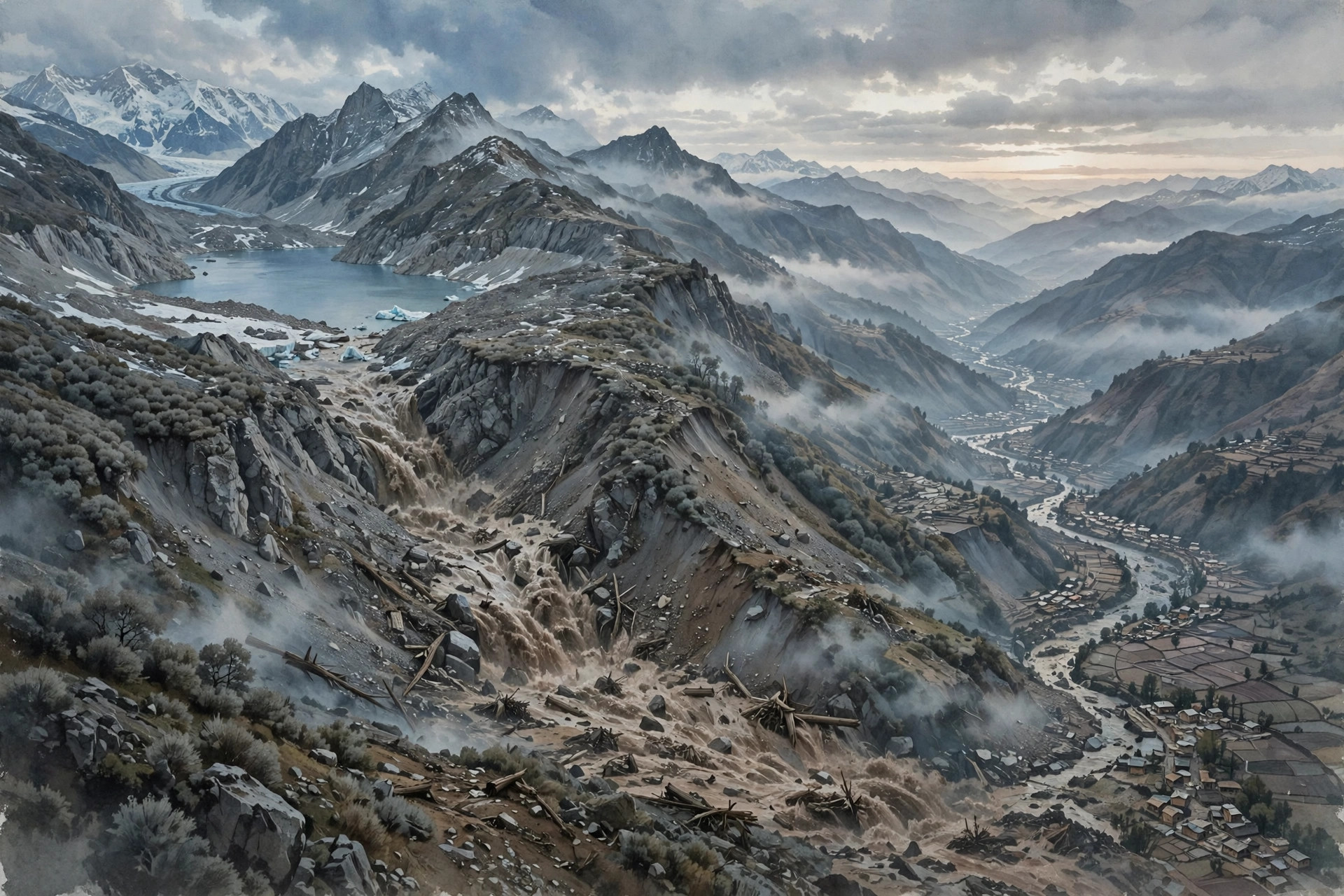
- A GLOF happens when a lake dammed by a glacier or a loose moraine ridge fails suddenly, sending water, mud and debris downstream — a hazard made more common as Himalayan glaciers retreat.
- As of Friday morning no deaths or injuries had been reported, the full damage in Bhutan was still being assessed, and the precise trigger of the outburst had not been established.
A Bhutan glacial lake outburst flood on the evening of 29 October 2026 has put the Sankosh river system in northern West Bengal and Assam on alert, after a surge of water from a high Himalayan lake flowed south into India. The outburst was reported at Shintaphu Lake — spelt Sintaphu in some reports — in Bhutan's Gasa district, and officials in India moved thousands of people living along the Sankosh to safer ground as a precaution.
What happened at Shintaphu Lake in Bhutan?
The glacial lake outburst was reported on Thursday evening at Shintaphu Lake, near Wakila Mountain in Lungo, Laya Gewog, in Bhutan's remote Gasa district. Some Indian reports also locate the event at Lemthang in the same region. Bhutanese media reported that floodwater reached Taktsemakhang at about 8.15 pm, damaging the road to Laya, washing away the Gasa Tshachu hot spring complex, and cutting a section of the Punakha-Gasa highway. Bhutan's state broadcaster was reported as saying two bailey bridges were likely washed away.
Reports put the volume of water released at nearly 7.4 million cubic metres — about 74 lakh cubic metres. That water flowed into the Mo Chhu river, which joins the Pho Chhu at Punakha to form the Punatsangchhu, and the Punatsangchhu enters India as the Sankosh. The full extent of the damage in Bhutan was not yet known on Friday morning, and the precise trigger of the outburst had not been established.
Shintaphu Lake is on Bhutan's official list of 17 potentially dangerous glacial lakes. Bhutan's National Centre for Hydrology and Meteorology monitored river levels at Tashithang and Yebesa, and warning sirens were sounded as the surge moved downstream.
Why is the Sankosh river on flood alert in West Bengal and Assam?
A glacial lake outburst flood, or GLOF, is dangerous far downstream because the water does not arrive as an ordinary river rise. It comes suddenly, carrying mud, rocks and debris, and it can raise water levels sharply in a matter of hours. That is why India's Central Water Commission issued a special advisory on 29 October, warning that a flash flood in the upper reaches of the Punatsangchhu could cause a sudden rise in the Sankosh in Alipurduar district in West Bengal and Dhubri district in Assam, and that the floodwater could reach the India-Bhutan border within six to eight hours.
In West Bengal, the Sankosh was placed on red alert. Alipurduar district shifted around 12,000 people living along the river to safer areas as a precaution — between 4,000 and 5,000 people were accommodated in temporary shelters, including school buildings, while more than 6,000 others were relocated to other safe locations. National Disaster Response Force personnel were deployed in the affected areas, and State Disaster Response Force teams, Civil Defence personnel and the local administration were mobilised. The Sankosh's water level rose by nearly two feet on Friday morning. Officials said the situation in Alipurduar was under control at present, and that no major damage or casualties had been reported in the Kumargram area adjoining the Sankosh so far. Alerts were also sounded in parts of Jalpaiguri district, including Binnaguri, Banarhat and Nagrakata, although officials said rivers flowing from Bhutan through Jalpaiguri had not seen a significant surge.
West Bengal Water Resources Investigation and Development Minister Nisith Pramanik urged residents living near tea gardens and riverbeds in Cooch Behar, Tufanganj and Basirhat to evacuate immediately, and said Assam's Dhubri was also likely to be affected. Darjeeling MP Raju Bista said everyone living in the catchment areas of the Sankosh and its tributaries had been asked to move to safe zones, and that people in the Darjeeling hills, Terai and Dooars regions must stay alert.
In Assam, the government placed vulnerable revenue circles in Dhubri and Kokrajhar districts on alert. Chief Minister Himanta Biswa Sarma said the state was closely monitoring the possible impact of the Bhutan glacial lake outburst flood across those areas, with disaster response teams and other agencies on standby. The Assam State Disaster Management Authority said the Sankosh's water level was steady as of 6.30 am on Friday, that water levels in Assam's rivers had not risen so far, and that no evacuation had started in Dhubri or other districts of Lower Assam as of Friday morning — but that district administrations and State Disaster Response Force teams were prepared to respond.
The contrast between the two states is the point of the alert system: the same surge can raise one stretch of river by two feet while leaving another stretch steady, because the timing, the river's shape and local rainfall all matter. The alert is therefore precautionary, not a prediction that every riverside village will flood.
What is a glacial lake outburst flood (GLOF)?
A GLOF is the sudden release of water from a lake that sits in front of, on top of, or beneath a melting glacier. As glaciers retreat, meltwater collects in hollows left behind by the ice. These lakes are often held back not by a built dam but by a moraine — a loose ridge of ice, sand, pebbles and rock debris pushed forward by the glacier when it was advancing. Unlike an engineered dam, a moraine dam is weak and can fail abruptly.
A breach can be triggered by several things: an avalanche or landslide falling into the lake and displacing the water, heavy rain or rapid melting that overfills the lake, an earthquake, or the slow weakening of the dam itself. When the dam gives way, millions of cubic metres of water can rush downstream in a short time, and peak flows as high as 15,000 cubic metres per second have been recorded in such events. Because the water carries debris, it can damage roads, bridges, hydropower structures and homes far from the lake itself.
The Himalayas are particularly exposed. India's National Disaster Management Authority has noted that glacier retreat linked to climate change across the Hindu Kush Himalaya has created numerous new glacial lakes, and many existing lakes are growing. The Himalayas hold tens of thousands of glacial lakes, and a significant share of the larger ones have expanded in recent decades. That does not mean every lake will burst, but it does mean the risk has to be tracked lake by lake, with satellite monitoring, river gauges and early-warning sirens in the valleys below.
India has painful recent experience of this hazard. The October 2023 outburst at South Lhonak Lake in Sikkim destroyed the Teesta III dam, killed dozens of people and affected thousands more, and was described as one of Asia's worst climate-related disasters of that year. The Bhutan event is a reminder that the same hazard crosses borders: a lake in one country can become a flood emergency in another within hours, which is why the Indian Embassy in Bhutan's report to the Central Water Commission, and the coordination between Indian and Bhutanese authorities, mattered so quickly on Thursday night.
What is being done now, and what should people in the area do?
Monitoring continues on both sides of the border. Bhutanese authorities are tracking river levels downstream of the breach, while Indian authorities are watching the Sankosh and its tributaries in Alipurduar, Jalpaiguri, Cooch Behar, Dhubri and Kokrajhar. Officials said the intensity of the flow had eased slightly by Friday, but the warnings remained in force, and the situation was being reviewed continuously rather than declared over.
For residents, the practical advice from the advisories is simple and worth repeating: stay away from riverbanks and low-lying areas near the Sankosh and its tributaries until the local administration says the alert is lifted, move to a shelter or a safe location immediately if officials ask you to evacuate, and do not wait to see the water rise before leaving. People should rely on district administration announcements and official advisories rather than rumours or unverified videos, and should keep cattle and valuables moved to higher ground where evacuation has been advised.
The longer lesson is about preparation rather than panic. Glacial lakes cannot be wished away, and the Himalayas will keep producing them as glaciers retreat. What can change is how early a breach is detected, how fast the warning travels across a border, and how ready downstream districts are to move people before the water arrives. On 29 and 30 October, that chain — from a remote lake in Gasa to shelters in Alipurduar and alerts in Dhubri — worked as intended, and as of Friday morning there were no reported deaths or injuries from the event. The damage assessment in Bhutan, and the final count of what the surge did to roads, bridges and the hot spring complex, will take longer to complete.
Conclusion
The Bhutan glacial lake outburst flood of 29 October 2026 is a cross-border disaster story in miniature: a remote Himalayan lake, a sudden release of millions of cubic metres of water, and a precautionary evacuation of thousands of people in India within hours. The Sankosh rose in West Bengal, Assam stayed on watch, and no casualties had been reported by Friday morning. The event underlines why GLOFs are tracked so closely in the Himalayas — they arrive with little warning, they travel far, and the difference between a close call and a catastrophe is often the warning system and the willingness to evacuate early.