Atal Bhujal Yojana Explained: How the Groundwater Scheme Works, Who Benefits and How Villages Participate
Key Takeaways
- Groundwater is a shared resource: one farmer's extra pumping lowers the neighbour's well.
- Atal Jal rewards better groundwater management, not just construction of structures.
- The village water security plan, approved by the gram sabha, is the heart of the scheme.
- Village teams learn to monitor wells and rain gauges so depletion becomes visible.
- Crop choice, efficient irrigation and recharge structures are the practical changes a plan brings.
Atal Bhujal Yojana Explained: How the Groundwater Scheme Works, Who Benefits and How Villages Participate
In many parts of India, the water a village drinks and farms with comes from below the ground. A borewell that once gave water at a shallow depth now has to go deeper, and a well that never dried up in a grandfather's time now runs dry in summer. Groundwater is invisible, so it is easy to treat as unlimited — until the day it is not. Atal Bhujal Yojana, usually called Atal Jal, is a central government programme that tries to fix this problem at its root: it helps villages understand their own groundwater, plan how much they can safely use, and change the habits that drain it.
Unlike schemes that simply build something and hand it over, Atal Jal is built around participation. Money and technical help flow to states and districts, but the real work happens in the gram panchayat, where farmers, panchayat members and local officials sit together and decide what their village will do differently.
Why Groundwater Became a Crisis
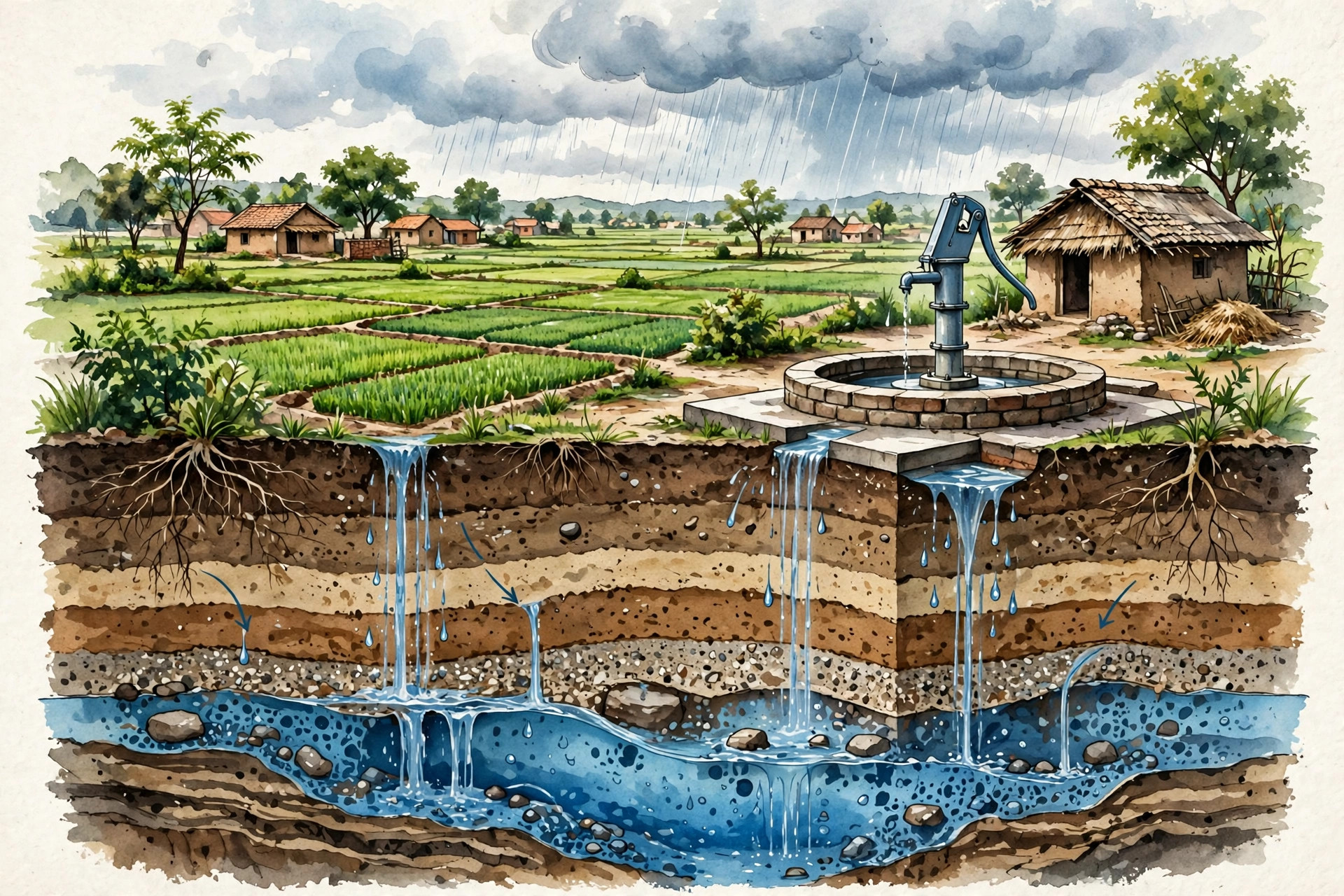
Groundwater is the largest source of irrigation and drinking water in India. Millions of farmers depend on wells and tube wells, and most rural drinking water supply schemes also draw on aquifers. The trouble is that extraction has outpaced recharge for decades in many blocks. When every farmer pumps as much as possible, the water table falls for everyone, including the small farmer who can least afford a deeper borewell.
The deeper problem is that groundwater is a shared resource with no visible meter. A farmer sees his own pump and his own field, not the aquifer beneath the whole village. One person's extra pumping quietly lowers the neighbour's well. Because the resource is shared, the solution has to be shared too. No single farmer can recharge an aquifer alone, and no government department can police every pump. That is the gap Atal Jal is designed to fill: it gives villages the information and the incentives to manage groundwater together.
How Atal Jal Is Different From a Construction Scheme
Most water programmes are measured in structures built — check dams, ponds, recharge pits. Atal Jal certainly supports water conservation work, but its core idea is different: it rewards better management, not just more construction. The programme works in water-stressed areas across several states, chosen because their groundwater blocks are over-exploited or critical.
The structure has three layers. At the top, the central government provides funds and technical guidance. States prepare plans and strengthen their groundwater departments. Districts coordinate between departments and panchayats. At the base, gram panchayats prepare their own water security plans. Funds are linked to performance: states and districts that show real progress in community planning, monitoring and sensible water use receive continued support. This performance link matters because it pushes officials to take the village-level work seriously instead of treating it as paperwork.
The Village Water Security Plan: The Heart of the Scheme
The most important document in Atal Jal is the village water security plan, prepared by the gram panchayat itself with help from technical teams. The process starts with data. How many wells does the village have? How deep is the water table, and how has it changed over the years? How much water do crops, livestock and households use? How much rain does the village receive, and how much of it soaks back into the ground?
Village teams are trained to read simple monitoring instruments, including observation wells and rain gauges. When a farmer can see the water level in a monitoring well fall month by month, the abstract idea of depletion becomes concrete. The plan then sets out what the village will do: which crops to shift, where recharge structures make sense, how drinking water sources will be protected, and what the community agrees about new borewells.
The plan is approved by the gram sabha, which gives it democratic weight. It is not a government order imposed from above; it is a commitment the village makes to itself, and that is why it has a better chance of surviving after the programme's officials move on.
What Changes on the Ground
A water security plan turns into practical changes that vary from village to village. One common change is crop choice. Water-guzzling crops in a stressed block are gradually replaced by less thirsty alternatives, sometimes with support from the agriculture department for seeds and advice. Another is demand management: farmers adopt drip or sprinkler irrigation, fix leaking channels, and agree on watering schedules so that pumping is spread out rather than concentrated.
On the supply side, villages build or revive recharge structures — percolation tanks, check dams, farm ponds and recharge pits — in places where geology lets water actually reach the aquifer, rather than wherever it is convenient to dig. Existing wells are sometimes converted into recharge wells during the monsoon. Drinking water sources get special protection, because a village that saves its irrigation water but loses its drinking supply has solved the wrong problem.
Behaviour change is the hardest part. A village may agree to a pause on new deep borewells, or to community monitoring of pumping during peak summer months. These agreements only work when the gram sabha genuinely owns them, which is why the scheme invests time in awareness meetings, training and wall writings that display water levels publicly.
How a Village Participates, Step by Step
For a resident, participation begins at the gram sabha meeting where the scheme is introduced. The panchayat forms a water management committee or uses an existing committee, and interested villagers — especially farmers, women and youth — are invited to join. Training sessions explain how to read a rain gauge, how to measure a well's water level, and how to keep basic records.
Next, the committee drafts the water security plan, discusses it in the gram sabha, and finalises the works and practices it will adopt, with support channelled through the district and regular monitoring of water levels.
If your village is in a participating block, ask your gram panchayat or block office whether a water security plan exists, and join the water management committee.
What Atal Jal Cannot Do Alone
Atal Jal cannot create rain, and it cannot force a farmer to change crops overnight. Where electricity for pumping is heavily subsidised, the incentive to pump remains strong, and no village plan can fully counter that.
Its real contribution is subtler. It gives villages a shared language for groundwater — water levels, budgets, recharge — and a forum where the shared nature of the problem can be discussed openly. Villages that manage their aquifers well protect their drinking water, reduce the cost of deeper drilling, and make farming less hostage to a falling water table.
Conclusion
Atal Bhujal Yojana treats groundwater as what it is: a common resource that only a community can manage. Its tools are information, planning, community agreement and targeted support for recharge and efficient use. For a village in a stressed block, the practical path is to get involved in the gram panchayat's water security plan, learn to read the village's water data, and support the crop and irrigation choices that keep the aquifer alive. A well that lasts is worth more than a deeper borewell, and Atal Jal is an attempt to make that choice easier for the whole village at once.